1. The pricing model is the strategy
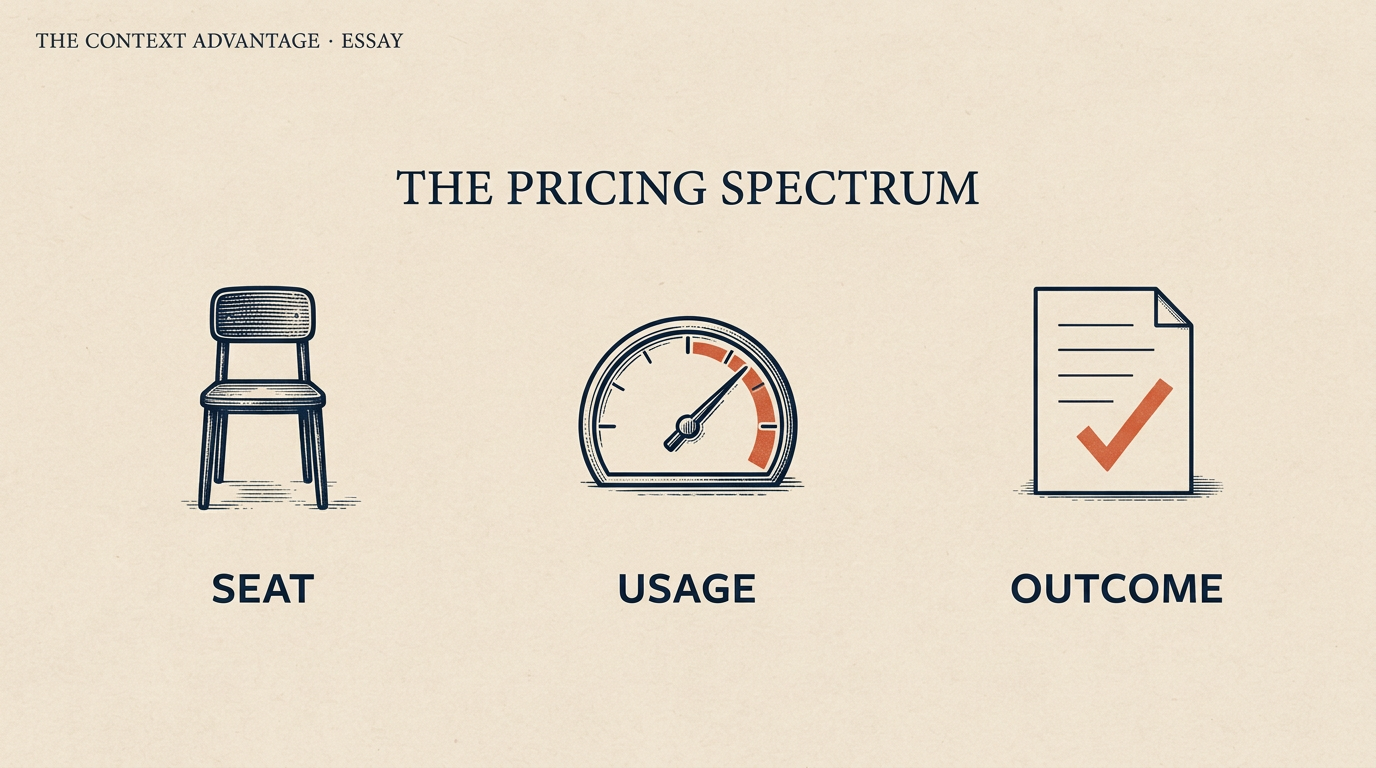
For twenty years, enterprise software had one dominant pricing shape: the seat. You paid for a person to have access, whether they used the product for eight hours a day or logged in twice a quarter. The seat was a proxy for value because humans were the unit of work. Salesforce, ServiceNow, Slack, every data tool you own — the seat was the business model.
Agents break the proxy. An agent does not log in. It does not have a chair. It runs at 3 a.m., processes four hundred invoices while the office sleeps, and costs the vendor real compute every time it acts. Charging a flat monthly fee for something with a variable cost of production and a variable volume of work is a pricing model waiting to collapse — and it is collapsing. Across 2025 and 2026, the major AI vendors have been quietly, then loudly, moving to credits, usage meters, and outcome pricing.
This is not a billing detail. The pricing model determines who bears the risk of failure, who profits from inefficiency, and what the vendor is incentivized to optimize. Under per-seat pricing, the vendor profits when you buy licenses you do not use. Under raw token metering, the vendor profits when the agent loops, retries, and rambles. Under outcome pricing, the vendor profits only when the work is accepted. Same technology, three different businesses, three different things you are actually buying.
This is the Cost pillar of the 4 C's meeting the Choice pillar in the contract. Chapter 15Chapter 15 · 6 min LockedGuardrails, Approvals, and Audit TrailsDesigning safe agent behavior in practice. frames vendor selection as an architecture decision. This essay is about the newest and least understood part of that decision: how you will be charged, and what the charge structure does to your incentives.
2. From seat to token to outcome
It helps to see the pricing shift as a spectrum with three stops. Per-seat pricing charges for access: predictable, easy to budget, and indifferent to value. Token and credit metering charges for consumption: aligned with the vendor's cost, aligned with almost nothing you care about. Outcome pricing charges for accepted work: a resolved case, a matched invoice, a qualified lead, a deployed change.
Most of the market is currently stuck in the uncomfortable middle. Credits and tokens are how vendors pass their own variable cost through to you. The problem is that consumption is not value, and in agentic systems the gap between them is enormous. An agent that answers a question in one tight turn and an agent that loops eleven times before producing the same answer generate wildly different bills and identical value. A pure meter cannot tell them apart. You can, but only if you measure outcomes separately.
Outcome pricing sounds like the obvious destination, and for some workflows it is. Intercom's Fin charges per resolution. Several support and sales-agent vendors now price per completed task. But outcome pricing has a trap of its own: the definition of the outcome becomes the whole game. If a vendor defines resolution as 'the customer stopped replying,' you are paying for abandonment. The meter moved, but the misalignment moved with it.
So the buyer's job is not to pick a point on the spectrum and relax. It is to understand which risks each model hands you, and to negotiate the definition, the caps, and the telemetry that keep the model honest. Chapter 18Chapter 18 · 6 min LockedThe Hidden Cost of Agentic AIWhere the dollars actually go. maps where agentic cost actually hides; this is where it lands on the invoice.
3. What a meter actually changes for the buyer
Under seat pricing, your worst case was known in January: licenses times price. Under a meter, your worst case is a function of your agent's worst behavior. A retry storm, a runaway loop, a prompt-injection incident that makes the agent call tools in circles — each is now a financial event, not just an operational one. The failure modes you already govern in the Control pillar acquire a price tag that compounds by the minute.
Budgeting changes too. Finance teams are built for subscriptions: a number, a renewal date, a procurement process. A meter is a utility, and utilities need rate analysis, consumption forecasting, and anomaly detection. Most enterprises buying metered AI today have none of the three. They discover the agent's real unit economics in the first invoice that surprises them — which, as we covered in Every Agent Needs a P&L, usually means they never built the account at all.
There is a subtler change: the meter rewires the relationship between your platform team and your vendor. When you paid per seat, the vendor's incentive was to expand headcount attached to the product. When you pay per consumption, the vendor's incentive is more calls, more context, more retries. Features that reduce your consumption — tighter context, better caching, smaller models for easy steps, budget-aware routing — are features that reduce their revenue. Expect them to arrive slowly. Plan to build some of them yourself.
4. The unit of work is the negotiation
Everything in outcome pricing reduces to one question: what, precisely, is one unit of work, and who decides it was done? Get this wrong and no discount will save you. Get it right and outcome pricing can be the most honest commercial relationship you have with any vendor.
A good unit definition has four properties. It is observable from data both parties can see, not from the vendor's private dashboard alone. It includes acceptance criteria, so 'resolved' means resolved-and-not-reopened, not merely 'answered.' It is hard to game — a unit the agent can inflate by splitting tasks or lowering quality is a unit that will be inflated. And it maps to something the business already values, so the price per unit can be compared against the cost of the alternatives: a person, a managed service, doing nothing.
Push hardest on who bears the cost of failure. In a fair outcome contract, retries, escalations, and failed attempts are the vendor's problem — priced into the unit rate. In an unfair one, they are billed back to you as consumption. This single clause is the difference between outcome pricing and token metering wearing a nicer suit. Ask for the failure-rate data behind the quoted unit price, and ask what happens to the price if the failure rate doubles.
Chapter 19Chapter 19 · 6 min LockedNot Every Task Needs the Best ModelRouting, cascades, and right-sized intelligence. covers the evaluation harness. This is where it becomes a commercial instrument: the acceptance test that defines your outcome unit should be the same eval you run in production. If the vendor's meter says nine hundred resolutions and your eval says six hundred, you have a contract dispute that only your own measurement can settle.

5. Five clauses that keep a meter honest
Whether you end up on credits, consumption, or outcomes, five clauses determine whether the pricing model works for you or on you.
First, transparency: itemized, exportable metering data at the level of the unit — per task, per workflow, per model call if that is what you are billed on. Aggregate monthly credits are not a meter; they are a fog. Second, caps and circuit breakers: hard spend ceilings per workflow per period, with automatic degradation to a cheaper path rather than an open-ended overrun. This is Chapter 20Chapter 20 · 6 min LockedBudget-Aware AI DesignDesigning for budgets from day one. written into the contract — budget as an architecture input, enforced by both parties.
Third, failure attribution: the contract must say what happens to the bill when the agent fails — retries, re-runs, human escalations, and incidents caused by the vendor's platform. Fourth, price protection on the rate itself: model prices have fallen an order of magnitude in two years, and a contract that locks your per-unit rate while the vendor's cost collapses is a subsidy flowing the wrong way. Ask for automatic pass-through of model price reductions, or at least an annual re-rating clause.
Fifth, exit. Metered vendors hold something seat-based vendors never did: a continuous record of your work patterns, volumes, and unit economics, plus — in outcome pricing — a commercial incentive to keep the definition of 'outcome' vague. The exit clause must cover your data, your evaluation sets, your context assets, and a truthful final reconciliation. Chapter 29Chapter 29 · 6 min LockedCareer Roadmap for the Agentic EraLearning paths for beginners, intermediates, and senior professionals. and The Exit Test are the playbook; the pricing model just raised the stakes.
6. What the meter changes for the vendor — and why you should care
It is worth understanding the vendor's problem, because it explains the contracts you are being offered. A vendor selling outcome pricing is selling insurance on its own agent's quality. If the agent fails often, the vendor's margin evaporates; if the outcome definition is tight, the vendor's revenue shrinks. So vendors face relentless pressure to widen the outcome definition, count marginal work as accepted, and keep failure costs on your side of the ledger. This is not malice. It is what the pricing model rewards.
Consumption pricing creates the opposite distortion. The vendor's revenue grows with your inefficiency, so the roadmap tilts toward capability and away from economy. Notice how eagerly platforms ship features that expand context windows, agent autonomy, and always-on operation — and how rarely they ship a button that says 'do this task with a cheaper model and less context.' The meter is the product now, which means the product is now optimized to be metered.
The rational buyer response is to own the optimization layer. Your routing, your caching, your context budget, your model choice per task — Chapter 21Chapter 21 · 6 min LockedQuality, Speed, and Cost TradeoffsHow to balance accuracy, latency, and spend. calls this the quality-speed-cost triangle, and it is increasingly something you must control rather than rent. Vendors will not volunteer efficiency. Efficiency is a transfer of revenue from them to you.
7. The buyer's control stack for metered AI
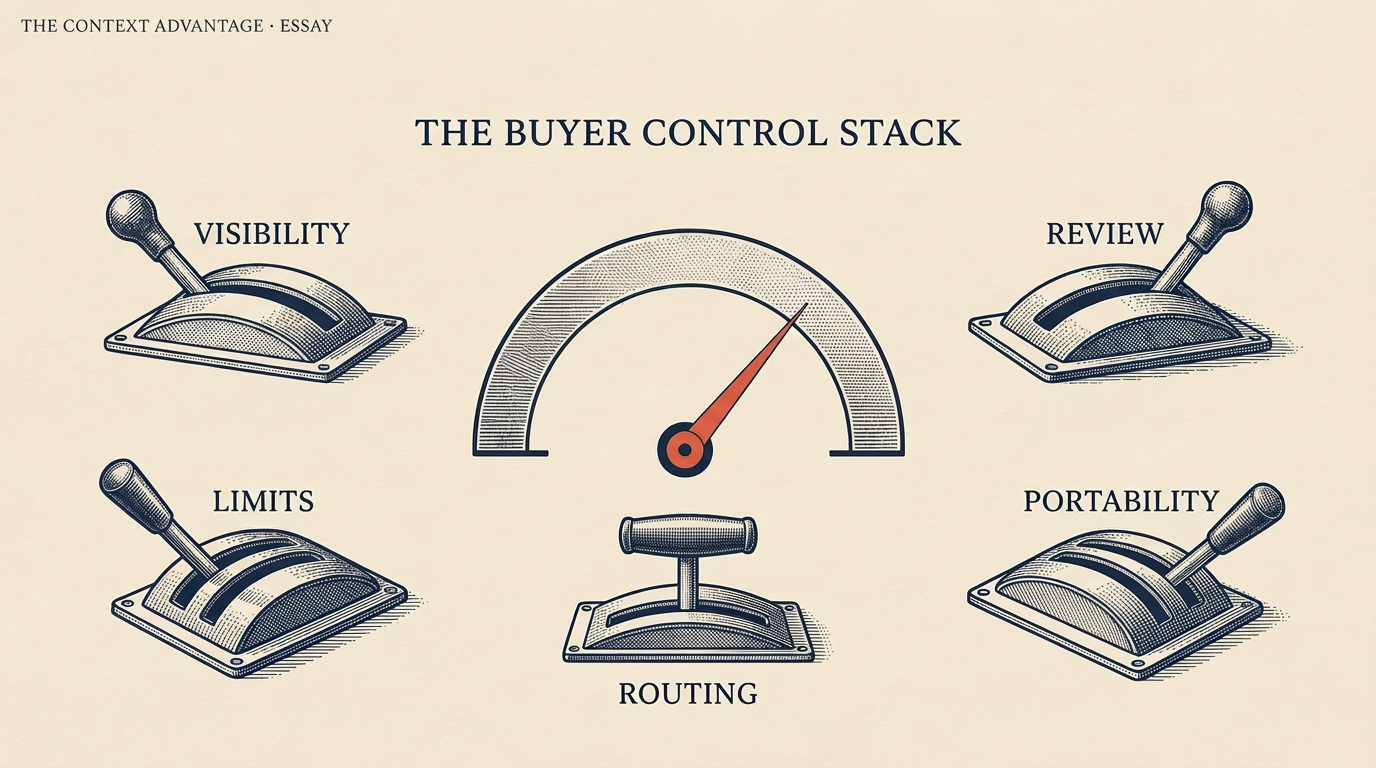
Treating metered AI as a utility means borrowing the discipline utilities taught us. Start with instrumentation you own: every billable event logged with workflow, unit type, model, tokens, latency, retries, and outcome status — in your systems, not only the vendor's console. Chapter 22Chapter 22 · 5 min LockedThe Danger of AI Lock-InHow yesterday's choices limit tomorrow's options. describes the observability layer; the meter makes it a financial control as well as an engineering one.
Then add the four controls that turn a meter from a blank cheque into a managed instrument. Rate controls: model and route selection per task class, so easy work never touches expensive capacity. Volume controls: budgets per workflow with automatic degradation, not alerts that someone reads on Monday. Quality controls: acceptance criteria measured continuously, because a meter without outcome measurement is just a way to pay for attempts. And drift controls: a monthly review of unit economics against the baseline, because agents change, vendors re-price, and yesterday's good deal is today's overrun.
None of this is optional at scale, and most of it is exactly what the Cost pillar of the 4 C's already asks of you. The pricing shift did not create new work so much as it removed the last excuse for not doing the old work. When cost was a flat line, sloppy economics hid inside it. The meter exposes everything — which is uncomfortable, and healthy.
8. A 30-day plan before you sign
Week one: instrument the workflow you are about to buy. Before any pricing conversation, measure the current cost per accepted outcome of doing the work however you do it today — people, existing tooling, everything. You cannot evaluate a unit price without your own baseline, and vendors know it.
Week two: define the unit. Write the acceptance criteria for one unit of work, run them past the team that owns the workflow, and test whether the definition can be gamed. Then demand the vendor's metering data model and check that your eval and their meter can be reconciled line by line.
Week three: negotiate the five clauses — itemized telemetry, hard caps, failure attribution, rate pass-through, exit with your data. Walk away from any deal where failure costs land on you and the outcome definition lives only in the vendor's dashboard.
Week four: build the account. Stand up the agent P&L for this workflow before the first production run: baseline, unit price, caps, review cadence, and the named human who owns the number. Chapter 16Chapter 16 · 5 min LockedTrust Is Designed, Not AssumedHow leaders earn confidence in AI systems. covers the operating model; the pricing model just made it mandatory.
9. The seat was comfortable. That was the problem.
It is tempting to mourn per-seat pricing. It was predictable. Procurement understood it. Nobody got fired over an invoice that matched last year's. But the comfort was the cost: seat pricing let shelfware accumulate, let adoption rot unmeasured, and let everyone avoid the question of what the software was actually worth.
The meter ends that truce. Every workflow now has to answer, continuously, in currency: what is one unit of your work worth, what does it cost, and who is watching the difference. Organizations that built the Cost pillar early — unit economics, budget architecture, a named owner per agent — will find the new pricing world merely formalizes what they already do. Organizations that treated cost as an annual procurement event are about to learn their agent economics from their vendors' invoices.
The seat is dead. The meter is the product. Make sure the meter is also yours.
"A meter is not a discount on a seat. It is a different product with different risks, and it needs different controls."
Try this at work
- Define one unit of work with acceptance criteria before evaluating any price
- Demand itemized, exportable metering data at the unit level
- Contract hard spend caps per workflow with automatic degradation
- Put retries, failures, and escalations on the vendor's side of the price
- Negotiate automatic pass-through when underlying model prices fall
- Reconcile the vendor's meter against your own eval monthly
- Secure exit rights for data, evals, and context assets in the pricing contract
- Stand up the agent P&L before the first production run
The pricing shift makes the Cost pillar non-negotiable. [Chapter 15](/context-advantage/book/chapter-15) covers vendor selection, [Chapter 18](/context-advantage/book/chapter-18) maps hidden agentic costs, [Chapter 19](/context-advantage/book/chapter-19) builds the eval that defines your unit, [Chapter 20](/context-advantage/book/chapter-20) makes budget an architecture input, [Chapter 21](/context-advantage/book/chapter-21) balances the quality-speed-cost triangle, and [Chapter 29](/context-advantage/book/chapter-29) keeps your exit clean. Start with the [free chapters](/context-advantage), or get all 36 chapters in [The Context Advantage](/buy).
Explore the book →Pull the last AI invoice your company paid. Can you state, from your own data, what one accepted unit of work cost — and would the vendor's number agree?