The chat window was a compromise
For three years, every conversation about AI in the enterprise started at the same place: a text box. Type here. Wait. Read the reply. Type again. It was a remarkable achievement — a general-purpose interface for a general-purpose model — and it was never going to be the final answer.
The chat window is a compromise. It works because it demands nothing of the surrounding software. It fits inside any app as a side panel, a modal, a floating pill. That neutrality is exactly what made it dominant in 2023, and exactly what makes it wrong for knowledge work in 2026.
Knowledge work does not happen in a text box. It happens in a document, in a spreadsheet, in a dashboard, in an IDE, in a claims screen, in a Salesforce record. Every time we make a user leave that surface, describe what they see, and paste the answer back, we lose context — and context is the whole game.
Three signals the chatbot is dying
Watch what the serious builders are shipping right now, not what they are marketing. Three patterns tell the same story from three angles.
The first is generative UI. Vercel's v0, ChatGPT's canvas, and Claude's artifacts do not answer with prose — they answer with a live artifact you can edit. The chat turn is still there, but it is a scaffolding step, not the product.
The second is inline agents. GitHub Copilot, Cursor, and Replit no longer live in a side panel. They live at the cursor. You do not switch contexts to ask them anything — they watch what you are doing and act inside it.
The third is ambient agents. Devin-style background workers, autonomous research agents, and long-running task runners do not need a text box at all. You hand them a goal, close the tab, and come back to a completed pull request or a filled-out brief. The interaction is minutes-to-hours, not seconds.
Three different form factors, one underlying shift: the model moved from a thing you talk to into a thing that lives inside the work.
The interface is the context
A text box strips context. That is not a design flaw — it is the definition. When you type into a chat window, you are asking the user to serialize everything they see, everything they know, and everything they intend into a single string. Most users are polite enough to do it badly.
A work surface carries context for free. The document already contains the paragraph you are editing. The spreadsheet already contains the column headers and the ten rows above the one you are on. The dashboard already contains the filters, the date range, the metric definitions. The agent that lives inside those surfaces starts every turn with all of it.
This is the same weights-to-context-to-harness shift we mapped in a previous essay — see the full argument at /context-advantage/blog/context-engineering-is-the-new-prompt-engineering. The UI layer is the last mile of context engineering. If your interface throws context away, no amount of retrieval magic downstream can put it back. Chapter 4Chapter 4 · 7 min LockedThe 4 C's FrameworkA simple lens for designing trusted enterprise AI. makes this point in the abstract; this essay is what it looks like when it hits your product surface.
Four post-chat UI patterns
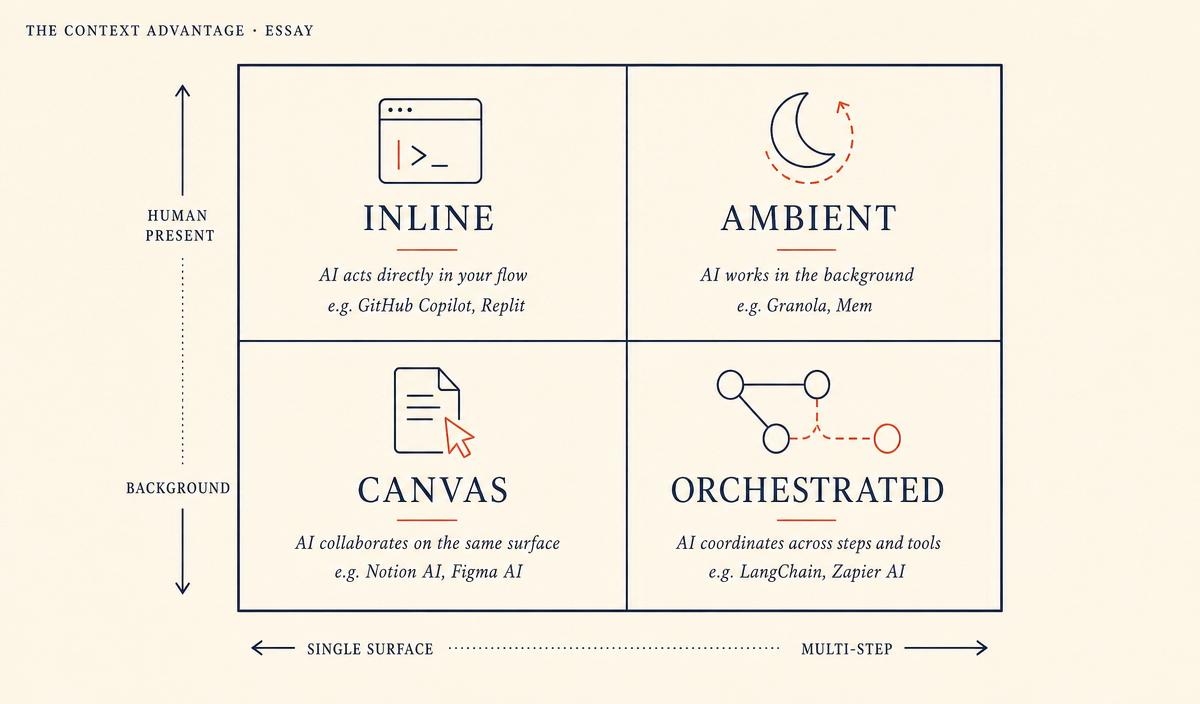
The post-chat world is not one interface — it is at least four, and they trade off along two axes. Along one axis: is a human present, or is the agent working in the background? Along the other: does the agent operate on a single surface, or does it coordinate multiple steps and tools?
Inline agents live at the human's cursor and operate on the current surface. Copilot suggestions, Cursor edits, inline SQL rewriters. Latency budget: sub-second. Trust surface: local diff.
Ambient agents run in the background on a single surface. Meeting notetakers that summarize your call, inbox triagers that pre-file your email, monitors that flag drift in a dashboard overnight. Latency budget: minutes. Trust surface: a report you review later.
Canvas agents share the surface with the human. Artifacts, notebooks, generative UI panels, whiteboard co-editors. Latency budget: seconds. Trust surface: the artifact itself, with revision history.
Orchestrated agents coordinate across surfaces and tools without a human present in each step. Long research runs, migration agents, code-writing agents. Latency budget: hours. Trust surface: an audit trail plus a final artifact.
The mistake most teams are making right now is picking a chatbot for every problem. Pick the pattern that matches the latency budget and the trust surface. Chapter 15Chapter 15 · 6 min LockedGuardrails, Approvals, and Audit TrailsDesigning safe agent behavior in practice. has the decision tree.
What this means for data products
For data teams, the shift is concrete and it is uncomfortable. The default AI feature request for the last two years has been "add a chatbot to the dashboard." That request is a category error.
The dashboard is already the interface. It has filters, drill-downs, metric definitions, an audience, and a workflow. A chatbot bolted onto the side asks the user to describe, in prose, what they can already see. It is slower than the surface it lives next to. It also throws away every piece of context the surface was designed to carry.
The right move is to make the dashboard itself agentic. Selecting a chart becomes a context signal. Hovering a metric becomes a retrieval trigger. Asking "why did this drop?" happens where the drop is, not in a side panel. The SQL the agent runs becomes a tool call inside the surface, not a chat reply. Chapter 16Chapter 16 · 5 min LockedTrust Is Designed, Not AssumedHow leaders earn confidence in AI systems. walks a real reference architecture for this; Chapter 7Chapter 7 · 7 min LockedSemantic Layers, Ontologies, and Metrics in Simple WordsThe big context words, explained without the jargon. covers why the semantic layer is the context layer that makes it work.
The trust surface moves too
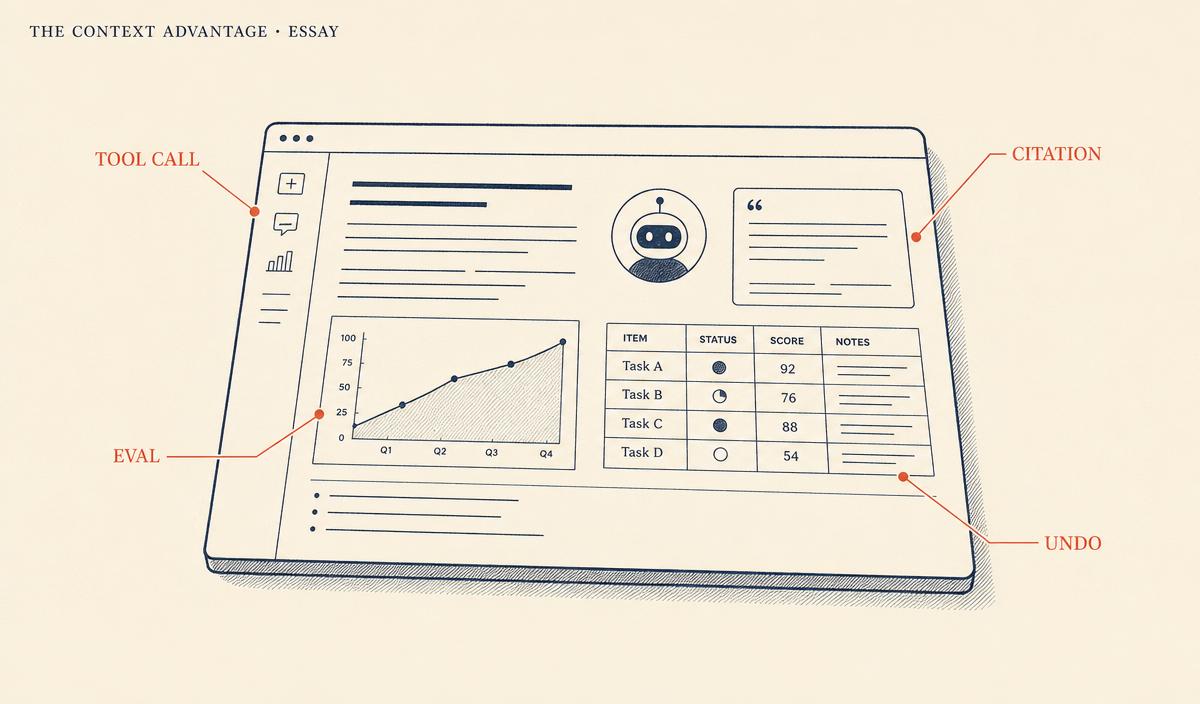
Everything that used to live in the chat transcript — the audit trail, the citations, the undo button, the eval score — has to move onto the work surface. This is the part most teams underestimate. The chat window was doing more work than we noticed.
In a chat, provenance is a line under the answer. On a work surface, provenance has to be attached to the cell, the paragraph, the row. In a chat, undo is a delete key. On a work surface, undo is a real transactional operation that has to know what the agent touched and what it did not. In a chat, an eval is a thumbs-up. On a work surface, an eval is a scoring signal that has to survive being embedded inside the artifact.
This is not cosmetic. If the trust surface does not move with the interaction surface, the agent stops being trustworthy the moment you close the chat. Chapter 17Chapter 17 · 6 min LockedHuman in the Loop Still MattersWhen humans should approve, review, or fully own the decision. covers tool contracts; Chapter 21Chapter 21 · 6 min LockedQuality, Speed, and Cost TradeoffsHow to balance accuracy, latency, and spend. covers eval harnesses in this new topology.
The cost model flips
The chat era had a comforting property: the human waited. That meant your cost model was bounded by human patience. A user tolerates maybe ten seconds and a few thousand tokens per turn. Multiply by their session length and you have a defensible bill.
Ambient and orchestrated agents break that assumption. When the human is not waiting, there is nothing stopping the loop from running for an hour, spending fifty thousand tokens, calling ten tools, and coming back with an answer nobody asked for anymore. The unit economics of an ambient agent are not the unit economics of a chatbot with a longer timeout.
The latency budget also flips. In chat, the constraint is "how long is the human willing to stare at a spinner." In ambient, the constraint is "how long before the human returns and expects the work to be done." Those are wildly different numbers, and they demand different scheduling, different retry logic, different failure modes. Chapter 23Chapter 23 · 5 min LockedOpen Formats, Open Interfaces, Open ThinkingWhy openness is a strategic moat. and Chapter 30Chapter 30 · 7 min LockedThe Trusted Agent ArchitectureA nine-step end-to-end reference architecture for production agents. go deep on this — the compute and latency budget essay at /context-advantage/blog/compute-latency-budgeting-agentic-workflows is the short version.
What to build this quarter
If you own an AI-adjacent product surface, there are three concrete moves that separate the teams shipping post-chat products from the teams still bolting chatbots onto old ones.
First, retire the standalone chatbot. If your app has a chat sidebar that duplicates what the main surface already offers, kill it. The chatbot becomes a fallback for the shape of questions your surface genuinely cannot answer — not the default front door.
Second, wire the agent into the surface users already live in. Selection is a context signal. Hover is a retrieval trigger. The active filter is a scope constraint. Every UI event your surface already emits is context your agent can use — most of it is being thrown away right now.
Third, put the trust primitives on the surface. Citation next to the number. Undo attached to the edit. Eval score attached to the artifact. If the user has to open a different panel to check whether they should trust what they are looking at, they will not check. Chapter 18Chapter 18 · 6 min LockedThe Hidden Cost of Agentic AIWhere the dollars actually go. has the reference model.
The last chat window
The chat window is not going to zero. It is going to the place every general-purpose interface eventually goes — the fallback. The command line did not disappear when we got graphical interfaces; it moved into the terminal, where power users still live, and left the main stage to something better suited to most tasks.
The chatbot will end up in exactly that role. Useful for the long tail of questions no work surface can anticipate. Useless as the default way to interact with a product that has a work surface of its own.
The teams that see this early are already building the next generation of AI products. The teams that miss it are shipping their fourth chatbot rewrite and wondering why adoption is flat. If you want the long-form architecture — the surface patterns, the trust primitives, the cost models, the eval harnesses — read The Context Advantage at https://thecontextadvantage.com/context-advantage, or unlock the full book at /context-advantage/buy.
"The chat window was a compromise. The next interface is the work itself, with an agent inside it."
Try this at work
- Audit every chatbot in your product. For each one, ask which of the four post-chat patterns would actually serve the user better.
- List the UI events your surface already emits — selection, hover, filter, scroll — and ask which of them your agent currently ignores. Wire at least one this month.
- Move one trust primitive — citation, undo, or eval score — off the side panel and onto the surface itself.
- For each ambient or orchestrated agent, write down its latency budget and its cost budget on one page. If both are unbounded, redesign before shipping.
- Kill one chatbot this quarter. Replace it with an inline or canvas pattern and measure the difference in task completion time.
The Context Advantage is the field guide to the post-chat world — the surface patterns, the trust primitives, the cost models, the eval harnesses, and the reference architectures we keep watching real teams reach for. Start free at [/context-advantage/blog](/context-advantage/blog), or unlock the full book at [/context-advantage/buy](/context-advantage/buy).
Explore the book →Where in your product is a chat sidebar duplicating what the main surface already offers — and what would it take to move the agent into the surface itself?