The bottleneck is no longer the model
In the first wave of enterprise AI, the winning question was which model to bet on. In the second wave, that question is nearly settled. Every serious model is capable enough for almost every serious workflow. The gap between the best and the second-best has narrowed to a rounding error on most real tasks, and it narrows again every quarter.
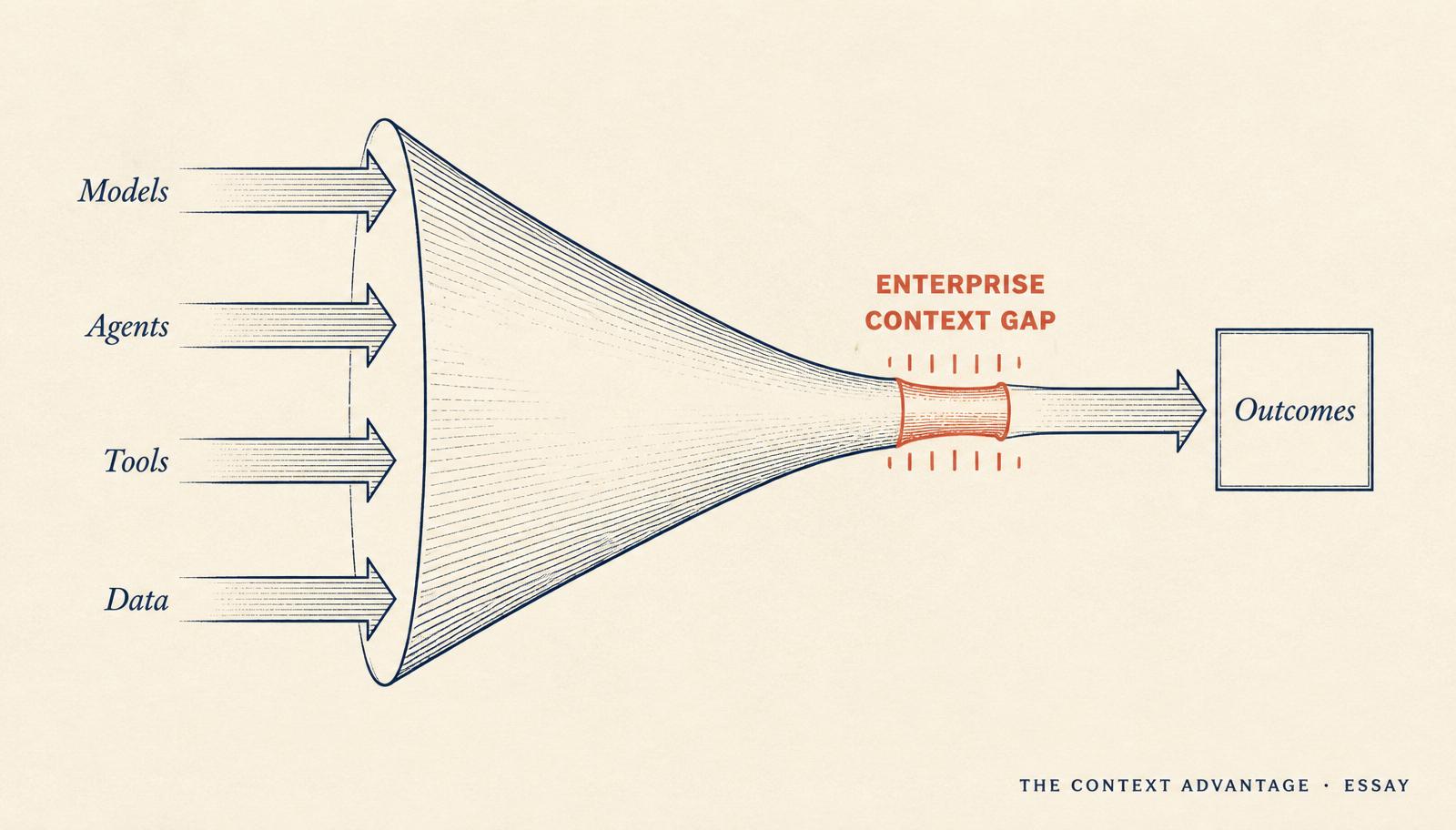
That shift changes the game. If everyone has the same intelligence available on tap, intelligence stops being the moat. What is left is the distance between what the model knows and what your organization knows. That distance is the bottleneck. It is also, quietly, the biggest business opportunity of the decade.
The companies that will dominate the next ten years are not the ones with the smartest models. They are the ones with the richest context — the ones whose definitions, decisions, policies, and organizational memory can be read, reasoned over, and acted on by any agent they choose to run.
What context-rich actually means
A context-rich company is not the one with the largest data lake. It is not the one with the most vector indexes, the biggest prompt library, or the fanciest RAG pipeline. Those are ingredients. Context is what happens when the ingredients are arranged into meaning that a machine can trust.
In practical terms, a context-rich company has four things. It has a semantic layer that names the twenty or thirty concepts the business actually runs on — revenue, customer, active user, churn, delinquency — and defines them once, with an owner, a history, and a review cadence. Chapter 5Chapter 5 · 7 min LockedContext Is the New Data LayerWhy meaning sits above storage and compute. and Chapter 7Chapter 7 · 7 min LockedSemantic Layers, Ontologies, and Metrics in Simple WordsThe big context words, explained without the jargon. walk through what that layer looks like when it is done well.
It has an institutional memory — a retrievable log of decisions, exceptions, and the reasons behind them, so that a new agent joining the workflow does not have to relearn from zero what a human colleague already knows. That is the argument of Chapter 10Chapter 10 · 9 min LockedInstitutional Memory Is the MoatAs frontier models converge, the durable advantage is the accumulated why — decisions, definition history, and organizational logic., which frames institutional memory as the durable moat once models converge.
It has a living context layer, not a launch document. Definitions drift. Portfolios shift. Regulators move the goalposts. Chapter 11Chapter 11 · 7 min LockedContext Is a Living Layer, Not a DocumentDefinitions drift, macro conditions shift, agents relearn — treat context like code, with ownership, versioning, and continuous review. makes the case that context has to be run like production code — owned, versioned, evaluated on every change — or it decays without anyone noticing until a board slide is wrong.
And it has portable context. The meaning is the company's IP, not the vendor's. Chapter 12Chapter 12 · 7 min LockedPortable Context: The Open Contract for AgentsContext is your IP — it must move across agents, models, and clouds through an open contract, not sit locked inside one runtime. argues that if your context cannot leave the runtime you built it in, you do not own it — you rent it.
Why context compounds and models do not
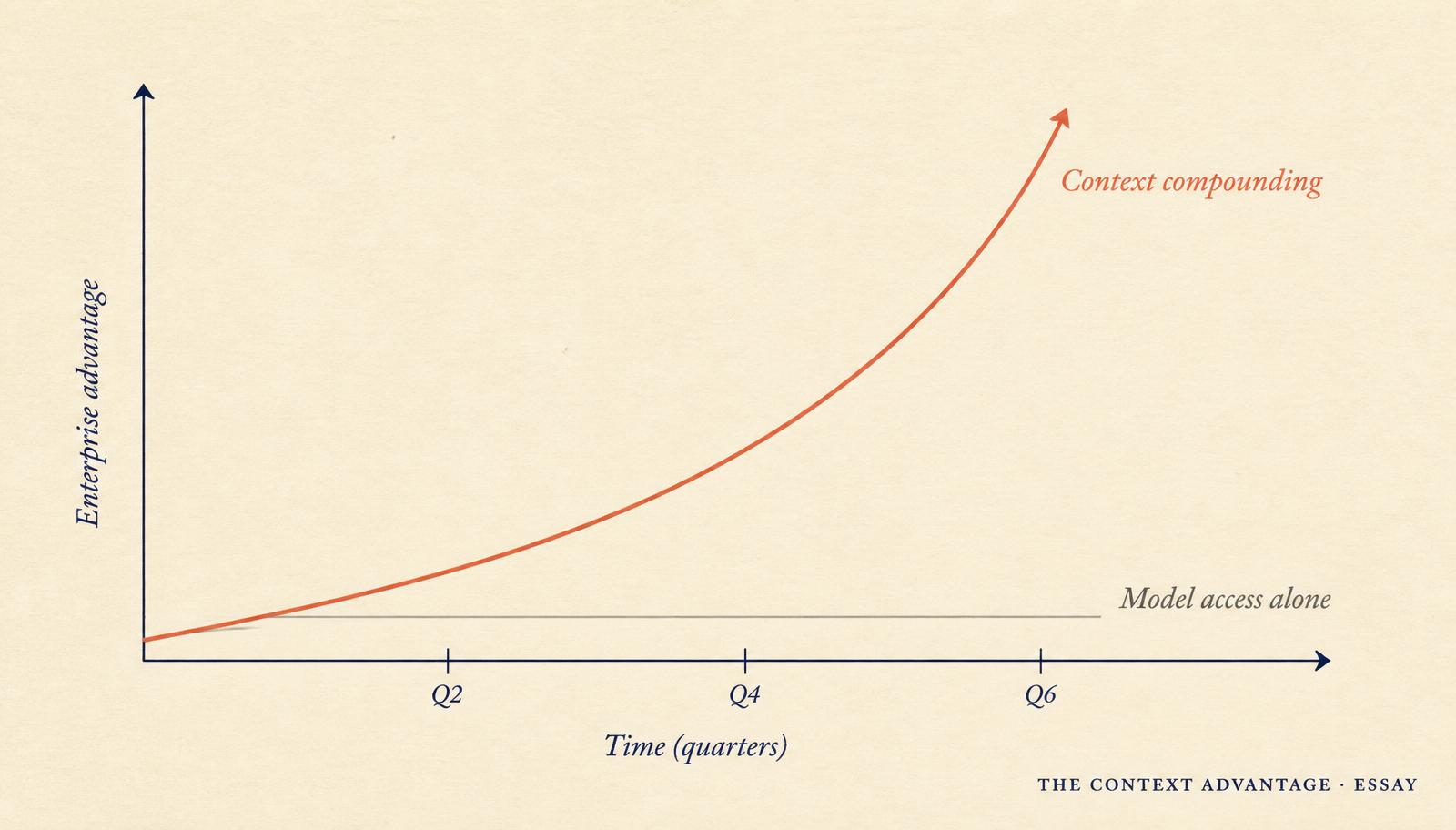
The reason context is the right place to invest is arithmetic, not ideology. Model access is a flat line. You pay for tokens, you get tokens. Two teams with the same budget get roughly the same capability out of the same model. There is no accumulation, no interest, no learning curve that belongs to you.
Context is the opposite. Every decision your team logs, every definition your analytics engineers version, every exception your risk team writes down, every correction a user makes to an agent — all of it lands in the layer and stays there. The layer gets denser every week. Agents that read from it get sharper every week. And because the layer is yours, not the vendor's, the compounding stays with you when the model underneath changes.
Chapter 3Chapter 3 · 9 min FreeSmart Models Still Need Smart SystemsWhy intelligence alone is never enough at enterprise scale. makes this point in detail: smart models still need smart systems, and the smart system is the one that turns every interaction into durable meaning. Chapter 8Chapter 8 · 8 min LockedFrom Data Catalog to Business MemoryCatalogs describe data. Memory describes meaning. shows the mechanics of moving from a data catalog, which merely describes columns, to a business memory that describes why decisions were made.
The 4 C's, revisited for a commoditized model era
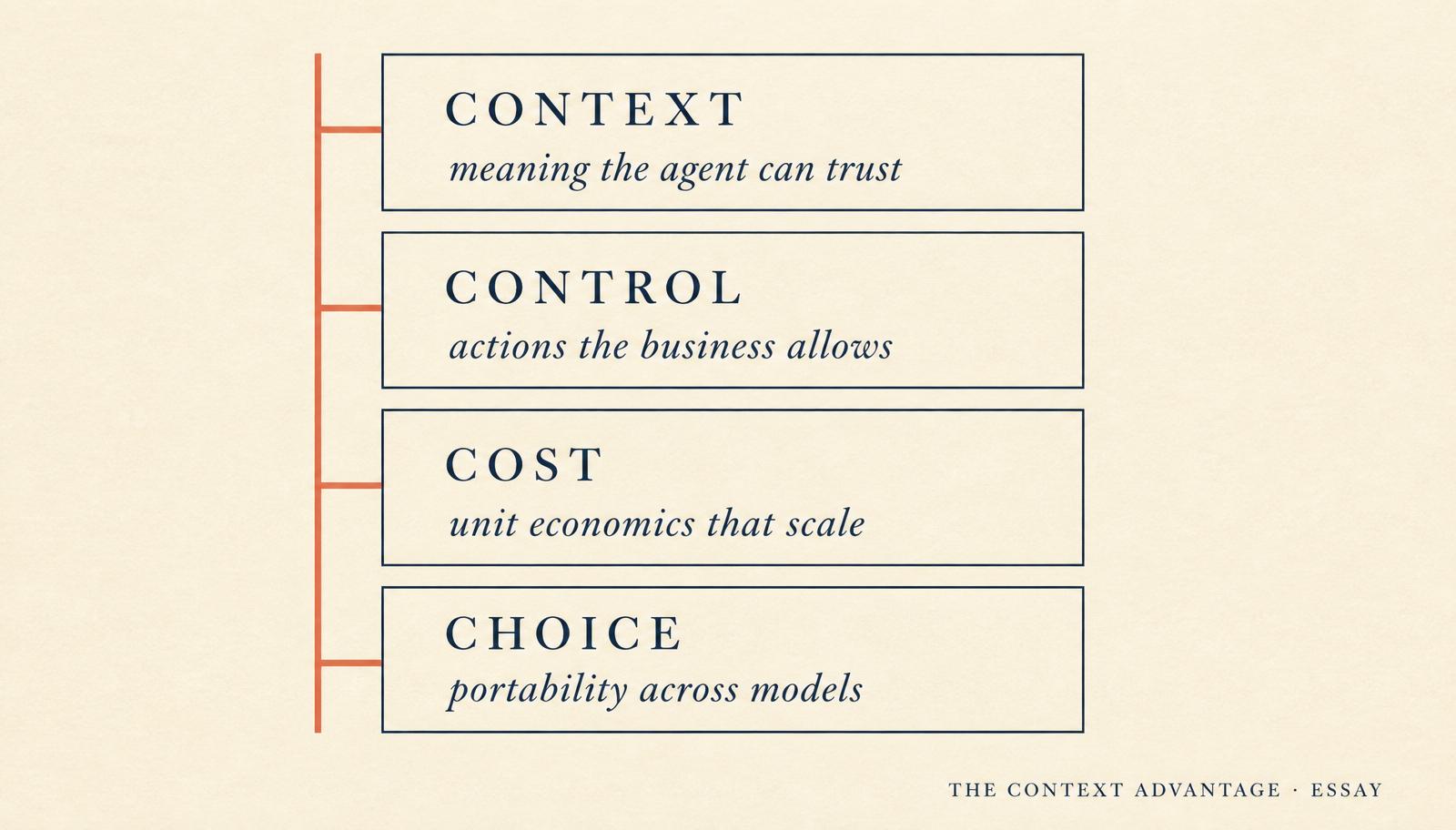
The framework at the heart of the book — Context, Control, Cost, and Choice — reads differently once you accept that the model itself is no longer where the advantage lives. Chapter 4Chapter 4 · 7 min LockedThe 4 C's FrameworkA simple lens for designing trusted enterprise AI. is the primer; here is the shorter version, filtered through the lens of this essay.
Context is the meaning layer. It is what makes an agent's answer true for your business, not just fluent in English. Without it, the best model in the world will confidently give the wrong number.
Control is the action layer. Once agents start doing, not just answering, you need governed action surfaces — who can act, on what, with what approval. Chapter 13Chapter 13 · 6 min LockedGovernance Was Built for Humans. Agents Need More.Access control is not action control. and Chapter 14Chapter 14 · 7 min LockedFrom Access Control to Action ControlMoving from who can see to what can act. walk through the shift from access control to action control that this era demands.
Cost is the unit economics layer. Frontier models are cheap per token and expensive per workflow. Chapter 18Chapter 18 · 6 min LockedThe Hidden Cost of Agentic AIWhere the dollars actually go. and Chapter 20Chapter 20 · 6 min LockedBudget-Aware AI DesignDesigning for budgets from day one. explore how compute and latency budgets separate demos that impress from products that scale.
Choice is the portability layer. Every enterprise will run more than one model, and the model they run in 2028 will not be the model they run in 2026. Chapter 12Chapter 12 · 7 min LockedPortable Context: The Open Contract for AgentsContext is your IP — it must move across agents, models, and clouds through an open contract, not sit locked inside one runtime. and Chapter 24Chapter 24 · 5 min LockedBuild for ChangeDesigning for change you can't predict. argue that context and tools have to be portable across runtimes, or the choice is not really yours to make.
What a context-rich company looks like on a Tuesday
It is easy to talk about context in the abstract. The more useful test is what a context-rich company looks like on a normal Tuesday, in a normal quarter, when nothing dramatic is happening.
On that Tuesday, an analyst asks an internal agent a question about customer risk. The agent answers with a number and, next to it, the exact definition it used, the owner of that definition, and the date it was last reviewed. The analyst clicks the definition and sees the last three changes, the rationale for each, and the eval results that gated them into production. Chapter 15Chapter 15 · 6 min LockedGuardrails, Approvals, and Audit TrailsDesigning safe agent behavior in practice. describes the audit trail behavior that makes this possible.
In parallel, a support agent handles a customer refund. Before the refund is issued, the agent checks the policy layer, confirms the exception rule that applies, and logs the decision along with the citation. The next agent that sees a similar case will find that decision in memory. Chapter 26Chapter 26 · 6 min LockedThe Agentic Data ProfessionalHow your role evolves in the next five years. frames this feedback as the mechanism by which agents get better without retraining the model.
Meanwhile, the platform team migrates one workflow from one frontier model to another. It takes an afternoon, not a quarter, because the context layer is portable, the tool contracts are open, and the evals are model-agnostic. Chapter 22Chapter 22 · 5 min LockedThe Danger of AI Lock-InHow yesterday's choices limit tomorrow's options. and Chapter 24Chapter 24 · 5 min LockedBuild for ChangeDesigning for change you can't predict. show what has to be true underneath for a Tuesday afternoon migration to be boring instead of terrifying.
Nothing in that Tuesday is exotic. Every piece of it is buildable today with technology that exists. The difference between the company that lives that Tuesday and the company that lives on ad-hoc prompts is not budget. It is intent.
The role that owns the layer
A context-rich company has a named human owner for the layer. Not a committee, not a shared responsibility across three teams that all point at each other in the postmortem — one owner, with a job title and a scorecard.
Chapter 9Chapter 9 · 6 min LockedThe Context EngineerA new role at the heart of agentic systems. introduces the Context Engineer, the role that emerged from analytics engineering and now sits at the heart of every serious agentic program. Their scorecard is simple: how fresh is the context, how correct are the answers grounded in it, and how portable is it when the runtime changes. Chapter 29Chapter 29 · 6 min LockedCareer Roadmap for the Agentic EraLearning paths for beginners, intermediates, and senior professionals. maps the career path — how a data engineer, an analytics engineer, or a semantic modeler becomes the person the CFO calls when a number on a slide is wrong.
If your organization cannot name that person today, that is the first thing to fix. Not the next model, not the next platform — the owner.
Where to start this quarter
You do not build a context layer in a sprint. You do, however, build the first honest version of it in a quarter, and once it exists, it starts compounding the next day.
Pick the ten definitions your business argues about most often — the ones where two dashboards disagree, where finance and product cite different numbers in the same meeting. Move them into source control. Give each one an owner, a rationale, and a review cadence. That is your semantic layer, chapter 5 and chapter 7 in practice.
Pick one workflow — support, risk, sales research, internal analytics — and put an agent on top of that layer, grounded only in those ten definitions plus a small pinned policy set. Turn on the write loop so every correction lands back in the layer. That is your institutional memory, chapter 10 in practice.
Wire an evaluation harness to the layer. Every change to a definition runs against a fixed suite of questions before it merges. That is your living layer, chapter 11 in practice.
And write down the export contract from day one. What does it look like to lift this layer out of this vendor and drop it into a different one? If you cannot answer, you do not own it yet. That is chapter 12 in practice.
Four moves. One quarter. The company that does them starts compounding an advantage that the company still shopping for the perfect model cannot buy back.
The next ten years, in one sentence
The next decade of enterprise AI will not be won by the company with the smartest model. It will be won by the company whose people and agents get a little sharper every week, because the context layer they share is a little richer than it was yesterday.
That is the whole thesis. The Context Advantage — https://thecontextadvantage.com/context-advantage — is a thirty-four chapter argument for why that is true and a practical field guide for how to build it. If you want to go deeper on any piece of this essay, every chapter linked above is where the depth lives. Chapters 1, 2, and 3 are free to read. Chapter 4 introduces the framework. From there, Part 2 is where the compounding begins.
Two years from now, the difference between the enterprises pulling ahead and the ones falling behind will not be which frontier model they picked. It will be whether they started building the layer above it, this quarter, on purpose.
"Models are commodities. Context is not. The advantage lives in the layer between them."
Try this at work
- Name the ten definitions your business argues about most and move them into source control with owners and review cadences.
- Stand up one grounded agent on top of that layer and turn on a write loop so every correction lands back in the context.
- Attach an eval harness to the layer so no definition change reaches production without passing a fixed suite of questions.
- Write the export contract for your context on day one — if it cannot leave the vendor, you do not own it.
- Name the human owner of the layer. Not a committee — one person, with a scorecard for freshness, correctness, and portability.
The Context Advantage is the long-form playbook for building the layer above the model. Thirty-four chapters, lifetime updates. Start free at [/context-advantage/blog](/context-advantage/blog), or unlock the full book at [/context-advantage/buy](/context-advantage/buy).
Explore the book →If every competitor in your industry woke up tomorrow with access to the same frontier model you use, what would still be yours by the end of the week?