The bottleneck was never the model
Ask a hundred enterprise leaders what is holding their AI back and most of them will point at the model. Not smart enough. Not fast enough. Not cheap enough. Not the right one for their use case. Wait until the next quarterly release, they say, and then we will move.
The next quarterly release always arrives. The demos always improve. The production numbers rarely do. A year later, the same team is waiting for the next model to save the same project.
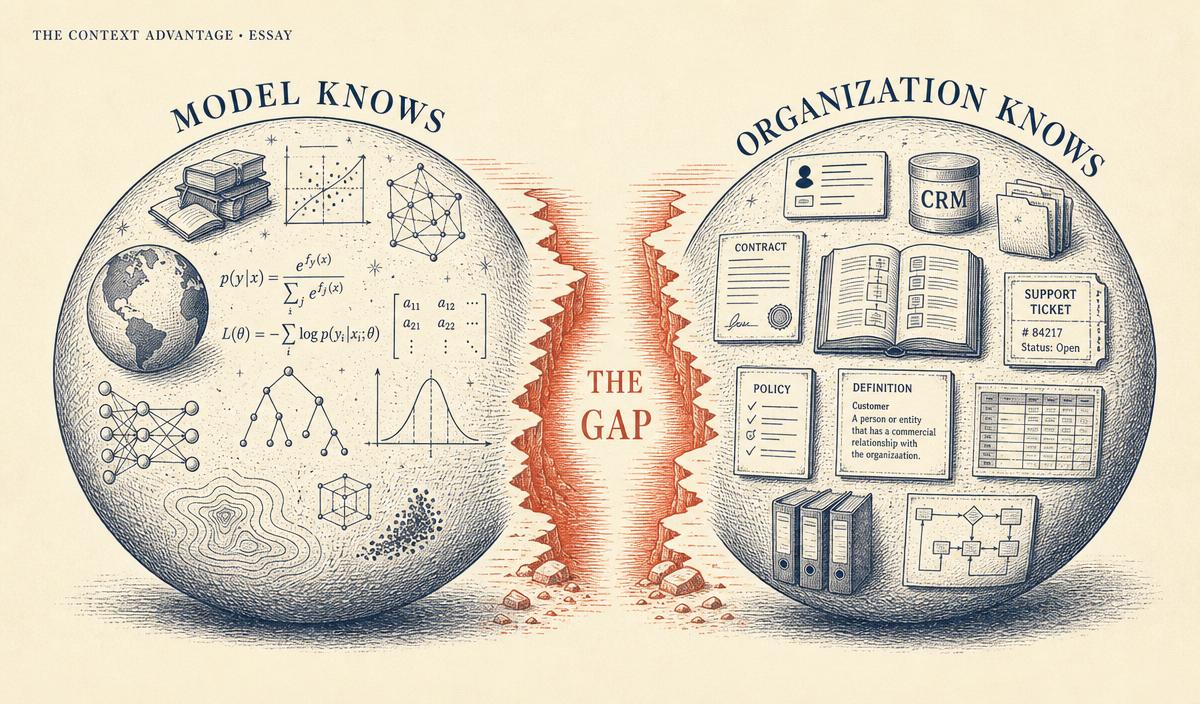
There is a simpler explanation, and it is the central idea behind The Context Advantage. The real bottleneck is not the model. It is the gap between what the model knows and what your organization knows. That gap is where every AI project quietly stalls, and it is where the durable advantage lives for the teams that decide to close it.
Two knowledge stacks that were never introduced
Every enterprise AI system today sits on top of two knowledge stacks that were assembled by different people, over different decades, for different reasons.
The first stack is the model. Trained on the open internet, on books, on code, on a compressed map of human knowledge in general. It knows what a customer is in the abstract. It knows what fraud looks like in a textbook. It knows how a contract is typically structured. It knows everything a well-read outsider would know about your industry.
The second stack is your company. It knows what "active customer" means in your billing system. It knows why the finance team's revenue number is different from the product team's. It knows which of the three columns called status is the one your VP trusts. It knows the definition of "eligible" that took legal, security, and marketing four meetings to agree on. It knows the last three incidents that changed how you deploy on Fridays.
The model has generality. Your company has specificity. Nobody has ever introduced them to each other. That is the gap. Chapter 4Chapter 4 · 7 min LockedThe 4 C's FrameworkA simple lens for designing trusted enterprise AI. is the long-form argument for why this framing beats every other frame we have tried.
Weights, context, harness
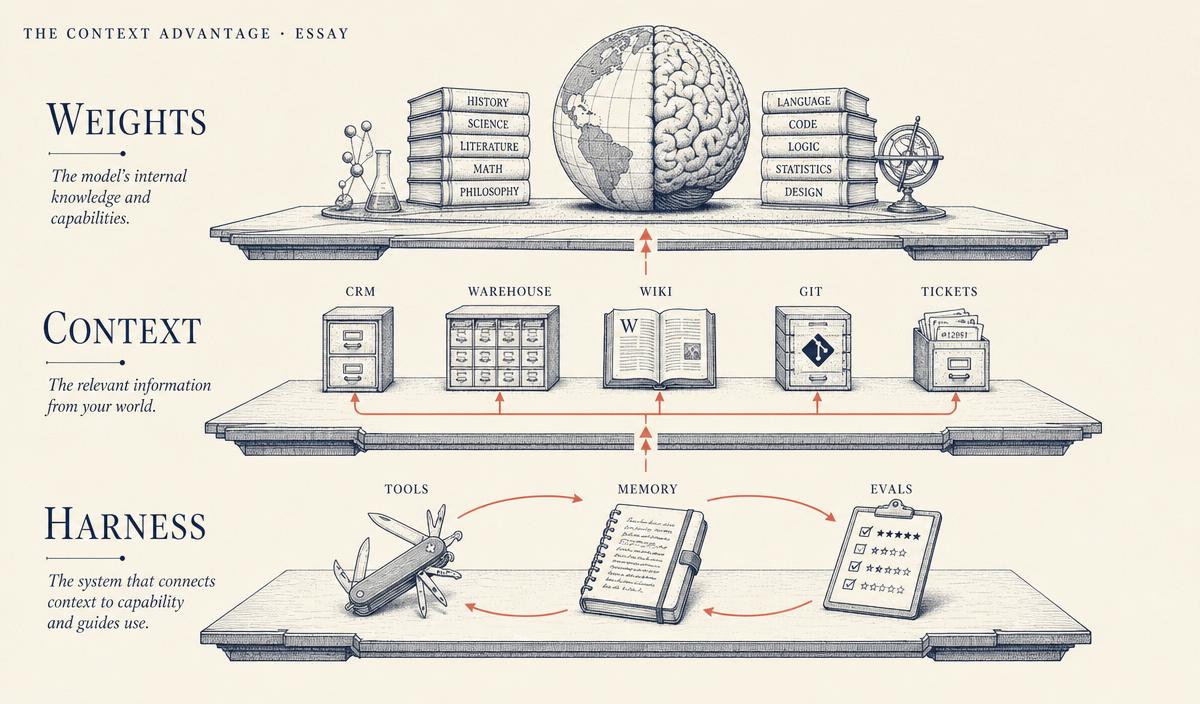
The most useful mental model we have found for closing the gap has three layers. The weights are what the model has learned from the world. The context is what the model is told about your world at the moment it acts. The harness is the software around the model that decides what context to fetch, what tools to call, what to remember, and what to check before returning an answer.
Everything you can improve about your AI system falls into one of those three layers. The industry spends most of its attention on the first. The second and third are where enterprise value actually lives.
Weights are a commodity. Anyone can call the same API. Context is a possession. Only you have your customers, your contracts, your history, your definitions. Harness is a discipline. It rewards the teams that treat AI as engineering, not as prompting. Chapter 15Chapter 15 · 6 min LockedGuardrails, Approvals, and Audit TrailsDesigning safe agent behavior in practice. and Chapter 16Chapter 16 · 5 min LockedTrust Is Designed, Not AssumedHow leaders earn confidence in AI systems. go deep on each layer.
Where the gap actually lives
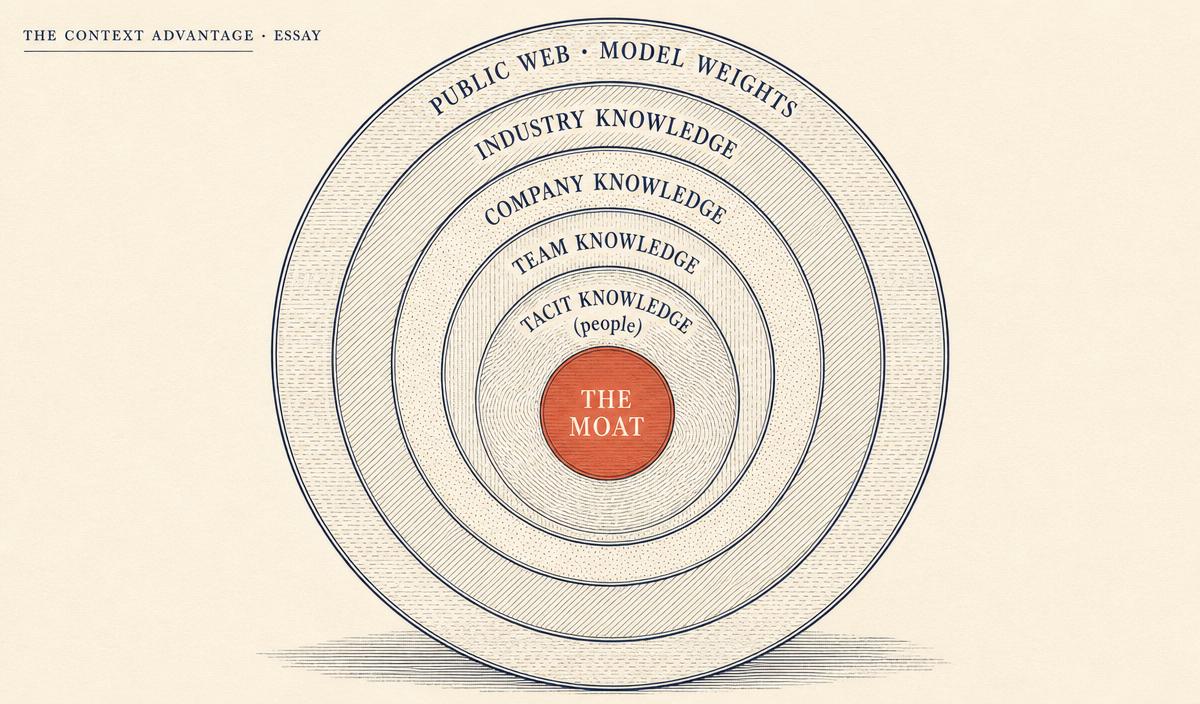
Zoom in on the gap and it is not one gap. It is a series of concentric rings of knowledge, each less shared and more valuable than the last.
The outermost ring is the public web and everything the model already absorbed. This is free. Everyone has it. It carries no advantage. The next ring is industry knowledge — the vocabulary, the regulations, the standard playbooks of your sector. Some of this leaks into model training over time. Most of it is still yours to bring.
Then comes company knowledge — your metrics, your policies, your product, your customers. This never leaks into public models. It lives in your systems and only in your systems. Then team knowledge — the local conventions, the ownership boundaries, the on-call rituals. And finally, at the center, tacit knowledge — what your best people carry in their heads and hardly ever write down. The judgment that separates a good decision from a bad one when the data is ambiguous.
The teams building the durable advantage are the ones that move deliberately from the outside ring toward the center. Public web is a starting line. Tacit knowledge, captured and made retrievable, is the moat.
Why the gap compounds
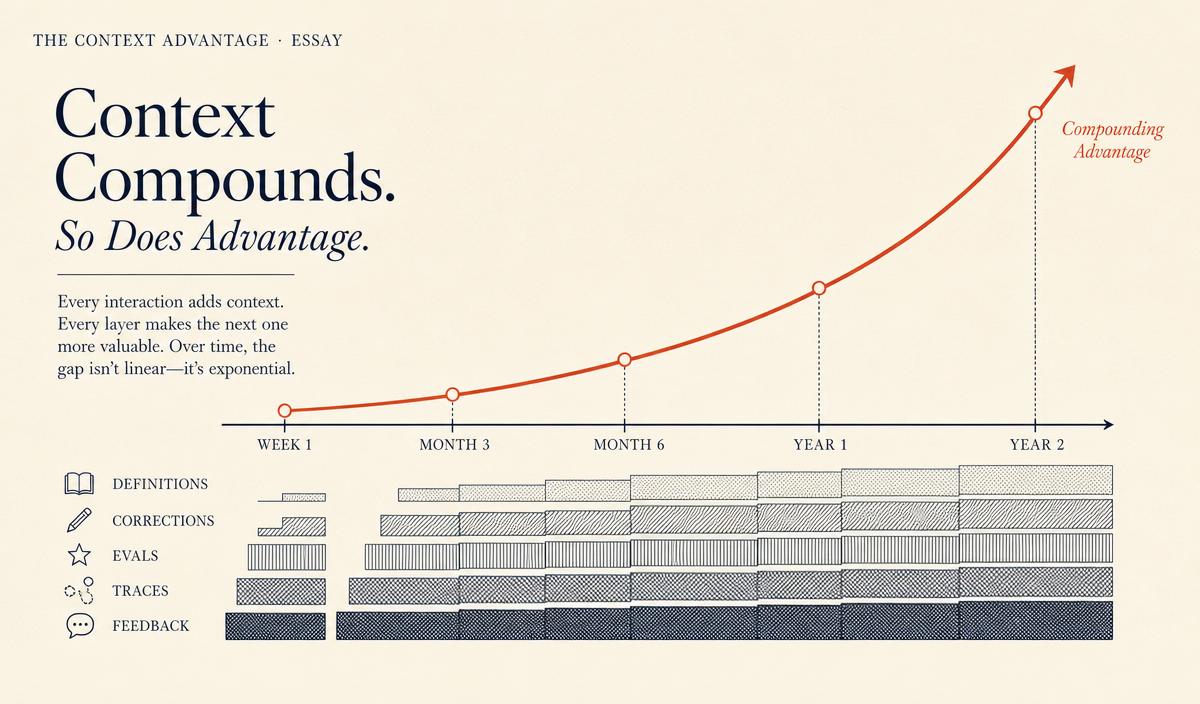
The subtle reason to take this seriously is not that the gap is large today. It is that the gap compounds. Every week your AI runs, it generates artifacts that can either be thrown away or captured. Definitions get sharpened. Corrections get logged. Evaluations catch new failure modes. Traces reveal which retrievals actually helped. Feedback tells you which answers users accepted.
A team that treats these as byproducts throws them away and starts every week from roughly the same place. A team that treats these as assets writes them back into the context layer and starts every week slightly ahead of the last one. Six months later, the two teams are running the same model and getting very different results.
This is why the phrase "model advantage" is misleading and "context advantage" is not. Model advantages evaporate on the next release. Context advantages compound. Chapter 25Chapter 25 · 6 min LockedPlatform Independent, Platform AwareLearn the concepts. Map them to Databricks, Snowflake, AWS, Azure, GCP, and open source. and Chapter 26Chapter 26 · 6 min LockedThe Agentic Data ProfessionalHow your role evolves in the next five years. walk the mechanics of the compounding loop.
The invisible half your company already paid for
The uncomfortable and encouraging fact is that most of the raw material to close the gap already exists inside your walls. Enterprises did not wait for AI to invent organizational memory. They have been building it for four decades under other names.
The CRM is organizational memory about customers. The ERP is organizational memory about transactions. The warehouse is organizational memory about the business as a whole. Wikis are organizational memory about how work gets done. Git is organizational memory about how systems evolved. Ticketing systems are organizational memory about what has broken and how it was fixed. The semantic layer is organizational memory about what things mean.
None of these were designed with AI in mind, which is why almost none of them are wired into your AI stack today. Closing the gap is, in large part, the act of connecting systems your CFO has been paying for since the 1990s to a model your CTO started paying for in 2023. Chapter 7Chapter 7 · 7 min LockedSemantic Layers, Ontologies, and Metrics in Simple WordsThe big context words, explained without the jargon. and Chapter 17Chapter 17 · 6 min LockedHuman in the Loop Still MattersWhen humans should approve, review, or fully own the decision. are the reference architectures.
Trust is the other half of the bridge
Wiring the memory in is only half the work. The other half is making the resulting answers trustworthy enough to act on. A model that pulls the right document and confidently mangles the answer is worse than a model that admits it does not know.
The pattern that works is boring and disciplined. Every retrieval is traced. Every claim carries a citation the user can open. Every action has an undo or a review. Every workflow has an eval that fails loudly before a customer sees a bad answer. Chapter 23Chapter 23 · 5 min LockedOpen Formats, Open Interfaces, Open ThinkingWhy openness is a strategic moat. and Chapter 30Chapter 30 · 7 min LockedThe Trusted Agent ArchitectureA nine-step end-to-end reference architecture for production agents. are the deep dives.
Trust is not a UI layer. It is a property of the harness. A team that treats the trust surface as an afterthought will keep discovering, in production, that its carefully assembled context was worse than no context at all.
The role that closes the gap
Every enterprise we have watched close this gap has quietly hired for the same role, even when the title is different. It is a person who lives at the seam between the business and the model. They know enough SQL and Python to be dangerous. They know enough about retrieval, evals, and orchestration to design a harness. They know enough about the business to argue a definition with a VP and win.
This person used to be called an analytics engineer. Today, at the companies moving fastest, they are called a context engineer or a knowledge engineer. The work is not new. Turning tacit business knowledge into structured, trustworthy artifacts is what the discipline has always been about. The medium is new — markdown, retrieval indexes, tool contracts, eval sets — but the job is the same. Chapter 21Chapter 21 · 6 min LockedQuality, Speed, and Cost TradeoffsHow to balance accuracy, latency, and spend. and Chapter 29Chapter 29 · 6 min LockedCareer Roadmap for the Agentic EraLearning paths for beginners, intermediates, and senior professionals. map the career.
If your organization does not have this role, you do not have a strategy for closing the gap. You have a strategy for waiting for a bigger model.
What to build this quarter
You will not close the gap in a sprint. You can, however, close it in loops, and the first loop is worth starting this week.
Pick one decision that matters and cost you money last quarter. Map every context source a competent human would use to answer it — the definition, the live data, the history, the policy. Wire the top three into a single agent. Instrument every answer with a citation, an undo path, and a lightweight eval. Route corrections back into the retrieval and the definition, not into a slack channel that nobody re-reads.
Then do it again next month with a second decision, using the memory and the harness you already built. The second loop is cheaper than the first. The third is cheaper than the second. By the fourth, you are not running a project — you are running a compounding system, and the gap between what your model knows and what your organization knows is measurably smaller than it was ninety days ago.
The advantage that grows every time your people learn
The most important sentence in this essay is the shortest one. Companies that close the model–organization gap build an advantage that grows every time their people and agents learn.
That is a very different sentence from the one most AI strategies are quietly built on, which is "our advantage grows every time the model gets better." The first sentence describes a moat that widens under your control. The second describes a boat that rises with everyone else's.
The frontier model your competitor uses is the same one available to you. The frontier context is not. If you want the long-form playbook — the memory architectures, the retrieval patterns, the trust surfaces, the eval harnesses, and the organizational moves that turn a raw model into a compounding system — read The Context Advantage at https://thecontextadvantage.com/context-advantage, or unlock the full book at /context-advantage/buy.
"Model advantages evaporate on the next release. Context advantages compound."
Try this at work
- Name one decision that cost you money last quarter and list every context source a human would consult to make it. Wire the top three into an agent this month.
- Draw your knowledge rings — public web, industry, company, team, tacit — and mark which ones are already reachable by your AI stack. Close the smallest ring you have not.
- Instrument one production answer with a citation, an undo, and a lightweight eval. Trust is a property of the harness, not a UI polish item.
- Route corrections back into retrieval and definitions, not into a chat channel. If the loop does not compound, you are running a demo, not a system.
- Hire or name the person who lives at the seam between the business and the model. Without that role, you have a wish, not a strategy.
The Context Advantage is the book about closing the gap between what the model knows and what your organization knows. It covers the memory architectures, retrieval patterns, tool contracts, eval harnesses, and organizational moves that turn a raw model into a compounding system. Start free at [/context-advantage/blog](/context-advantage/blog), or unlock the full book at [/context-advantage/buy](/context-advantage/buy).
Explore the book →If your competitor called the same model API tomorrow, which piece of your organization's knowledge would still be uniquely yours — and is any of it wired into your AI stack today?