The demo that keeps failing the second time
There is a familiar shape to every failed enterprise AI pilot. The first demo is astonishing. The second is fine. By the third, the sponsor is quietly asking whether the model has gotten worse. It has not. The model is the same. What is missing is memory.
A stateless agent is a very smart stranger who walks into the same meeting every morning and reintroduces itself. You explain the customer, the account, the last incident, the definitions your team argued about for two weeks. It gives a brilliant answer. Tomorrow, it walks in as a stranger again. You explain again. The demo dazzles. The teammate never arrives.
In 2026 this is the single most under-appreciated shift in enterprise AI. Every serious platform — OpenAI, Anthropic, Google, Cursor, Letta, MemGPT — is quietly rebuilding itself around persistent state. The bet, correctly, is that memory is not a feature. Memory is the moat.
Why stateless was always a compromise
The first generation of LLM products were stateless for a good reason. Serving a giant model was expensive, latency budgets were tight, and the cleanest way to scale was to make every request independent. Each call was a fresh conversation. Whatever state the user needed lived in their head or in a Google Doc pasted into the prompt.
That compromise fit a chatbot. It does not fit a teammate. A teammate remembers your project. A teammate remembers the decision you made last Tuesday and does not ask you to re-explain it. A teammate remembers that when you say "active customer" you mean the one who has logged in in the last thirty days and has a non-zero balance, because your VP settled that argument in Q1.
The stateless era ended the moment the first serious user asked their AI to "pick up where we left off." Every roadmap in the industry now points at the same destination: agents that carry state across sessions, across surfaces, and across time. Chapter 15Chapter 15 · 6 min LockedGuardrails, Approvals, and Audit TrailsDesigning safe agent behavior in practice. is the long-form argument for why memory belongs at the center of the harness, not at the edge.
The four tiers of agent memory
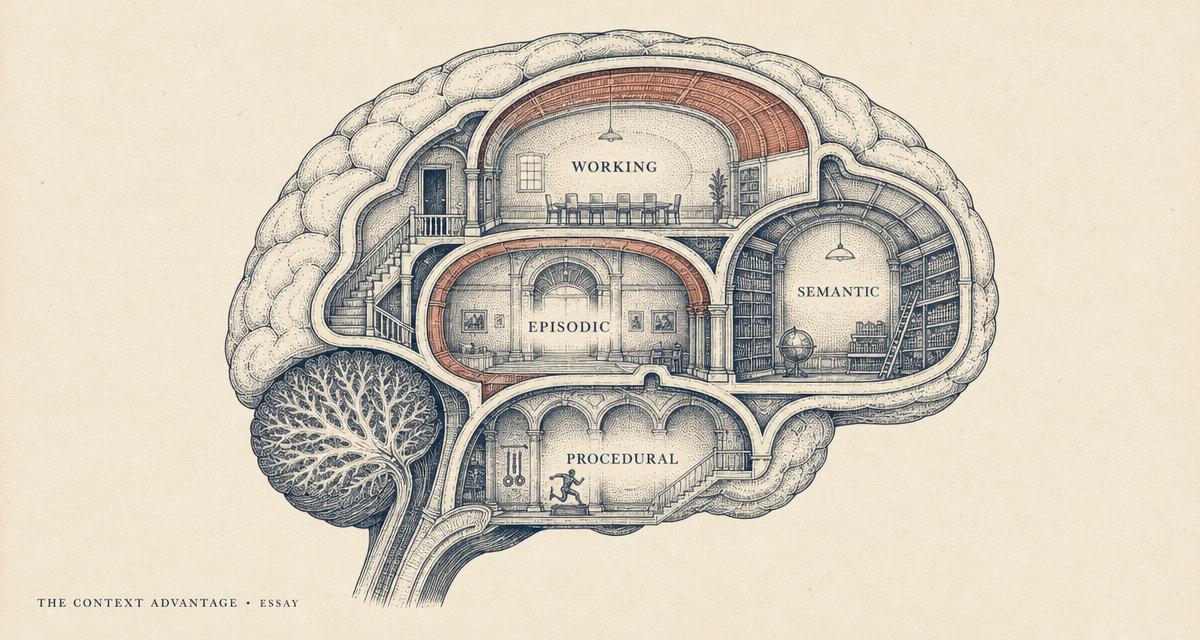
The most useful mental model we have found borrows directly from cognitive science. Human memory is not one system. It is at least four, each tuned to a different timescale and a different job. Enterprise agent memory has to mirror the same structure.
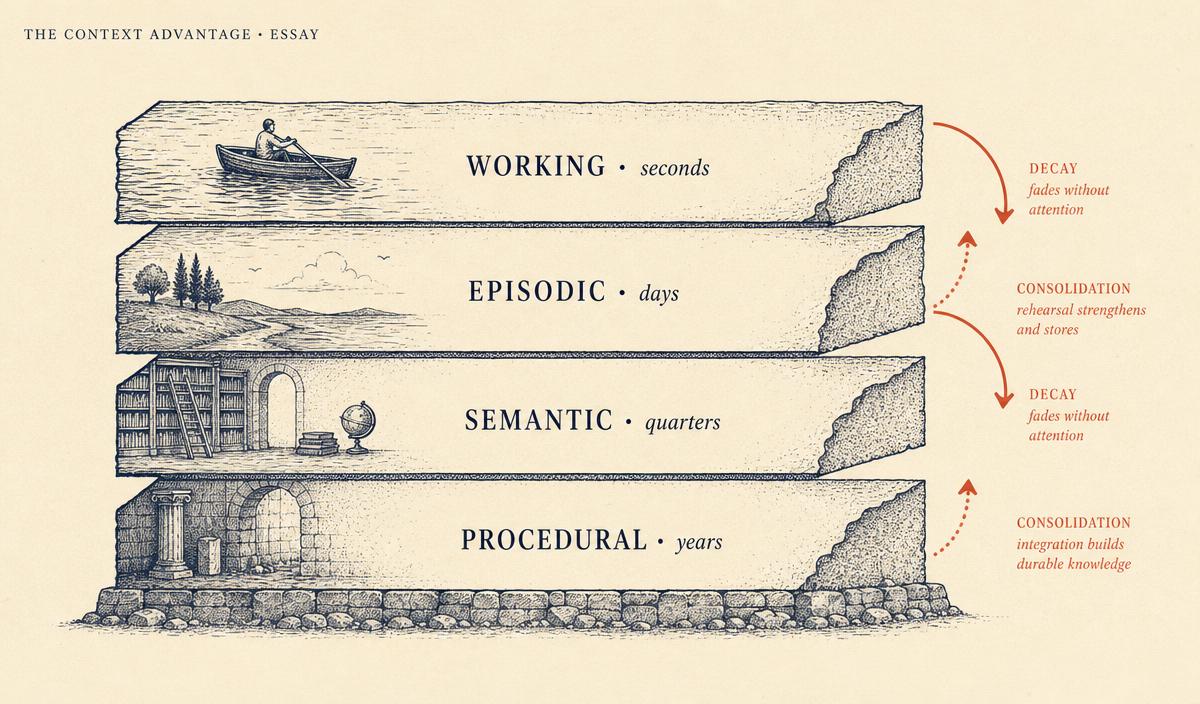
Working memory is the scratchpad — the tokens currently in the context window, the intermediate thoughts, the tool outputs from the last two steps. It lives for seconds and evaporates when the turn ends. Episodic memory is the log — every interaction, every tool call, every user correction, timestamped and retrievable. It lives for days to quarters. Semantic memory is the distilled knowledge — the definitions, the entities, the policies, the summaries that the agent has learned are worth keeping. It lives for quarters to years. Procedural memory is the how-to — the workflows, the tool contracts, the escalation patterns, the routines the agent has practiced enough to execute without re-deriving them. It lives for years and rarely changes.
Most teams building agents today ship only the first tier and then wonder why their agent has amnesia. The interesting engineering is not in the working memory. It is in the promotion path — how an observation becomes an episode, how repeated episodes become a semantic fact, how a semantic fact becomes a procedural habit. Chapter 16Chapter 16 · 5 min LockedTrust Is Designed, Not AssumedHow leaders earn confidence in AI systems. and Chapter 17Chapter 17 · 6 min LockedHuman in the Loop Still MattersWhen humans should approve, review, or fully own the decision. walk the reference architecture layer by layer.
The write loop everyone gets wrong
Ask a team how their agent remembers things and most will describe a read loop. Vector store. Similarity search. Top-k results injected into the prompt. That is retrieval. It is necessary. It is not memory.
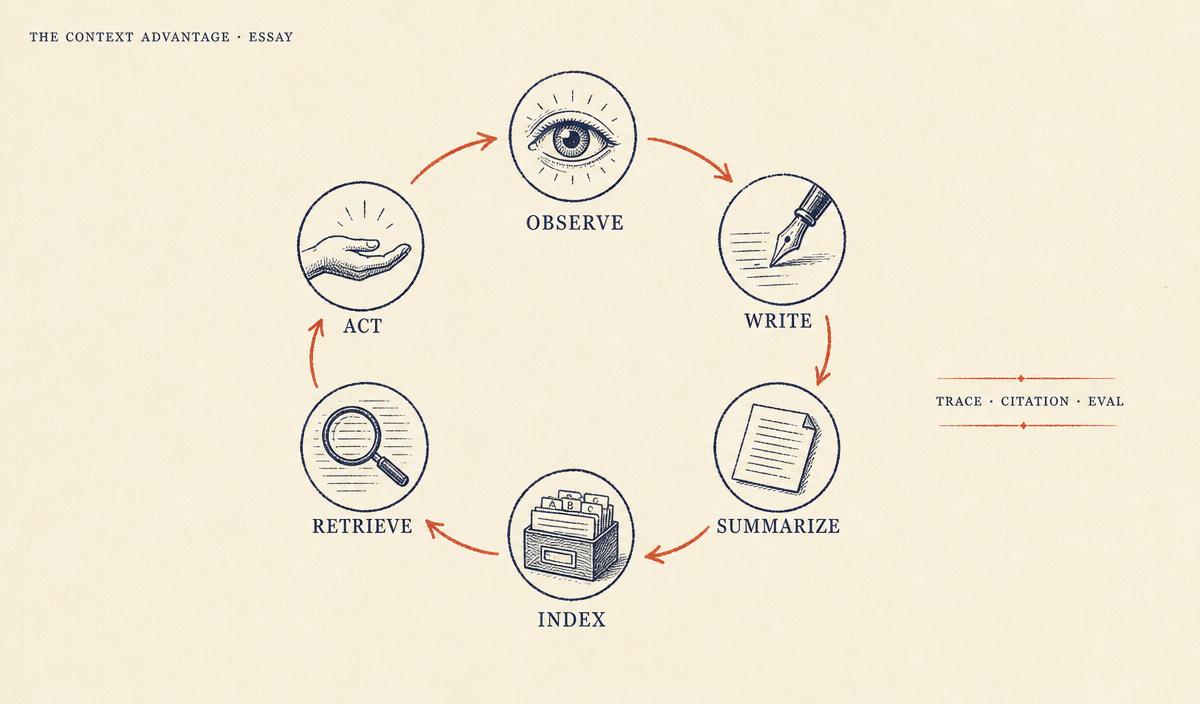
Memory is a write loop. Something happens. The agent observes it. It decides whether the observation is worth keeping. It summarizes it into a form that will still be useful three months from now. It indexes it so future retrieval can find it. Later, it retrieves it, acts on it, and — this is the step almost everyone skips — writes back what it learned from acting. Corrections update the record. Contradictions trigger a merge. Stale entries decay.
A team without a write loop is running a very expensive read-only cache. A team with a write loop is running a system that gets sharper every week. The difference does not show up in the first demo. It shows up in month three, when one team's agent is still asking the same clarifying question for the fortieth time and the other team's agent has quietly learned the answer.
Forgetting is a feature, not a bug
The counterintuitive truth about memory systems is that the hard problem is not remembering. The hard problem is forgetting. A memory that keeps everything is a memory that retrieves nothing useful, because the signal drowns in the noise.
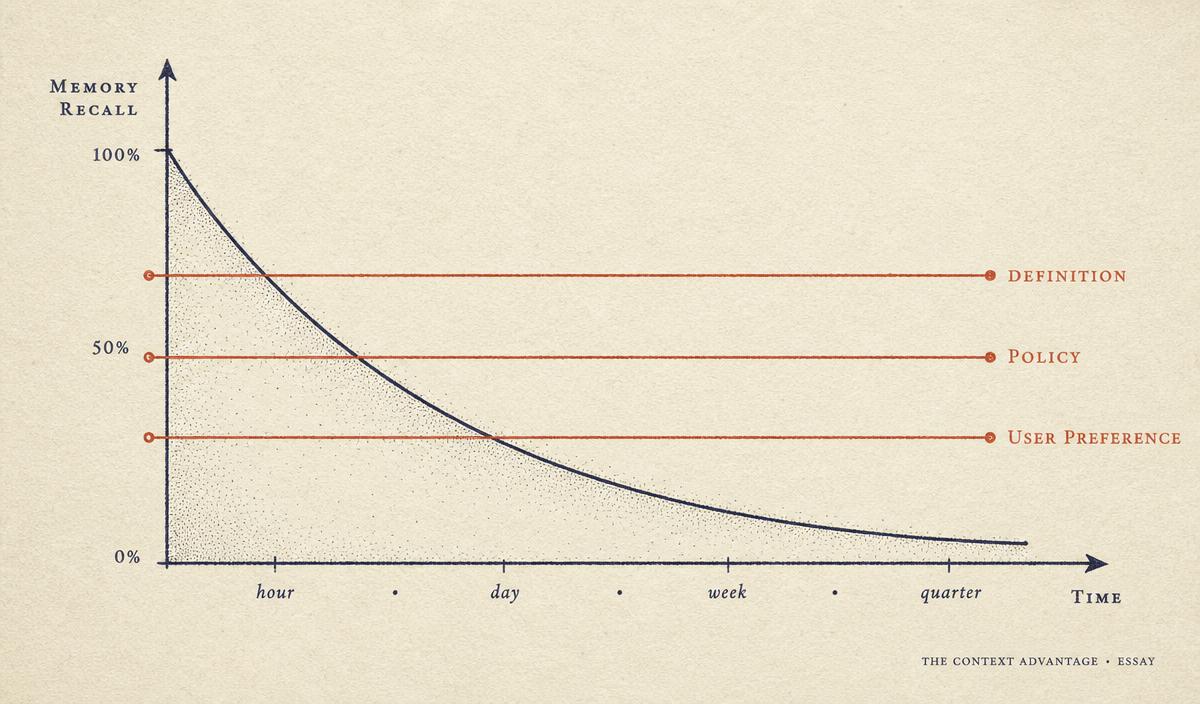
Human brains solve this with a forgetting curve. Most of what you experience today will be gone by next week unless something rehearses it. The things that survive are the things you revisit, the things that connect to what you already know, and the things that carry emotional weight. Agent memory needs the same discipline. Every episode should decay unless something promotes it. Every semantic fact should have a freshness stamp. Every procedural pattern should be reviewable and revocable.
The exceptions are the pins. A handful of facts should never decay — the definition of "active customer," the escalation policy, the user's stated preference to receive answers in bullet points. Those are the load-bearing beams of the memory system, and they should be explicit, versioned, and treated more like code than like data. Chapter 6Chapter 6 · 6 min LockedBusiness Meaning Beats Raw RetrievalNaive RAG is not a context strategy. is the treatment of definitions as first-class artifacts.
Memory is where trust actually lives
There is a deeper reason memory matters that has nothing to do with convenience. Trust in an AI system is not a property of a single answer. It is a property of a relationship. And relationships require memory on both sides.
When a user corrects an agent — "that was wrong, the customer is on the enterprise plan" — a memoryless system nods and forgets. A memoryful system writes it down, and the next time it retrieves that customer, the correction is in the context. The user learns, over weeks, that corrections stick. That is the moment the tool becomes a teammate. Without a write loop that survives sessions, that moment never arrives.
The same logic applies to citations, undo, and evals. A citation is a memory of where an answer came from. An undo is a memory of what changed. An eval is a memory of what a good answer looks like for this workflow. The trust surface — the primitives we describe in Chapter 23Chapter 23 · 5 min LockedOpen Formats, Open Interfaces, Open ThinkingWhy openness is a strategic moat. and Chapter 30Chapter 30 · 7 min LockedThe Trusted Agent ArchitectureA nine-step end-to-end reference architecture for production agents. — is really the memory surface, wearing different clothes.
The organizational memory you already own
Here is the encouraging half of the argument. Your company does not need to invent memory from scratch. It has been building organizational memory for four decades under other names, and most of it is still sitting there unused.
The CRM is memory about customers. The ERP is memory about transactions. The warehouse is memory about the business. The wiki is memory about how work is done. Git is memory about how the product evolved. The ticketing system is memory about what broke and how it was fixed. The semantic layer is memory about what things mean. None of these were designed for agents, which is why almost none of them are wired into your agent stack.
The team that closes the memory gap fastest is not the one that stands up a new vector database. It is the one that treats these existing systems as memory tiers — cold storage for episodes, warm storage for semantics — and builds the write loop that reads from them, distills what matters, and writes back what it learned. Chapter 7Chapter 7 · 7 min LockedSemantic Layers, Ontologies, and Metrics in Simple WordsThe big context words, explained without the jargon. is the reference wiring.
Why memory is a moat and model choice is not
The strategic case for treating memory as core infrastructure is that it is one of the few things in an AI stack that actually compounds. Model choice does not compound — you pick a model this quarter, your competitor picks the same one next quarter, and the advantage evaporates. Prompt libraries do not compound — the best prompts leak within weeks. Even fine-tunes rarely compound, because the base model shifts underneath them.
Memory compounds because it is downstream of everything your company does. Every meeting, every ticket, every deployment, every correction, every eval failure is a potential entry in the memory system. A team that captures those entries is running a system that is sharper this week than it was last week and will be sharper next week than it is now. A competitor calling the same model API cannot copy that. They would have to copy your history, and history is the one thing you get to keep.
This is why we call it the Context Advantage in Chapter 4Chapter 4 · 7 min LockedThe 4 C's FrameworkA simple lens for designing trusted enterprise AI. and why the moat is not on the model — it is on the memory the model gets to read and write. Chapter 25Chapter 25 · 6 min LockedPlatform Independent, Platform AwareLearn the concepts. Map them to Databricks, Snowflake, AWS, Azure, GCP, and open source. and Chapter 26Chapter 26 · 6 min LockedThe Agentic Data ProfessionalHow your role evolves in the next five years. trace the compounding mechanics loop by loop.
What to build this quarter
You will not ship a full memory architecture in a sprint. You can, however, ship the first useful tier in a week. Pick one workflow — a support agent, a sales research agent, an internal analytics assistant — and give it three things it did not have yesterday.
First, an episodic log. Every interaction, every tool call, every user correction, timestamped and retrievable by user and by entity. Second, a small pinned semantic store — the ten definitions, five policies, and three user preferences the agent must never forget. Version them like code. Third, a write loop. When the user corrects the agent, the correction lands in the log and, if it matches a pinned entry, updates the semantic store with an approval step.
That is the smallest useful memory system. It is also the seed of the moat. Six months of running that loop on one workflow will teach you more about your organization's knowledge than any consulting engagement. Chapter 21Chapter 21 · 6 min LockedQuality, Speed, and Cost TradeoffsHow to balance accuracy, latency, and spend. is the playbook for the role that owns this work. Chapter 29Chapter 29 · 6 min LockedCareer Roadmap for the Agentic EraLearning paths for beginners, intermediates, and senior professionals. maps the career path for the people doing it.
The teammate you are actually trying to build
If you strip away the vocabulary — agents, RAG, tools, harness — what enterprises are trying to build is not that exotic. It is a colleague. A colleague who remembers the last meeting. A colleague who does not need the definition of "active customer" re-explained every morning. A colleague who gets a little better every week because they were paying attention.
You cannot get to colleague from stateless. You can only get there through memory. The teams that internalize this in 2026 will pull away from the teams still treating memory as a nice-to-have — quietly at first, and then all at once. The frontier model your competitor uses is the same one available to you. The frontier memory is not.
If you want the long-form playbook — the memory architectures, the retrieval patterns, the trust surfaces, the eval harnesses, and the organizational moves that turn a raw model into a compounding teammate — read The Context Advantage at https://thecontextadvantage.com/context-advantage, or unlock the full book at /context-advantage/buy.
"Intelligence lives on the frontier model. Memory lives with you. Only one of those compounds."
Try this at work
- Pick one live agent and audit which of the four memory tiers — working, episodic, semantic, procedural — it actually has. Ship the smallest missing tier this month.
- Draw your agent's write loop end to end. If corrections do not survive the session, you have retrieval, not memory. Fix that first.
- Name the ten definitions, five policies, and three user preferences your agent must never forget. Version them like code and pin them in a semantic store.
- Add a decay policy to your episodic log. A memory system that keeps everything retrieves nothing useful.
- Wire one existing system — CRM, wiki, warehouse, ticketing — into the agent as a memory tier this quarter. You already paid for it.
The Context Advantage is a book about the layer that turns a raw model into a compounding teammate — memory, retrieval, tools, trust, and the organizational moves that make them stick. Start free at [/context-advantage/blog](/context-advantage/blog), or unlock the full book at [/context-advantage/buy](/context-advantage/buy).
Explore the book →If your best AI agent lost every memory tonight and had to start tomorrow as a stranger, how much of the advantage you have built in the last six months would survive the reset?