The update, in one line
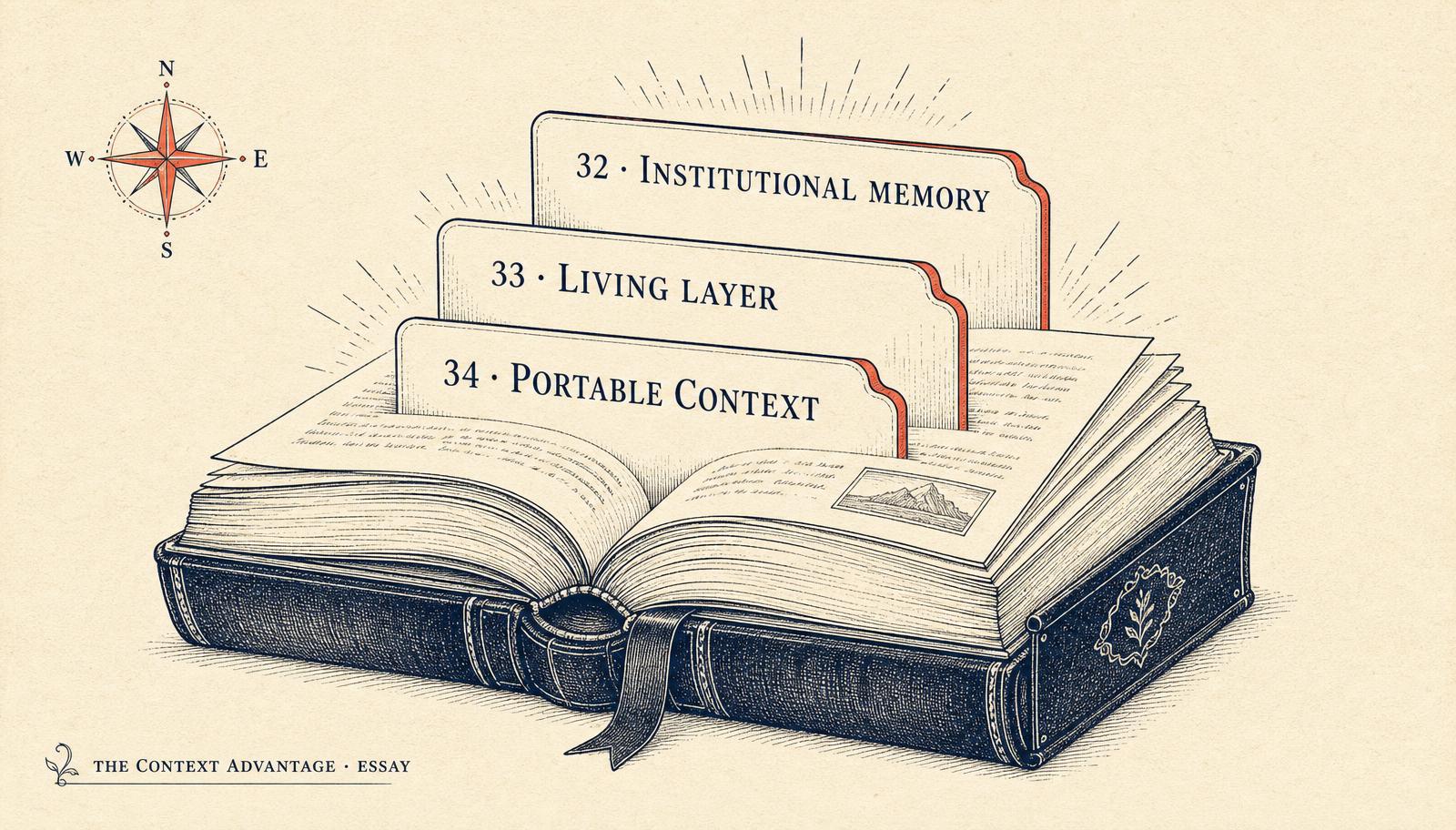
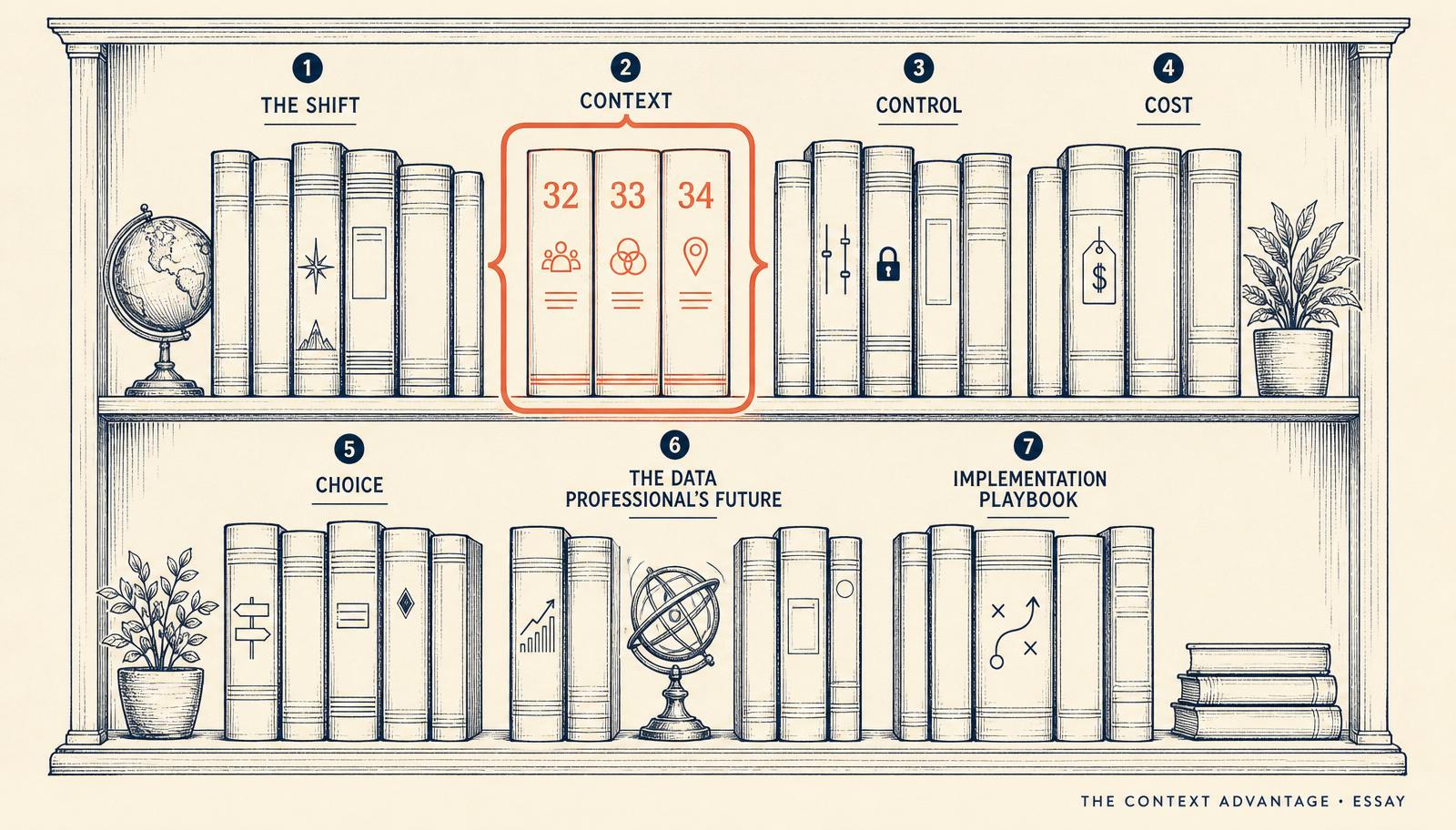
The Context Advantage is now a thirty-four chapter book. Three new chapters land inside Part 2, the Context part, and together they answer a question the first edition circled but never named: once the frontier models converge, what is left for a company to actually own?
The short answer is context. The longer answer is the three chapters we just shipped.
Why we added them now
Over the last two quarters, three patterns kept surfacing in reader questions, executive briefings, and every serious enterprise AI conversation we sat in on.
The first pattern: teams with equivalent tooling, equivalent budgets, and access to the same frontier models were getting dramatically different results in production. The gap did not track with model choice or vector database. It tracked with how carefully the team had captured the why behind their data.
The second pattern: context layers that were correct at launch became quietly wrong within a quarter. Definitions drift. Segments get renamed. A macro shift changes what "top customer" means. Nobody updates the context, and the agent slowly hallucinates itself into an incident.
The third pattern: buyers who had made a strong bet on one model or one agent framework were discovering that their real intellectual property — the accumulated organizational context — was trapped inside that vendor's prompt format, memory schema, or proprietary metric layer. They could not leave without rebuilding the moat from scratch.
One book update, three chapters, one theme: the moat is not the model. The moat is the context you accumulate, keep alive, and can carry with you.
Chapter 10 — Institutional Memory Is the Moat
As OpenAI, Anthropic, and Google converge on similar capabilities at similar price points, raw intelligence stops being a differentiator. What survives the churn is the accumulated why inside a company: decisions, definition history, org-specific logic, meeting notes, escalation traces, the reason "active customer" was redefined in Q3.
Chapter 10 argues that this institutional memory is the trillion-dollar layer nobody put on the architecture diagram. It shows how agents fail not because they hallucinate randomly, but because they hallucinate out of context — answering a question they never had enough organizational knowledge to answer correctly.
The chapter gives the four capture patterns that actually work in practice: decision logs bound to definitions, definition history as a first-class table, escalation traces as training data, and a role — the context steward — that owns the whole surface.
Chapter 11 — Context Is a Living Layer, Not a Document
Every failed context project we have looked at made the same mistake: it treated context as a static artifact. A prompt library. A wiki page. A one-time semantic layer configuration. Then the business moved on and the artifact quietly went out of sync with reality.
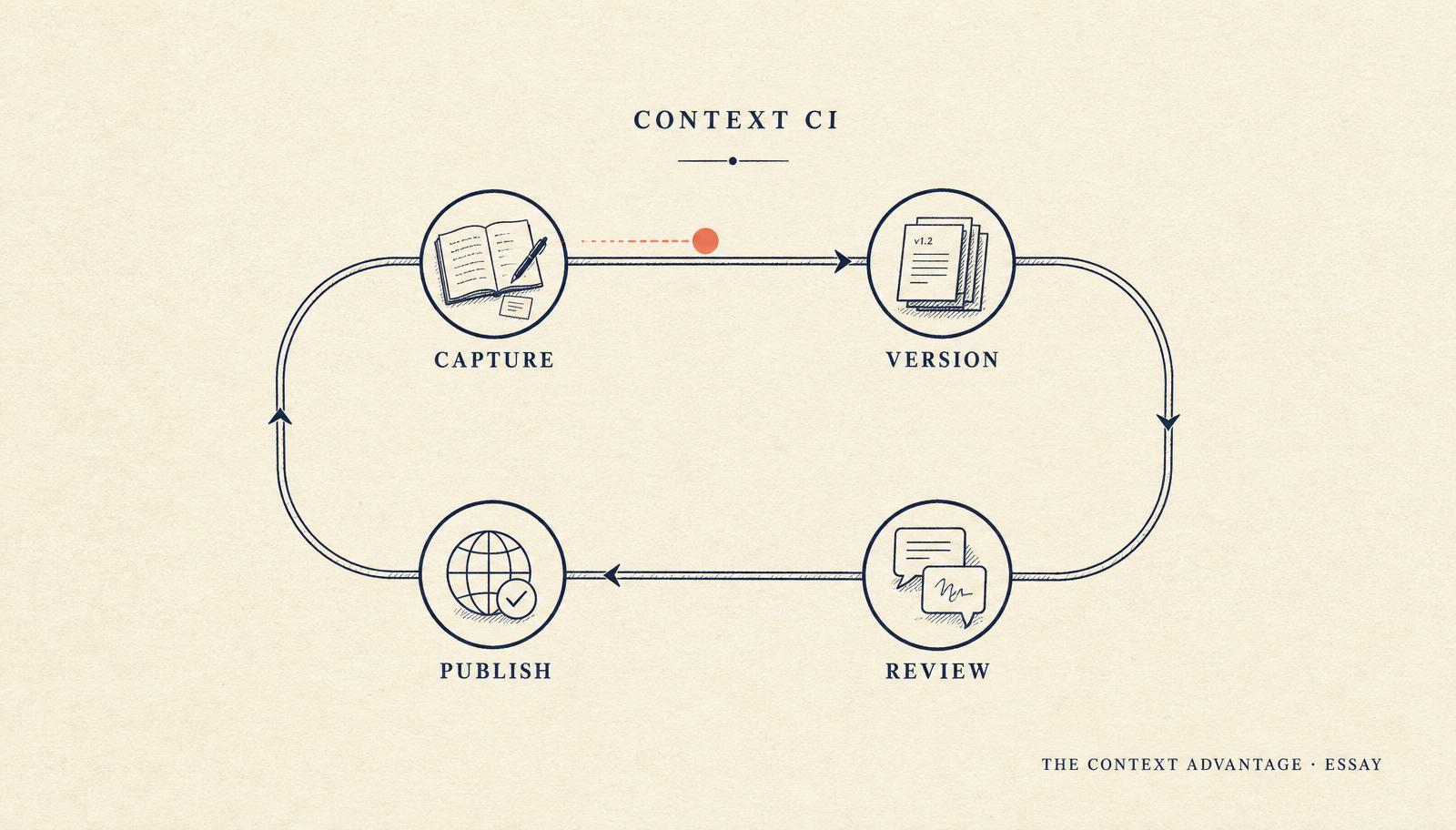
Chapter 11 introduces what we are calling Context CI — a continuous integration loop for meaning. Ownership, versioning, review, evals, and rollback for every business definition, policy, and decision rule the agent is allowed to use. Context is treated like code, because in an agentic system, it behaves like code.
The chapter includes the maturity ladder we use with reader teams and a rollout plan that gets a mid-size organization from static prompts to a versioned, evaluated, continuously-reviewed context layer in about two quarters.
Chapter 12 — Portable Context: The Open Contract for Agents
If context is your intellectual property, then locking it inside one vendor's runtime is a strategic error, not a convenience. Chapter 12 makes the case for portable context: an open contract that lets your definitions, decisions, and policies move across agents, models, and clouds without a rewrite.
The chapter walks through the emerging protocol layer — MCP, A2A, agent-to-agent contracts — and shows how to structure a context payload that any compliant runtime can consume. It ends with a portability audit you can run on your current stack in under an hour to see how deep the lock-in already goes.
This is the chapter buyers keep quoting back to us: "our context is our IP, and it needs to be able to leave."
What changed in the rest of the book
New chapters are the visible edit. The quieter edit is the deep-linking work we did across the older material to make the three new ideas load-bearing instead of bolted on.
Chapter 8 (From Data Catalog to Business Memory) now hands off directly into Chapter 10. Chapter 23 (Open Formats, Open Interfaces, Open Thinking) now sets up the portability argument that Chapter 12 completes. Chapter 25 (Platform Independent, Platform Aware) picks up the open-contract idea and maps it across Databricks, Snowflake, and the major clouds. Chapter 30 (The Trusted Agent Architecture) now names the context layer as a first-class component of the reference architecture. Chapter 32 (The 4 C's Readiness Assessment) added scoring items for institutional memory, context CI, and portability, so any reader running the assessment picks up the new dimensions automatically.
The pillar page for Context on the site was rewritten to lead with these three chapters. The changelog was updated. The table of contents on the site now shows all thirty-four chapters, grouped by part.
The through-line: the moat moved
Every serious data leader we spoke to this year said a version of the same sentence: the model is not the differentiator anymore. Access is table stakes. Latency is a solved problem for most workloads. Even reasoning quality is converging faster than most buyers can retool.
What is not converging is the ability of a system to act correctly inside your specific company. That capability lives in a layer nobody has been managing well — the layer between raw data and model output, where a company's meaning, policy, and history live. When that layer is thin, agents look impressive in a demo and fail in production. When it is thick, versioned, and portable, agents compound.
The three new chapters name that layer, describe how to keep it alive, and argue that it must be portable. That is the update.
Where to start if you already own the book
Open the reader and jump straight to Chapter 10. Read the three new chapters in order. They are designed to be read as a trilogy — each one leaves an unanswered question that the next one picks up.
Then re-run the readiness assessment in Chapter 32. The rubric now includes scoring items for institutional memory capture, context CI maturity, and portability. Most teams score noticeably lower on the new dimensions than they did on the original four C's — that gap is where the next two quarters of work sits.
Where to start if you have not read the book yet
Chapters 1, 2, and 3 are free in the reader. They set up the shift from model-first thinking to context-first thinking. Chapter 4 introduces the 4 C's framework — Context, Control, Cost, and Choice — which is the spine of everything that follows.
From there, Part 2 is where the new material lives. If you have thirty minutes this week, read Chapter 5, then jump ahead to Chapter 10. Those two chapters, back to back, are the fastest way to understand why the market is repricing the moat.
"The bottleneck is no longer model capability or data volume. It is the absence of a structured, governed, and continuously updated context layer that encodes organizational meaning."
Try this at work
- Read Chapter 10 to name your institutional memory surface.
- Read Chapter 11 to design the Context CI loop that keeps it alive.
- Read Chapter 12 to check whether your context can leave the vendor you are on.
- Re-run the Chapter 32 readiness assessment against the new scoring items.
- Book a thirty-minute review with your data leadership using the three new chapters as the agenda.
The Context Advantage is now thirty-four chapters. Lifetime access, three devices, every future update included.
Explore the book →If your top model vendor doubled prices tomorrow, could you carry your organizational context to a different runtime in a week — or would you have to rebuild it?