1. The forwarded headline
It usually arrives on a Monday. An executive forwards an announcement with a single line on top: can we do this? The announcement describes an agent that writes most of its own code, or answers any question about company data in plain English, or runs a workflow end to end without a human. The demo is impressive. The benchmark number is high. The planning meeting that follows is predictable.
Here is the pattern we keep seeing, described as an illustrative composite rather than any single company. A team wires the new capability into a pilot. The first two weeks look great. By the fourth week the agent is quoting a revenue definition finance retired last quarter, attempting an action it should never have been allowed to take, and costing more per task than the analyst it was meant to help. Nobody did anything wrong. The model was fine. The organization around it was not ready.
This essay is our view on how to read that news. It is opinion and analysis written from the perspective of The Context Advantage, not reporting on any specific product. Where we mention companies or products, we do so only to identify the category being discussed.
2. Why the model is rarely the bottleneck
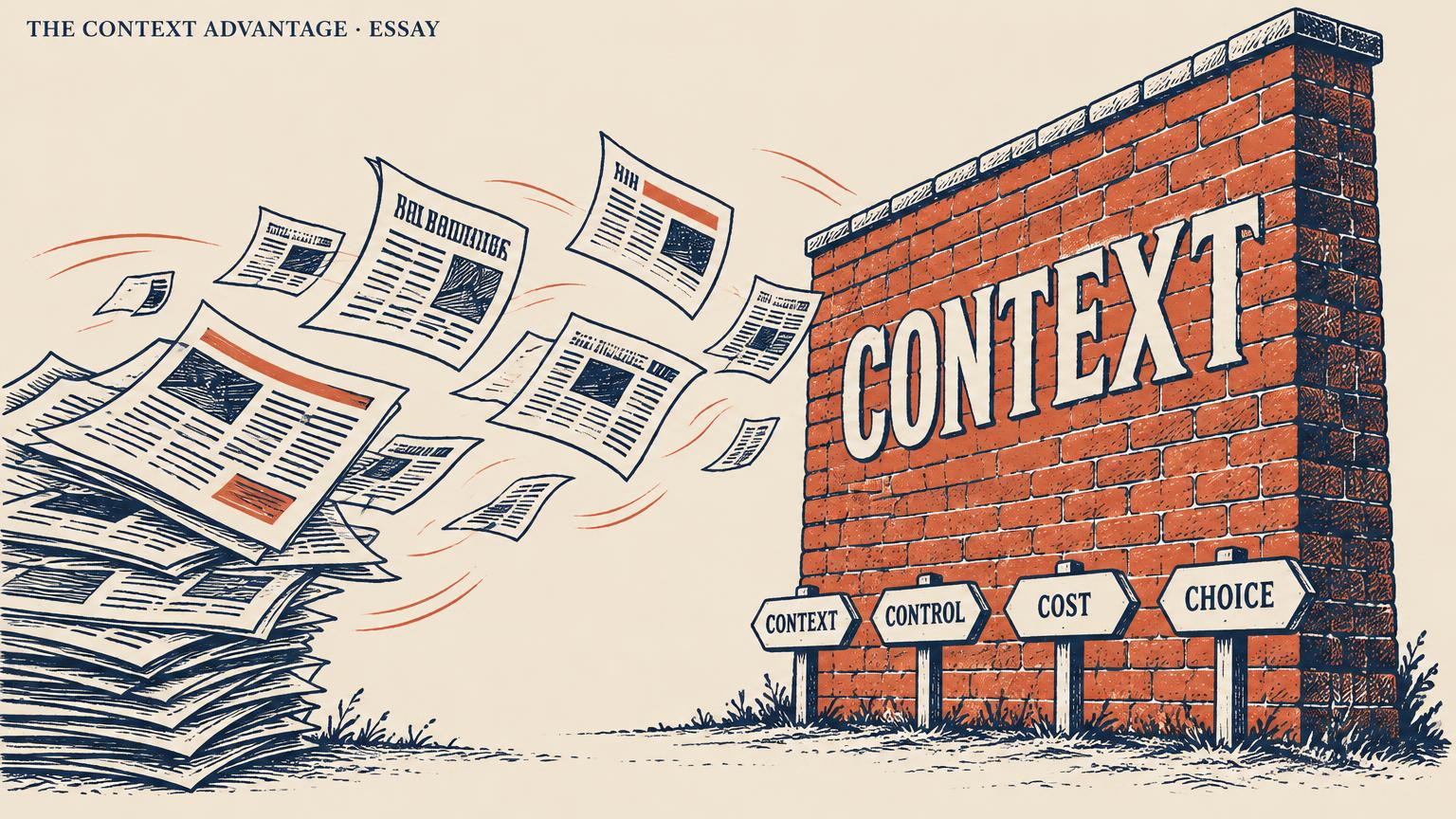
Model capability has improved faster than almost anyone predicted, and that is genuinely good news. But capability is measured in clean conditions: a public benchmark, a curated demo dataset, a task with an unambiguous right answer. Enterprise work is none of those things. It is full of private definitions, unwritten exceptions, permissions that differ by role, and facts that changed last Tuesday.
We call this the gap between what the model knows and what the organization knows, and Chapter 1 makes the case that closing it is the real work of enterprise AI. A better model narrows the reasoning gap. It does nothing for the knowledge gap. Your fiscal calendar, your approval thresholds, and your customer tiers are not in any training set, and they should not be.
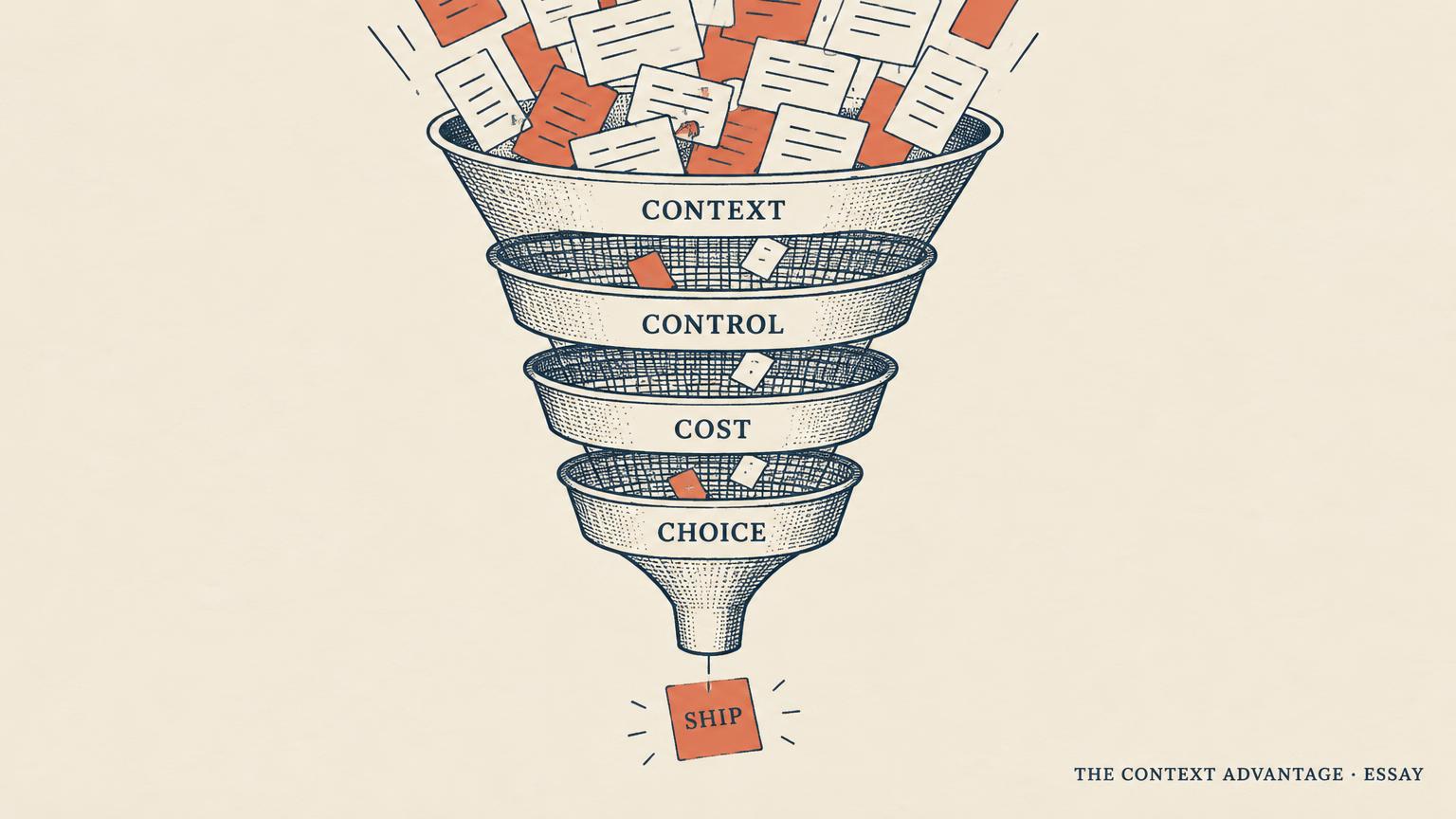
So when a headline says a model now scores higher on a reasoning test, the honest translation for an enterprise team is: the ceiling went up. Whether you reach that ceiling depends on the context you supply, the controls you enforce, the costs you can sustain, and the choices you keep open. Those are the 4 C's, and The 4 C's of Enterprise AI explains why they survive every model release.
3. The Context check, connected is not the same as understood
The most common announcement in Data and AI right now is some version of: point the agent at your data and ask anything. Connectivity is useful, and it is also the easy part. A table named orders_v3_final tells a model almost nothing about which orders count as revenue, which are test records, and which region owns the exception.
Context is the layer that turns raw access into understanding: governed definitions, lineage, ownership, freshness, and the business rules a new employee would learn in their first month. Chapter 5 covers the semantic layer, Chapter 35 covers retrieval mechanics, and Chapter 36 covers why a curated working context beats a giant window. Our recent essay on context compaction goes deeper on that last point.
The question to ask of any headline is simple. Where does the agent learn what our words mean? If the answer is the model will figure it out, the pilot will work on clean examples and drift on real ones, exactly as Semantic Drift describes.
4. The Control check, autonomy needs a perimeter
The second wave of headlines celebrates autonomy: agents that take actions, call tools, and chain tasks without asking. Autonomy is where the value is, and it is also where the risk concentrates. An agent that can read a table is an analyst. An agent that can update one is an employee, and employees have job descriptions, permissions, and managers.
Before adopting any autonomous capability, ask what the agent is allowed to do, under whose identity, and what stops it when something goes wrong. Chapter 15 and Chapter 16 cover guardrails and governance. Our essays on agent identity, the blast radius, and circuit breakers turn those principles into patterns.
A good rule of thumb: if an announcement does not explain how actions are scoped, logged, and reversible, that is not a reason to reject it. It is a list of work your team will have to do before it is safe to use.
5. The Cost check, the demo price is not the production price
Announcements often lead with falling prices per token. That trend is real, and it is also misleading on its own. Agentic work multiplies tokens. A single task can involve planning, several tool calls, retries, verification, and long histories re-sent on every turn. The price of one call fell. The number of calls per outcome rose.
The metric that matters is cost per correct outcome, not cost per token. Chapter 17 frames this as a compute and latency budget, and Chapter 18 covers unit economics. Cheaper Tokens Will Not Save Your AI Budget and The Shadow AI Bill show how spending hides once pilots spread.
When a headline promises lower cost, ask what a full task costs at production volume, including retries and the human review your risk policy requires. If nobody can estimate it, the business case is not ready yet.
6. The Choice check, every bundle is also a lock
Many announcements bundle the model, the orchestration, the memory, and the data platform into one convenient package. Convenience is valuable, especially early. But a bundle quietly decides where your prompts, evaluations, tool definitions, and accumulated context live, and those assets are what make leaving expensive.
Choice does not mean refusing platforms. It means keeping your context portable and your models swappable so the next announcement is an option rather than a migration. Chapter 19 covers model portability and Chapter 12 covers portable context. The Exit Test and The Model Router offer practical ways to stay flexible.
Ask of any headline: if a better option appears in six months, what would we have to rebuild? The smaller that answer, the safer the adoption.
7. How we write about news, and how you can too
Because this blog comments on an industry full of brands and fast-moving claims, we hold ourselves to a few rules, and we recommend them to any team publishing internal or external AI commentary.
First, opinion is labelled as opinion. We analyse patterns and architecture, and we do not present guesses about a company's roadmap or performance as fact. Second, we do not reproduce press releases, paywalled articles, or long quotes. We summarise in our own words, link to the original source when we rely on it, and keep any quotation short and attributed. Third, product and company names are used only to identify what we are discussing. They belong to their owners, and mentioning them implies no affiliation, sponsorship, or endorsement. Fourth, we do not publish benchmark numbers or customer results we have not verified. When we tell a story to illustrate a point, as in the opening of this essay, we say it is illustrative.
These rules are not legal advice, and teams with specific concerns should talk to their own counsel. They are simply good editorial hygiene, and they make the writing more useful, because analysis that survives the next announcement is worth more than a summary of the last one.
8. Turning headlines into roadmap decisions
The goal is not to ignore news. Some announcements genuinely change what is possible, and teams that dismiss everything fall behind. The goal is to translate each headline into the work it implies for your organization.
In practice that means a short written note for any announcement that reaches a planning meeting: what capability changed, which of the 4 C's it affects, what context or controls we would need to add, a rough production cost per outcome, and what we would lose if we later switched. Teams that do this consistently stop chasing demos and start compounding. Chapter 29 covers the operating model, and Chapter 33 covers how context stays a living layer as tools change around it.
This is also a career skill. The data engineers who become trusted context engineers are the ones who can calmly explain what a headline means for this company, this quarter. The Context Engineer Job Description describes that role in more detail.
9. The headline filter checklist
Use these ten questions whenever an AI announcement lands in your inbox:
1. What specific capability changed, in one sentence, without the marketing adjectives?
2. Was it demonstrated on public benchmarks, curated demos, or real messy enterprise data?
3. Where would the agent learn our definitions, rules, and exceptions?
4. How fresh is that context, and who owns keeping it correct?
5. What actions could the agent take, under whose identity, and are they reversible?
6. What stops it, and who is alerted, when it is wrong?
7. What is the estimated cost per correct outcome at production volume, including retries and review?
8. Where would our prompts, evaluations, and context live, and could we export them?
9. What would we need to rebuild if a better option appeared in six months?
10. Which evaluation would prove it works for us before we scale it?
If your team can answer these, you are ready to adopt the news. If you cannot, you have found your real roadmap. To practise these skills in a structured way, explore the book or try the Context Engineer practice exam.
"A headline tells you what a model can do. Only your context tells you what it will do for you."