1. The job posting that did not exist two years ago
Every data team already has someone doing context engineering. The work just has not been given a clean job description. It lives between tickets, inside prompt reviews, in the person who knows why the assistant gave one answer in March and a different answer in May, and in the engineer who keeps getting pulled into meetings because the agent is technically working but somehow still wrong.
That informal arrangement is now too expensive. Once agents answer customers, reconcile finance data, route tickets, and prepare decisions, context stops being a prompt detail. It becomes production infrastructure. Somebody has to own the definitions, retrieval, memory, permissions, evaluation, and cost envelope as one system. That somebody is the context engineer.
The mistake is to write the posting as if this were a prompt engineering role with a newer label. Prompt wording is part of the job, but it is the smallest part. The real job is to turn business meaning into machine-usable context, then prove that the resulting system is accurate, safe, affordable, and changeable. That is why the role belongs beside data engineering and analytics engineering, not inside a growth experiment or a chatbot team. Chapter 9Chapter 9 · 6 min LockedThe Context EngineerA new role at the heart of agentic systems. introduced the role, and this essay turns it into something a team can actually hire against.
2. The one-sentence job description
Here is the shortest useful version: the context engineer designs, builds, evaluates, and maintains the layer that lets AI systems understand the business, retrieve the right knowledge, act within the right limits, and improve from evidence.
Every clause matters. Designs, because the layer has to be intentional rather than accumulated. Builds, because this is engineering work and not advisory work. Evaluates, because a context system without a measurement loop is a belief system. Maintains, because context decays faster than code. And the object of the job is not the model. It is the layer around the model.
That is also why the role maps so cleanly onto the 4 C's. Context is the raw material. Control is the boundary. Cost is the operating constraint. Choice is the escape hatch. A good context engineer touches all four every week. Chapter 4Chapter 4 · 7 min LockedThe 4 C's FrameworkA simple lens for designing trusted enterprise AI. lays out the framework, and the rest of the book is essentially the expanded job description.
3. What the role owns
The cleanest way to define the role is by artifacts. A context engineer owns the semantic definitions that tell the system what the business means, the retrieval design that decides what enters the working set, the memory policy that decides what persists, the evaluation set that decides what good means, and the operational constraints that decide what the agent may do and what the run may cost.
In practice that means the role owns a surprising amount of territory. A metric definition that used to serve a dashboard now serves an agent. A document that used to sit in a knowledge base now needs freshness rules, provenance, and a reason to be retrieved. A tool description that used to be a developer convenience now determines whether an agent acts safely. A cost dashboard that used to be finance reporting now shapes the architecture itself. Chapter 5Chapter 5 · 7 min LockedContext Is the New Data LayerWhy meaning sits above storage and compute. explains why context is the new data layer, and Chapter 6Chapter 6 · 6 min LockedBusiness Meaning Beats Raw RetrievalNaive RAG is not a context strategy. explains why raw retrieval alone does not solve the meaning problem.
This is also where the career story becomes important. The role is not a rejection of data engineering or analytics engineering. It is the next form of both. The people best suited to it usually already know how data is modeled, how metrics drift, how definitions become political, and how production systems fail. What changes is the consumer. The consumer is now a model that must act on the meaning, not a human reading a chart.
4. A day in the life
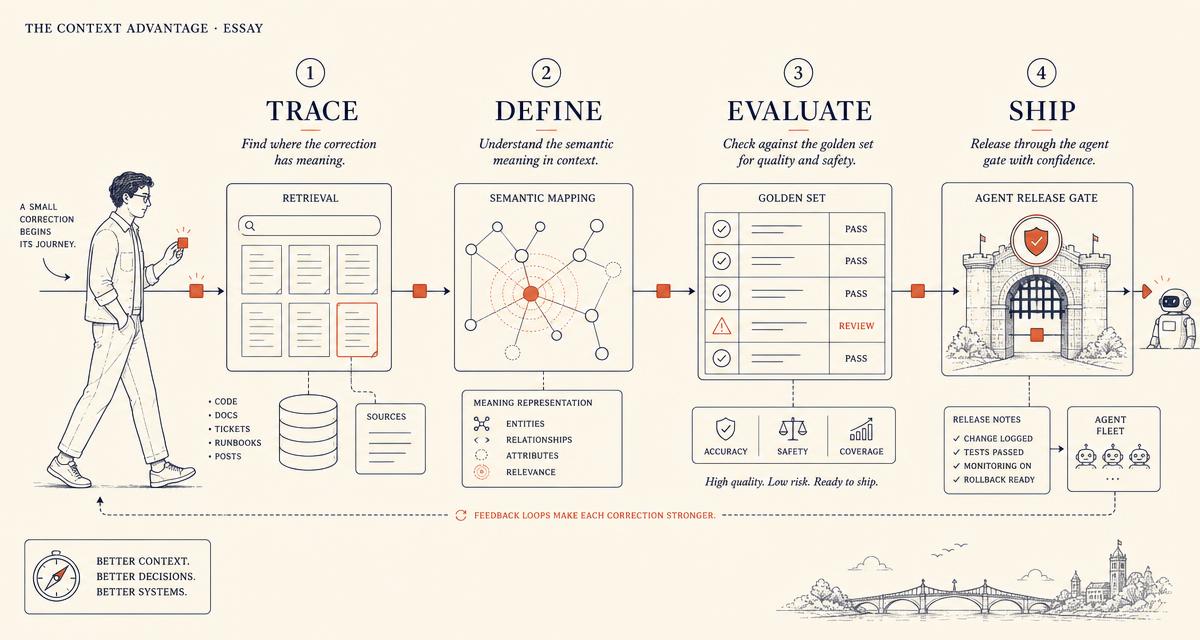
A realistic day starts with a failure report. An internal agent gave two different answers about renewal eligibility, or a customer-facing assistant cited a policy that was superseded in April. The context engineer traces the issue through the retrieval path, the source freshness, the definition layer, the prompt instructions, and the evaluation history. The point is not just to answer the ticket. The point is to identify which layer allowed the wrong answer to look plausible.
The next block of work is often definition work. A term such as active customer, qualified lead, or net revenue has three meanings across the company, and the agent has inherited all of them. The context engineer writes the canonical definition, records the exceptions, identifies the owner, and updates the retrieval pack or semantic mapping so the system stops guessing. This is why Chapter 8Chapter 8 · 8 min LockedFrom Data Catalog to Business MemoryCatalogs describe data. Memory describes meaning. on business memory matters so much: the agent does not need more documents. It needs the right memory in the right shape.
The afternoon may be evaluation and rollout. Add the failed case to the golden set. Re-run the suite. Narrow the retrieval scope. Adjust the budget. Check whether the new behavior raises cost without raising correctness. Then ship the change behind a gate, with release notes and rollback. This is why the role sits naturally near Chapter 31Chapter 31 · 7 min LockedBuilding Your First Context LayerA step-by-step practical guide from zero to a working layer in eight weeks. on building a first context layer and Chapter 32Chapter 32 · 6 min LockedThe 4 C's Readiness AssessmentA full scoring rubric you can run on any AI project or program. on readiness scoring. It is operational work with a paper trail.
5. The skill stack that matters
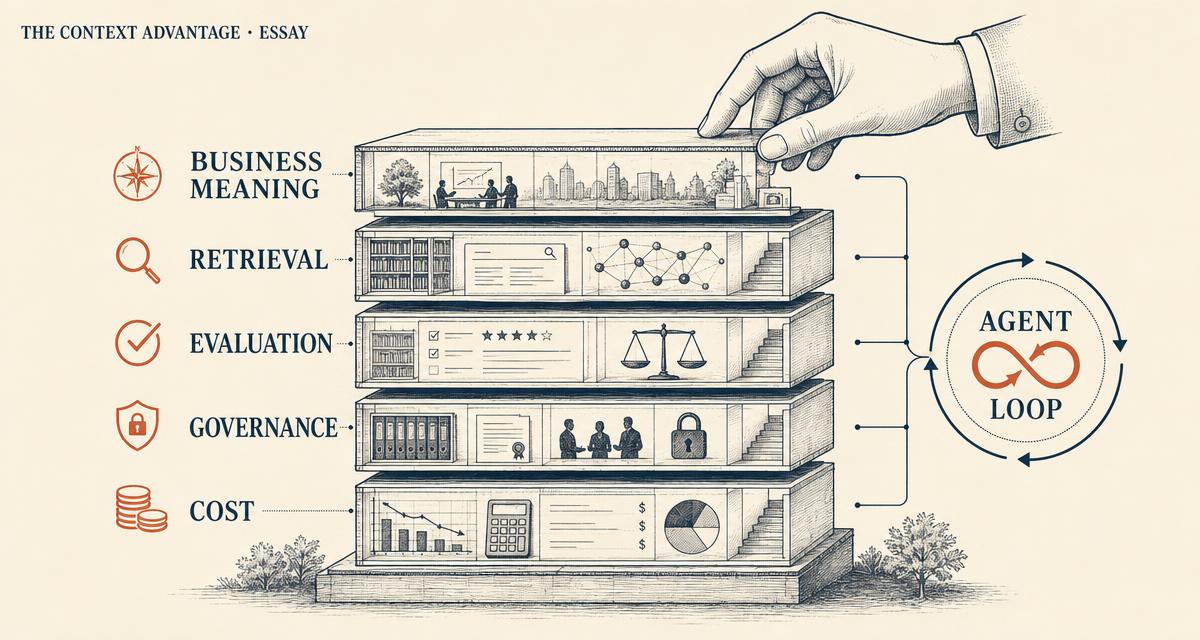
The strongest context engineers are not necessarily the strongest model whisperers. They are the people who can hold five layers in their head at once. The first layer is business meaning: definitions, exceptions, provenance, and the difference between a label and a decision. The second is retrieval: chunking, indexing, hybrid search, reranking, freshness, and source quality. The third is evaluation: golden sets, regression checks, judge calibration, and cost per correct answer.
The fourth layer is governance: access control, action control, approval boundaries, audit trails, and the ability to say no without stopping the program. The fifth is cost: token budgets, compaction, routing, and the discipline to ask whether a more capable model is buying outcomes or merely buying verbosity. Chapter 18Chapter 18 · 6 min LockedThe Hidden Cost of Agentic AIWhere the dollars actually go. through Chapter 21Chapter 21 · 6 min LockedQuality, Speed, and Cost TradeoffsHow to balance accuracy, latency, and spend. cover the economics, and Chapter 35Chapter 35 · 11 min LockedRetrieval Mechanics: Chunking, Hybrid Search, and RerankingThe engineering layer under every context strategy — chunking, hybrid search, reranking, and how to prove it works. and Chapter 36Chapter 36 · 10 min LockedCompaction and the Token BudgetBudget tokens like money, compact history without dropping commitments, and detect degradation before a user does. cover the retrieval and token mechanics in depth.
This stack explains why the role is such a strong career move. It is difficult to automate because it combines technical judgment with organizational judgment. A model can draft a definition or summarize a document. It cannot decide which definition the business should stand behind, which source is authoritative, which risk is acceptable, or which trade-off is worth paying for. Those are human responsibilities, and they are becoming more valuable, not less. Chapter 26Chapter 26 · 6 min LockedThe Agentic Data ProfessionalHow your role evolves in the next five years., Chapter 27Chapter 27 · 6 min LockedSkills That Will Matter More Than ToolsDurable skills that outlast every framework, model, and platform., and Chapter 29Chapter 29 · 6 min LockedCareer Roadmap for the Agentic EraLearning paths for beginners, intermediates, and senior professionals. make the broader career case.
6. What the role is not
It is not a prompt librarian. If the job can be done by collecting clever instructions in a shared document, the job has been scoped too small. Prompt quality matters, but prompt quality without retrieval design, evaluation, and governance is decoration.
It is not a machine-learning platform role either. The context engineer does not need to train foundation models, and most should not spend their time there. The leverage is in making any model useful inside a specific organization. That distinction matters because it keeps the role durable across model changes. The model provider can improve the engine without owning the meaning layer.
It is also not an everything role. If the posting asks one person to own data ingestion, application design, product strategy, legal review, prompt writing, analytics, security, and enablement, the organization has not hired a context engineer. It has written a wish list. The healthy version of the role has boundaries: own the context layer, partner deeply with platform and product teams, and make the interfaces explicit. Chapter 13Chapter 13 · 6 min LockedGovernance Was Built for Humans. Agents Need More.Access control is not action control. and Chapter 15Chapter 15 · 6 min LockedGuardrails, Approvals, and Audit TrailsDesigning safe agent behavior in practice. show why those boundaries matter once agents can act.
7. How to interview for it
Most interviews for this role fail because they test the wrong thing. They ask for model trivia, framework familiarity, or prompt tricks. Those are easy to rehearse and weakly correlated with the work. Better questions put the candidate inside an ambiguous context failure and watch how they reason.
Ask what they would do when an agent answers correctly in testing and incorrectly in production. Strong candidates reach for traces, source freshness, retrieval scope, definition ownership, and evaluation coverage before they reach for model swapping. Ask how they would make a term like customer health machine-usable. Strong candidates talk about inputs, exceptions, provenance, and consumer-specific context, not just a glossary entry. Ask how they would know whether a retrieval change improved the system. Strong candidates talk about golden sets, per-layer scoring, and regression gates.
The strongest signal is whether the candidate treats context as a production asset with owners, versions, tests, and budgets. The weakest signal is whether they describe context as a bag of documents. That one distinction tells you almost everything. For a practical screen, the context engineering interview questions page and the practice exam are useful starting points, especially when the team wants a shared bar rather than interviewer intuition.
8. How to become one without waiting for permission
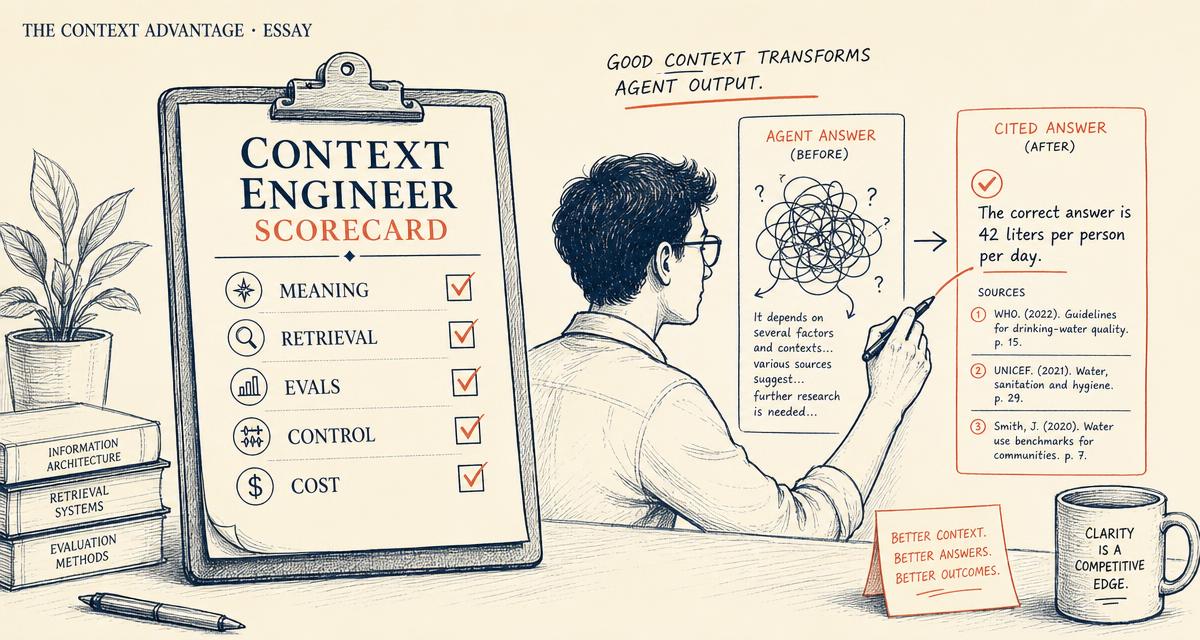
The path into the role is usually not a requisition. It is a series of visible repairs. Pick one recurring agent failure and trace it all the way through the context system. Write down the definition that was missing. Add the source that should have been retrieved. Add the eval case that would have caught the regression. Name the owner. Measure the cost before and after. That sequence is the job.
If you are a data engineer, your advantage is systems thinking. You already understand pipelines, quality, freshness, and operational pain. Move one layer up and make meaning machine-readable. If you are an analytics engineer, your advantage is business semantics. You already know how metrics become political. Move one layer down and learn the retrieval and evaluation mechanics. If you are a BI developer or solutions engineer, your advantage is proximity to the decision. Move toward the artifacts that decide what the agent knows and does.
The fastest portfolio is not a demo chatbot. It is a small context layer with evidence: one business domain, a handful of canonical definitions, a retrieval pack, a golden set, a regression report, and a cost envelope. That is exactly the thinking in the 30-day path from data engineer to context engineer, and it is the kind of proof hiring managers can trust because it resembles the work itself.
9. The job description template worth stealing
If you are writing the posting, keep it concrete. The role exists to design and operate the context layer for production AI systems. The responsibilities are to define business meaning, build retrieval and memory paths, create evaluation sets, set control boundaries, manage cost and latency budgets, and make changes safely through versioning, testing, and release gates.
The qualifications should read like engineering plus judgment. Strong experience in data or analytics engineering. Fluency with semantic modeling, retrieval systems, and evaluation design. Comfort working across product, operations, security, and finance. Ability to turn ambiguous business language into explicit artifacts. Ability to reason about cost and risk without losing sight of quality.
The success measures should be just as clear. Higher task success rate. Fewer repeated corrections. Lower cost per correct answer. Faster, safer model or vendor swaps. Better traceability from source to answer. More context changes shipped through a gate instead of a hope. Those outcomes are the real job description, because they connect the role to business value rather than to AI novelty. And if your organization is still deciding whether the role is real, run the 4 C's readiness assessmentChapter 32 · 6 min LockedThe 4 C's Readiness AssessmentA full scoring rubric you can run on any AI project or program. on one agent in production. The gaps will write the posting for you.
"A context engineer does not make the model sound smarter. They make the organization legible to the model, and the model accountable to the organization."
Try this at work
- Define the role as owner of the context layer, not as a prompt writer.
- Tie the job to artifacts: definitions, retrieval packs, memory policy, eval sets, gates, and budgets.
- Interview for judgment across meaning, retrieval, evaluation, control, and cost.
- Look for data or analytics engineers who already understand production failure modes.
- Give the first hire one domain, one agent, one golden set, and one measurable outcome.
- Measure success with task success, correction rate, cost per correct answer, and swap safety.
The Context Advantage treats this role as a first-class career path, from the role itself in [Chapter 9](/context-advantage/book/chapter-9) to the professional roadmap in [Chapter 26](/context-advantage/book/chapter-26), [Chapter 27](/context-advantage/book/chapter-27), and [Chapter 29](/context-advantage/book/chapter-29), plus the practical build chapters in [Chapter 31](/context-advantage/book/chapter-31) through [Chapter 36](/context-advantage/book/chapter-36).
Explore the book →If you had to hire for this role tomorrow, which part of the job would be hardest to find: the meaning work, the retrieval work, the evaluation work, or the judgment to balance all three?