You are closer than you think
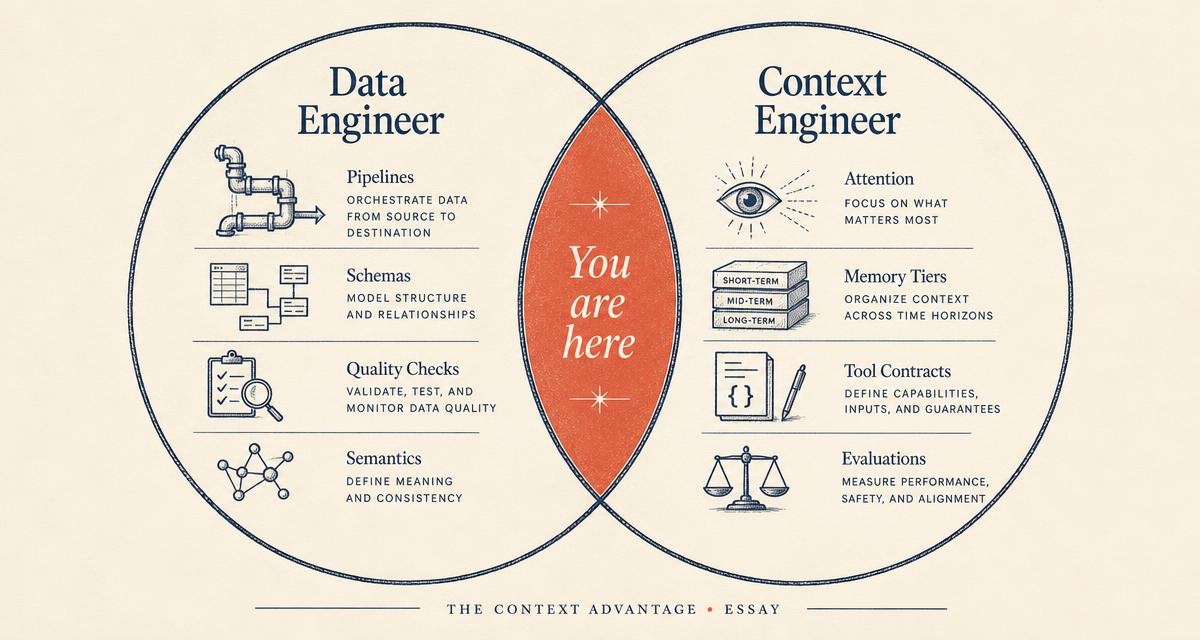
The first thing to understand about the move from data engineer to context engineer is that you are not starting over. You are already doing most of the work. The pipelines you build determine which facts are available. The schemas you maintain decide how those facts can be joined and questioned. The quality checks you write are the reason an agent can trust a row instead of hallucinating around it. The semantic definitions you argue about in Slack are the raw material of every correct answer an agent will ever give.
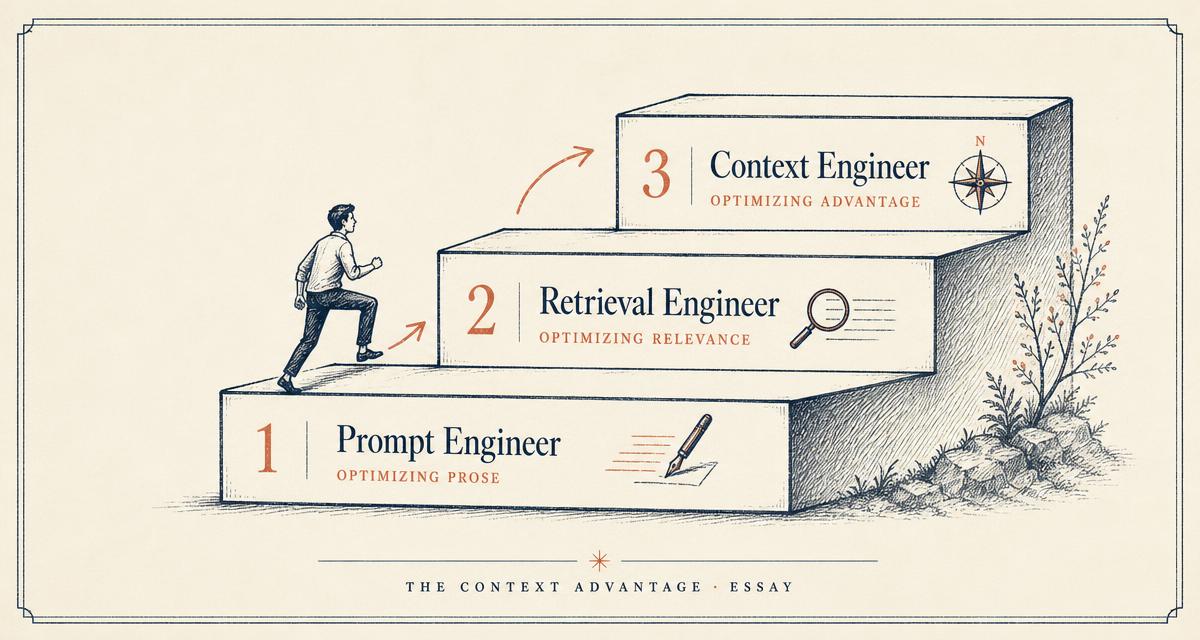
What changes is the lens. A data engineer asks: is the data correct, fresh, and available. A context engineer asks: given a finite window and a specific task, which subset of that correct, fresh, available data should be placed in front of the model, and how should it be arranged so the model uses it correctly. The first question is about supply. The second is about relevance under constraint. That is the whole shift.
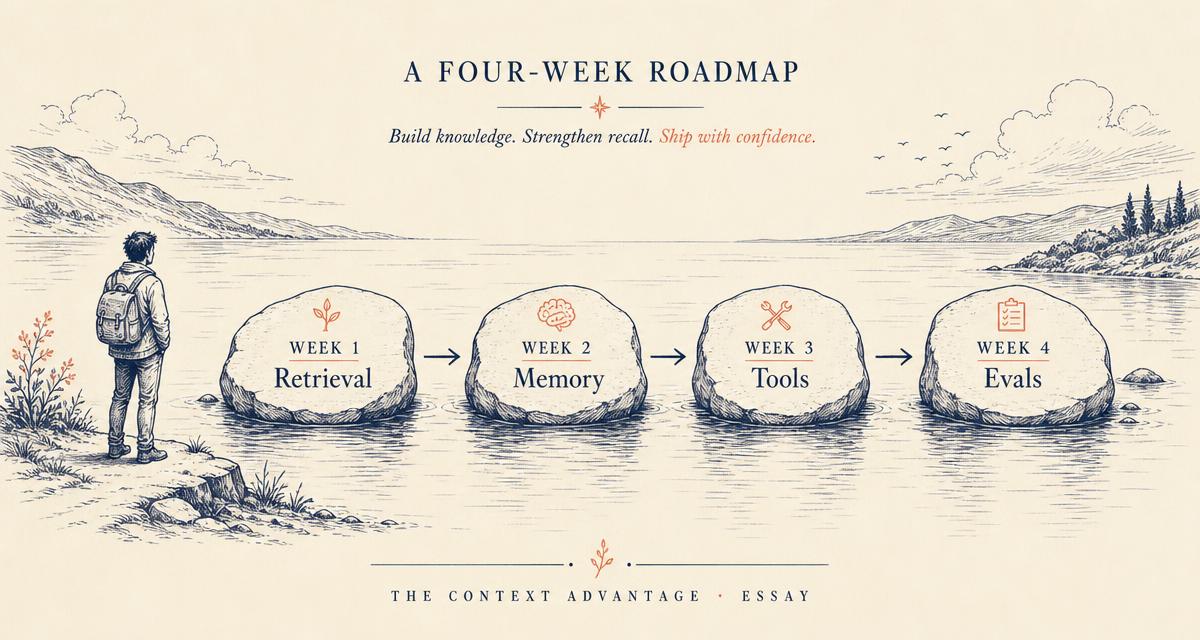
This is why the Databricks Certified Context Engineer Associate exam is not an alien credential. It is a credential built out of the same materials you already touch every day. The difference is that it tests whether you can reason about attention, memory, compaction, and tool contracts — not just about tables and partitions. This essay is a thirty-day plan to build that reasoning. At the end of it, you can take the free practice exam we built for the certification and use your score as a diagnostic for where to go next.
Week one: reframe retrieval as a product surface
Most data engineers treat retrieval as an infrastructure problem. Build the index, tune the chunk size, benchmark latency, move on. That is necessary work, but it is not sufficient for context engineering. The context engineer treats retrieval as a product surface: the user asked a question, and the answer they get depends on what the retrieval layer decided to show the model.
Start the week by picking one real question that an agent or assistant in your organization answers poorly. Trace it backward. What did the retrieval layer return? Was it the right document? Was it a stale version? Was it a chunk that cut a definition in half? Was the metadata so thin that the retriever had no way to know this row was authoritative and that row was a draft? Write down the failure mode in one sentence. That sentence is your first context-engineering diagnosis.
Then spend two days reading the retrieval chapters in the book. Chapter 7Chapter 7 · 7 min LockedSemantic Layers, Ontologies, and Metrics in Simple WordsThe big context words, explained without the jargon. explains why the semantic layer is the highest-leverage artifact in an AI program. Chapter 35Chapter 35 · 11 min LockedRetrieval Mechanics: Chunking, Hybrid Search, and RerankingThe engineering layer under every context strategy — chunking, hybrid search, reranking, and how to prove it works. covers the mechanics of hybrid search, reranking, and chunking. The point is not to memorize algorithms. The point is to see retrieval as a series of decisions about authority, freshness, and scope — decisions that currently live in code you already own.
By Friday, make one change to a retrieval pipeline you control. It can be small. Add a metadata field that marks a document as authoritative. Change the chunk boundary so definitions do not get split. Add a filter that excludes draft tables from the candidate set. The change itself matters less than the habit: you are now reasoning about what the model will see, not only about what the warehouse contains.
Week two: build memory and compaction intuition
Week two is about the part of context engineering that feels most foreign to data engineers: memory. Not database memory. Conversational and institutional memory. The accumulated state that lets an agent know what it learned yesterday, what the user prefers, and what the organization has already decided.
The mistake most people make is to assume more memory is better. It is not. An agent that remembers everything remembers badly. The skill is tiering. Working context is the current turn. Session memory spans the conversation. Durable cross-session memory persists preferences and entity state. A system of record is the production data the agent reads and writes. Each tier has different durability, latency, and cost characteristics, and putting information in the wrong tier is the fastest way to make an agent expensive and unreliable.
Spend Monday and Tuesday auditing one agent trace. Pick a conversation that went wrong after a few turns. Look at what was in the window at the moment of failure. Was the relevant fact missing because it had been compacted away? Was the window full of irrelevant memory records that drowned out the one that mattered? Was the agent using a stale preference because the durable memory had not been updated? Write the diagnosis in the same one-sentence format you used in week one.
Then read the memory chapters. Chapter 8Chapter 8 · 8 min LockedFrom Data Catalog to Business MemoryCatalogs describe data. Memory describes meaning. covers the architecture of memory. Chapter 10Chapter 10 · 9 min LockedInstitutional Memory Is the MoatAs frontier models converge, the durable advantage is the accumulated why — decisions, definition history, and organizational logic. explains institutional memory as a moat. Chapter 11Chapter 11 · 7 min LockedContext Is a Living Layer, Not a DocumentDefinitions drift, macro conditions shift, agents relearn — treat context like code, with ownership, versioning, and continuous review. argues that context is a living layer, not a static asset. By Friday, design a small compaction prompt for one of your agent workflows. The prompt should decide what to keep, what to summarize, and what to discard. Test it on three real traces and measure whether the post-compaction window still contains the facts needed for the next turn.
Week three: learn tool contracts and portability
Week three moves from what the model knows to what the model can do. Tools are the action surface of an agent, and tool contracts are the interface definitions that determine whether the agent can call the right thing, in the right way, at the right time. Bad tool contracts are the reason agents call the wrong function, pass malformed arguments, or loop forever between two tools that disagree about what a customer ID looks like.
A data engineer is already familiar with contracts. You write schemas, enforce types, and version APIs. Tool contracts are the same discipline applied to a model consumer. The description must be precise. The arguments must be unambiguous. The failure modes must be documented. The return shape must be predictable. If a tool description says "retrieves customer information," the model has no idea when to use it. If it says "returns the active subscription for a customer given a valid customer UUID, or an empty result if the customer has no active subscription," the model can reason about whether the call is relevant.
This week, read Chapter 13Chapter 13 · 6 min LockedGovernance Was Built for Humans. Agents Need More.Access control is not action control. on action control and Chapter 23Chapter 23 · 5 min LockedOpen Formats, Open Interfaces, Open ThinkingWhy openness is a strategic moat. on open protocols. Then audit the tool descriptions in one agent you have access to. For each tool, ask: does the description say what the tool does, when to use it, and what it returns? Does the argument schema eliminate ambiguity? Is there a documented error path? Rewrite the three worst descriptions. The improvement in agent behavior will be immediate and visible.
The second half of the week is about portability. The Model Context Protocol and the Agent-to-Agent protocol are not trivia. They are the standards that keep your tool contracts from becoming proprietary glue. A tool expressed in MCP can be called by a different runtime. An agent handoff expressed in A2A can be moved. That is what Chapter 22Chapter 22 · 5 min LockedThe Danger of AI Lock-InHow yesterday's choices limit tomorrow's options. means by choice as a moat. Spend Thursday and Friday identifying one vendor-specific tool contract in your stack and sketching what an MCP version of the same contract would look like.
Week four: run evaluations and tie them to outcomes
The final week is where most data engineers feel at home, because it is about measurement. Evaluations are the dashboards of the agentic era. They tell you whether the system is getting better or worse, and they force you to define "better" in a way that a business person can understand.
An evaluation is not a unit test. A unit test says: given this input, does the function return this output. An evaluation says: given this real task, does the agent produce an answer that is correct, useful, and aligned with what the organization would have wanted. That requires labeled examples, a rubric, and a way to attribute failure to the right layer. Sometimes the model is wrong. Sometimes the retrieval is wrong. Sometimes the tool contract is wrong. Sometimes the user asked the wrong question. An evaluation that cannot tell these apart is just a scoreboard.
Start the week by reading The Evals Are the New Dashboards essay and Chapter 30Chapter 30 · 7 min LockedThe Trusted Agent ArchitectureA nine-step end-to-end reference architecture for production agents. on observability and correctness. Then build a tiny evaluation set for one agent workflow. Ten examples is enough. For each example, write the input, the expected output, the rubric, and the layer where failure would most likely originate. Run the agent against the set. Score it. Look at the failures. You now have a baseline.
By Friday, make one improvement based on the evaluation results. Fix a retrieval filter. Update a tool description. Adjust a compaction prompt. Re-run the evaluation set. If the score moves, you have just done the core work of a context engineer: you diagnosed a context failure, intervened, and measured the result.
The three skills that separate the roles
Across the four weeks, three skills keep appearing. They are the difference between a data engineer who has learned some new vocabulary and a context engineer who can ship.
The first is attention budgeting. A data engineer thinks in rows and bytes. A context engineer thinks in attention. The same fact placed at the top of a long context, in the middle, or at the bottom can produce different answers. The position of information is part of its weight. This is the subject of Chapter 6Chapter 6 · 6 min LockedBusiness Meaning Beats Raw RetrievalNaive RAG is not a context strategy., and it is the reason token count is a poor proxy for context quality.
The second is semantic ownership. A data engineer maintains schemas. A context engineer owns the meaning that makes agents useful. That means deciding what a customer is, how revenue is calculated, which definitions are authoritative, and how contradictions between sources are resolved. Chapter 15Chapter 15 · 6 min LockedGuardrails, Approvals, and Audit TrailsDesigning safe agent behavior in practice. and Chapter 16Chapter 16 · 5 min LockedTrust Is Designed, Not AssumedHow leaders earn confidence in AI systems. make the case that this ownership is the highest-leverage work in enterprise AI.
The third is eval-driven iteration. A data engineer ships a pipeline and monitors it for failures. A context engineer ships a context change and measures whether the agent's answers improve. The loop is tighter, the feedback is noisier, and the metric is not uptime — it is correctness under uncertainty. This is what Chapter 30Chapter 30 · 7 min LockedThe Trusted Agent ArchitectureA nine-step end-to-end reference architecture for production agents. calls the correctness layer, and it is where context engineering becomes a craft.
How to prove the skill
Thirty days of focused practice will change how you see agentic systems. But you still need a way to signal the skill to a manager, a hiring committee, or yourself. That is where the certification and the practice exam come in.
The Databricks Certified Context Engineer Associate exam is a ninety-minute, forty-five-question assessment across seven domains. It is not a perfect measure, but it is the first widely recognized signal that a person can reason about context, not just about prompts. The registration fee is two hundred dollars. The credential is valid for two years. For many organizations, it will become the filter that separates "has read about agents" from "can work on agents."
We built a free, timed, forty-five-question practice exam that mirrors the real structure. It is delivered by email, and you can take it up to three times per day. The questions are independently written, so they are not leaked exam content. They are designed to test the same reasoning patterns the certification tests: diagnosing context failures, choosing the right retrieval strategy, placing information in the right memory tier, scoping tool access, and reasoning about cost under a budget. You can request your link at /practice/databricks-context-engineer-associate.
Use the practice exam twice during your thirty days. Once at the end of week two, to find your weak domains. Once at the end of week four, to confirm improvement. The score is less important than the diagnostic report, which tells you which chapters to revisit and which book sections to read next.
What to tell your manager
If you need permission to spend time on this transition, here is a one-paragraph narrative you can use. Say that you are moving from a data engineering focus to a context engineering focus. The business value is that your agentic projects will get more correct answers per dollar, with fewer governance surprises. The work uses the same pipelines and schemas you already maintain, but it applies them to a new surface: the window the model sees. Over the next thirty days you will improve retrieval, memory, tool contracts, and evaluations for one pilot workflow. At the end you will take the Databricks Context Engineer Associate practice exam to validate the skill.
That paragraph contains everything a good manager wants to hear. There is a clear business outcome. There is a defined time box. There is a connection to existing work. There is a measurable validation at the end. There is no request for a new hire, a new vendor, or a new budget.
The deeper argument is the one this book makes. Organizations that treat context as a first-class engineering discipline will build an advantage that compounds every time their people and agents learn. Organizations that treat it as a prompt-writing afterthought will pay the exploration tax forever. A data engineer who becomes a context engineer is not changing careers. They are moving to the part of the field where the leverage is highest.
The Monday move
You do not need to finish a course before you start. The Monday move is to pick one agentic workflow in your environment and ask a single question: what did the model see before it produced this answer. If you can answer that question, you are already thinking like a context engineer. If you cannot, you have found your first project.
The thirty-day plan is a scaffold. You can compress it, stretch it, or reorder it based on what is live in your environment. The important part is to stop treating agentic AI as a consumer of data and start treating it as a product surface that your data work already feeds. The pipelines, schemas, and quality checks you own are the foundation. The context layer is what you build on top of them.
The future belongs to context-rich companies, as the essay on that topic argues. But context-rich companies are built by context-rich individuals — people who can look at a window, a retrieval result, a memory record, and a tool contract and know whether the agent is about to get it right. That skill is learnable in thirty days. Start today.
"The jump from data engineer to context engineer is not a new degree. It is the decision to optimize what the model sees, not only what the warehouse contains."
Try this at work
- Pick one real agentic question your organization answers poorly and trace it backward through retrieval, memory, tools, and evaluation.
- Read the retrieval chapters this week and make one small change to a pipeline that affects what the model sees.
- Audit one agent trace for memory-tier mistakes and design a compaction prompt that preserves the facts the next turn needs.
- Rewrite the three worst tool descriptions in your stack and sketch what an MCP version of your most vendor-specific contract would look like.
- Build a ten-example evaluation set for one workflow, run it, and use the failures to choose your next intervention.
- Request the free Databricks Context Engineer Associate practice exam at [/practice/databricks-context-engineer-associate](/practice/databricks-context-engineer-associate) and use the diagnostic report to guide the rest of your study.
The Context Advantage is the long-form guide behind this transition — thirty-six chapters on Context, Control, Cost, and Choice, with the retrieval, memory, tool, and evaluation practices that turn a data engineer into a context engineer. Read the free chapters at [/context-advantage/book](/context-advantage/book), or unlock the full book at [/context-advantage/buy](/context-advantage/buy).
Explore the book →Which agentic workflow in your environment would change the most if the model simply saw the right context at the right time — and who currently owns that context?