A job title becomes a blueprint
For about three years, context engineering has been a thing people did without a name for it. Somebody on the data team quietly became the person who knew why the assistant answered correctly on Monday and wrongly on Thursday. That person tuned the retrieval, rewrote the system prompt, decided what the agent was allowed to remember, and argued with a vendor about why the tool descriptions were ambiguous. There was no title for it, no curriculum, and no way to hire for it except by looking at what somebody had already shipped.
Databricks has now written the name down. The Certified Context Engineer Associate exam is a proctored, ninety-minute, forty-five-question assessment with a published guide, seven scored domains, and a weighting that tells you exactly which parts of the discipline the industry believes are load-bearing. Whatever you think of certifications as a category, this one is worth reading closely, because it is the first serious attempt by a major platform to define the boundaries of the job.
And the boundaries are informative. The exam does not test prompt writing as a craft. It does not test model selection. It barely touches fine-tuning. What it tests, over and over, in different costumes, is one question: given a finite window and an infinite organization, what do you put in front of the model, and what do you leave out. That is the question this book was written around. Chapter 4Chapter 4 · 7 min LockedThe 4 C's FrameworkA simple lens for designing trusted enterprise AI. frames it as the central discipline of the agentic era, and the exam blueprint reads like an independent confirmation of the same thesis.

What the exam actually is
The facts first, because they are frequently misreported. The Databricks Certified Context Engineer Associate exam runs for ninety minutes and contains forty-five scored questions. It is delivered online with a proctor. The registration fee is two hundred United States dollars. The credential is valid for two years. There are no formal prerequisites, though the guide assumes working familiarity with the Databricks platform — Unity Catalog, Genie, Vector Search, Lakebase, MLflow, and the Model Context Protocol integration.
Ninety minutes for forty-five questions works out to two minutes per question, which sounds generous until you see the question style. These are not definition recall questions. The typical item describes an agent that is behaving badly — the answers drift after turn twelve, the retrieval returns plausible but stale rows, the sub-agents contradict each other — and asks you to identify the root cause or select the intervention that fixes it at the lowest cost. That is diagnostic reasoning under a clock, and two minutes goes quickly when the scenario is four sentences long and three of the four options are defensible.
The absence of prerequisites is deliberate and slightly misleading. Nothing stops a newcomer from registering. Very little in the blueprint can be learned without having watched a real agentic workflow fail in production at least a few times. The exam rewards scar tissue.
The seven domains and what the weights are telling you
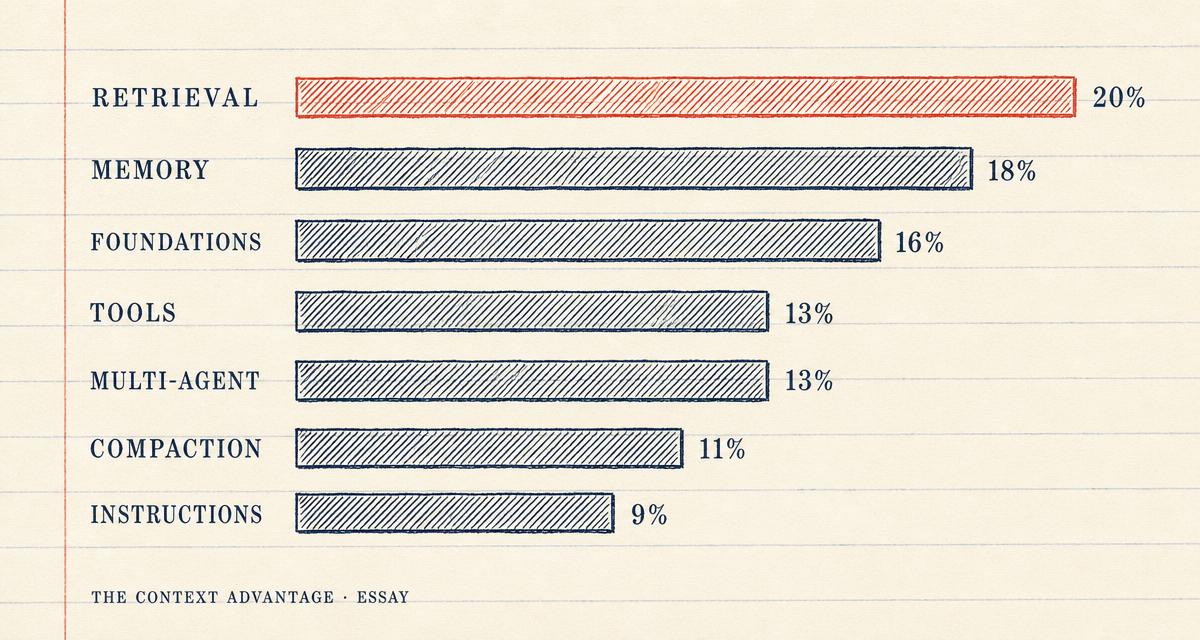
The scored content splits across seven domains. Retrieval carries twenty percent. Memory carries eighteen. Foundations of context engineering carries sixteen. Tools and the Model Context Protocol carry thirteen, as does multi-agent and long-horizon design. Compaction and compression carry eleven. System prompt and instruction design carries nine.
Read that distribution twice, because it contains an argument. The single largest block is retrieval, and the second largest is memory. Together they are thirty-eight percent of the exam — more than a third of the assessment is about deciding which information reaches the model and how it persists across time. Instruction design, the part of the discipline that most public discourse still treats as the whole discipline, is the smallest block on the sheet at nine percent.
That inversion is the story. The industry spent three years optimizing the wording of prompts and is now formally acknowledging that the wording was never the constraint. The constraint was, and remains, the pipeline behind the prompt. This is the exact claim Chapter 5Chapter 5 · 7 min LockedContext Is the New Data LayerWhy meaning sits above storage and compute. makes about the difference between prompt engineering and context engineering, and the one Chapter 6Chapter 6 · 6 min LockedBusiness Meaning Beats Raw RetrievalNaive RAG is not a context strategy. extends into business meaning that outperforms raw retrieval.
Domain one: foundations, and the four ways context fails
The foundations domain, at sixteen percent, is where the exam establishes its vocabulary. The most useful thing in it is a taxonomy of failure that every practitioner should be able to recite. Context poisoning is when an error enters the context and is then treated as ground truth by every subsequent turn, so the agent confidently compounds a mistake it made forty minutes ago. Context distraction is when the accumulated history grows so large that the model attends to the wrong parts of it and loses the thread of the actual task. Context confusion is when irrelevant material that happens to be superficially similar to the query crowds out the material that mattered. Context clash is when two pieces of information in the window contradict each other and the model silently picks one, usually the more recent one, without flagging the conflict.
Being able to name these is not academic. Each has a different fix. Poisoning is fixed by validating what enters the window and by giving the agent a way to mark a prior conclusion as retracted. Distraction is fixed by compaction and by scoping tool results before they land. Confusion is fixed at the retrieval layer, by tightening what the search is allowed to return. Clash is fixed by governance — by deciding, upstream, which source is authoritative when two sources disagree. Teams that cannot tell these apart end up applying the compaction fix to a governance problem and wondering why the behavior did not change. Chapter 8Chapter 8 · 8 min LockedFrom Data Catalog to Business MemoryCatalogs describe data. Memory describes meaning. works through the memory side of this in detail, and Chapter 30Chapter 30 · 7 min LockedThe Trusted Agent ArchitectureA nine-step end-to-end reference architecture for production agents. covers the trusted-architecture observability you need to tell them apart from a trace rather than a guess.
The foundations domain also expects you to reason about attention budget rather than token count. Two contexts of identical length can behave completely differently depending on how the important material is distributed inside them. The well-documented degradation in the middle of a long window means that the position of a fact is part of its effective weight. A context engineer who thinks in tokens will fill the window efficiently and still get poor answers. A context engineer who thinks in attention will put the decisive material where the model will actually use it.
Domains two and three: instructions and retrieval
Instruction design is the smallest domain, but the questions in it are not easy. The recurring theme is marginal contribution under a budget. Given a fixed token allowance for few-shot examples, which examples earn their place? The exam's answer, consistently, is the ones that cover behavior the model has not otherwise been shown: an untested tool path, an unusual output structure, an ambiguous input where the desired disambiguation is not obvious. Adding a fourth example of the case the model already handles correctly costs tokens and buys nothing. This is budget thinking applied to prose, and it is the same discipline Chapter 18Chapter 18 · 6 min LockedThe Hidden Cost of Agentic AIWhere the dollars actually go. applies to cost across the whole workflow.
Retrieval, the largest domain, is where the exam gets specific about the platform. Expect questions that distinguish pre-inference embedding retrieval, where relevant material is fetched and placed in the window before the model runs, from just-in-time agentic retrieval, where the agent decides mid-task to call a tool or run a query. Both are correct in different situations, and the exam wants you to choose based on whether the information need is predictable. Predictable needs belong in pre-inference retrieval. Unpredictable, branch-dependent needs belong in tool calls, because pre-fetching everything the agent might want is how a window fills with material that is never read.
The other retrieval thread is governance as a quality mechanism. Several objectives ask you to diagnose a retrieval accuracy problem whose root cause is not the search algorithm at all — it is missing or careless metadata on the underlying catalog objects, or a Genie space that has been pointed at every table in the workspace rather than a curated set of trusted assets. This is the least glamorous finding in the whole blueprint and probably the most commercially important one. The retrieval layer is only as good as the descriptions of the things it retrieves. Chapter 7Chapter 7 · 7 min LockedSemantic Layers, Ontologies, and Metrics in Simple WordsThe big context words, explained without the jargon. makes the case for the semantic layer as the highest-leverage artifact in an AI program, and this domain is the certification's version of the same argument.
Domain four: memory, and the difference between remembering and hoarding
Memory is the second-largest domain at eighteen percent, and it is the one where candidates most often over-answer. The instinct, when a question describes an agent that forgot something important, is to reach for more persistence. The exam usually rewards the opposite instinct: identify which memory tier the information actually belongs in, and stop putting everything everywhere.
The tiers matter. Working context is the current turn and the immediate task state. Session memory spans a conversation and dies with it. Durable cross-session memory persists a user's preferences, prior decisions, and entity state across weeks. A Delta-backed state object is a fourth thing entirely — it is not memory in the conversational sense, it is a system of record the agent reads and writes, and it is what you need when the state must survive a crash, be audited, or be shared between agents. An in-context scratchpad cannot do any of those three things. Recognizing when a scenario has crossed that line is a recurring exam pattern, and it is the practical core of Chapter 10Chapter 10 · 9 min LockedInstitutional Memory Is the MoatAs frontier models converge, the durable advantage is the accumulated why — decisions, definition history, and organizational logic. on institutional memory and Chapter 11Chapter 11 · 7 min LockedContext Is a Living Layer, Not a DocumentDefinitions drift, macro conditions shift, agents relearn — treat context like code, with ownership, versioning, and continuous review. on treating context as a living layer rather than a static asset.
The over-retrieval questions are the sharpest in this domain. An agent that pulls forty memory records when three were relevant is not being thorough. It is polluting its own context and paying twice — once in tokens and once in the accuracy it loses when the three relevant records get buried among thirty-seven irrelevant ones. Precision in memory retrieval is worth more than recall in almost every scenario the exam presents, which is a reversal of the instinct most people bring from search.
Domains five and six: tools and compaction
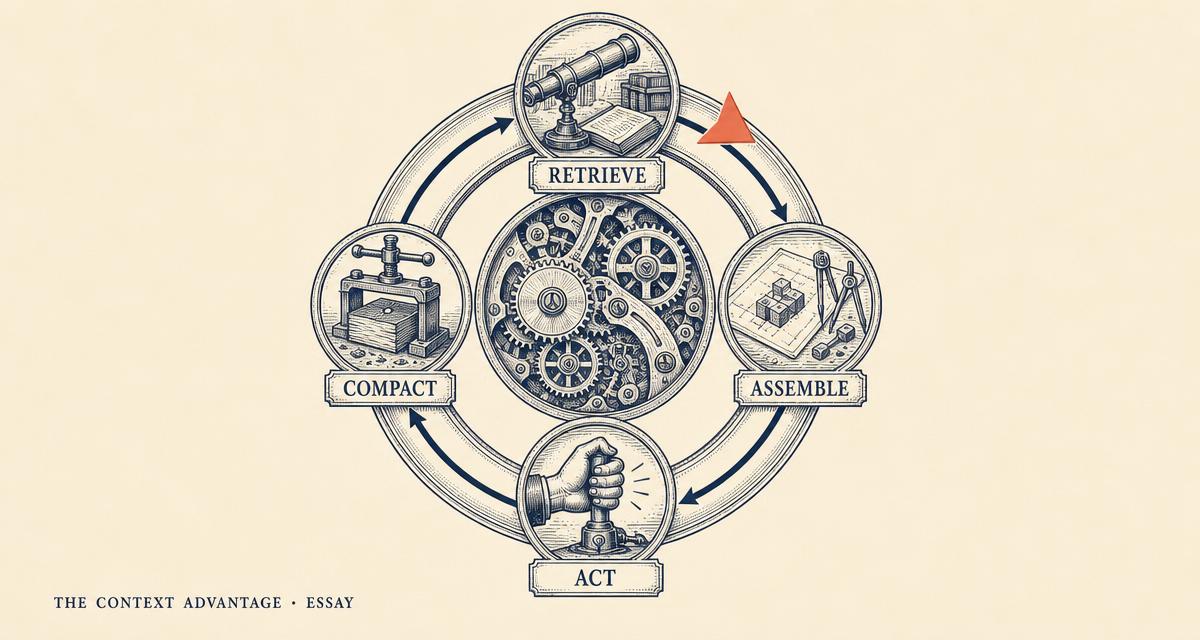
The tools domain is thirteen percent, and its governing idea is progressive disclosure. The naive design loads every tool schema the agent might need into the system context at startup. With eight tools, that is fine. With eighty, the baseline context cost is enormous before the agent has done anything, and tool selection accuracy collapses because several descriptions overlap and the model cannot tell which one the task calls for. The exam wants you to stage tool discovery — expose a small, unambiguous core set, and load the rest on demand — and to recognize ambiguous tool descriptions as a design defect rather than a model failure.
This connects directly to the Model Context Protocol material. MCP is treated in the guide not as a feature but as an interoperability decision, which is precisely the framing Chapter 23Chapter 23 · 5 min LockedOpen Formats, Open Interfaces, Open ThinkingWhy openness is a strategic moat. uses when it argues that portability of tools and context is what separates an advantage you own from one you rent. Expect questions where the correct answer is the one that keeps the tool surface swappable.
Compaction, at eleven percent, is the domain people underprepare because it sounds mechanical. It is not. The hardest questions in the whole blueprint are the compaction diagnostics: an agent's coherence collapses after a summarization pass, and you must identify which category of information the compaction prompt wrongly discarded. Was it the task constraints? The tool call results that later steps depend on? The user's stated preferences? The reasoning that justified an earlier decision? Each produces a different downstream symptom, and the fix is a revision to the compaction prompt, not a larger window. The guide is also clear that compaction prompts should be tuned for recall before precision — losing something important is far more expensive than keeping something redundant. Chapter 20Chapter 20 · 6 min LockedBudget-Aware AI DesignDesigning for budgets from day one. on budget-aware design and Chapter 21Chapter 21 · 6 min LockedQuality, Speed, and Cost TradeoffsHow to balance accuracy, latency, and spend. on quality, speed, and cost tradeoffs both cover this ground.
How to prepare in two weeks
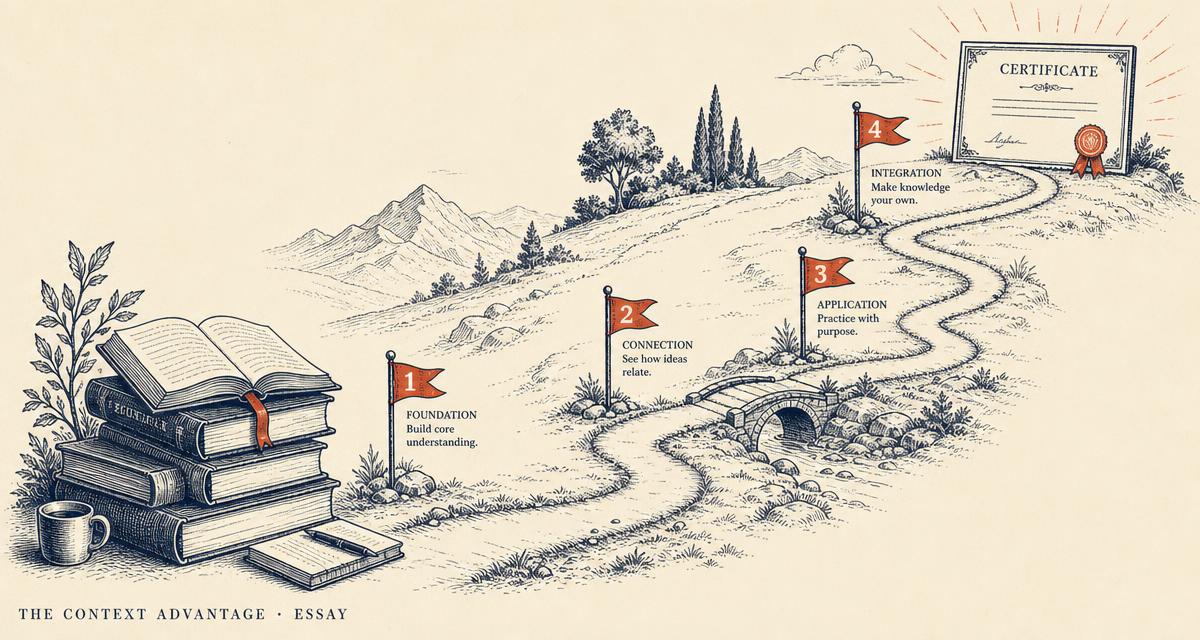
A realistic preparation plan has four stages, and none of them is memorization.
Stage one, roughly three days: build the vocabulary. You should be able to define poisoning, distraction, confusion, and clash without hesitating, and name the distinct fix for each. You should be able to draw the memory tiers on a whiteboard and say which one a given piece of information belongs in. This is the layer where the exam's foundations and memory domains overlap, and it is the cheapest sixteen to thirty-four percent of the assessment to secure.
Stage two, roughly four days: get hands on retrieval. Configure a Genie space with a deliberately curated set of trusted assets rather than everything you have access to. Write proper descriptions on the catalog objects, then break them on purpose and observe how the answers degrade. Compare a pre-inference retrieval design against a just-in-time tool-calling design on the same question set. This is the twenty percent block, and it is the one where hands-on time converts most directly into exam points.
Stage three, roughly three days: run something long enough to need compaction, and then break it. Take a workflow past the point where the window fills, watch what the summarization pass discards, and correlate the loss with the downstream failure. Do the same with a two-agent setup where the agents share nothing. These are the domains that reward having seen the failure rather than having read about it.
Stage four, the last four days: practice under the clock. Two minutes per question, no reference material, full ninety-minute sittings. The single most common failure mode reported for diagnostic exams of this style is not knowledge — it is pace. Candidates spend six minutes on question three because all four options look plausible, and then run out of time on the last eight questions, which were easier.
The free practice exam
We built a practice exam to go with this, and it is free. It is not a brain dump and it does not contain a single real exam question. Every item was written independently, from the published exam guide, by practitioners who have run these systems in production. The value is in the reasoning, not in the leak.
The structure mirrors the real assessment. Forty-five questions, ninety minutes, and a domain distribution that matches the published weights — so a mock attempt gives you a defensible read on where you stand rather than a vibe. Every question carries a full explanation, an account of why each of the other three options is wrong, a study tip, and a link to the chapter of the book that covers the underlying idea in depth. There is also a practice mode with no timer, if you would rather work through a domain slowly before sitting a full mock.
Access works by email. You enter your address, we send you a one-click link, and the link opens the exam. You get three attempts per day, and links expire after twenty-four hours. When you finish, you get a score report by domain — which is the part that matters, because a sixty-eight percent that is uniformly distributed means something entirely different from a sixty-eight percent that is being carried by two domains while retrieval sits at forty.
Start here: the Databricks Certified Context Engineer Associate practice exam.
Why a certification is the right moment to read the book
There is a version of certification preparation that is entirely tactical: learn the blueprint, drill the questions, pass, forget. It works, and it is a waste. The reason this particular exam is worth taking seriously is that the blueprint happens to be a genuinely good curriculum for a genuinely important job. The seven domains are the seven things that decide whether an enterprise agent program produces value or produces incidents.
The book covers the same terrain from the other direction. Where the exam asks which intervention fixes this trace, the book asks why an organization keeps producing traces that need fixing. Retrieval, memory, tool governance, compaction, and multi-agent boundaries are chapters in it because they are the load-bearing walls of the discipline, not because a vendor put them on a syllabus. The certification validates that you can do the work. The book is about why the work compounds into an advantage that a competitor cannot buy.
Databricks named the job. The exam scores it. What you do with the two years the credential is valid for is the actual question.
"More than a third of the exam is about which information reaches the model and how it persists. Prompt wording is nine percent. That is the industry admitting, in writing, where the work actually is."
Try this at work
- Name the four context failure modes — poisoning, distraction, confusion, clash — and the distinct fix for each.
- Decide every information need against a memory tier: working, session, durable, or Delta-backed state.
- Curate the Genie space to trusted assets with real descriptions, rather than pointing it at the whole catalog.
- Stage tool discovery instead of loading every schema up front, and treat overlapping tool descriptions as a defect.
- Tune compaction prompts for recall first, then precision, and diagnose failures by what category of information was lost.
- Propagate the minimal shared context between agents — decisions, definitions, constraints — and keep the rest local.
- Sit at least two full ninety-minute mocks under the clock before exam day.
The exam scores the skill. The book explains why it compounds. Start with the chapters on retrieval, memory, and multi-agent design.
Explore the book →Which of the seven domains would your current agent deployment fail on today, and what would it cost you to fix it?