1. The pull request nobody wrote
Here is an illustrative composite, not a single real team. A data engineer opens her laptop on Monday and finds three pull requests waiting. None of them were written by a person. A coding agent drafted a new ingestion job, refactored a slow transformation, and added tests to a model that had none. The code is clean. The tests pass. Her manager asks, half joking, what she is going to do all week.
That question is landing on data teams everywhere, and it deserves a serious answer rather than a defensive one. Agents really are getting good at the typing part of data engineering. Pretending otherwise is a poor career strategy. The better strategy is to understand exactly which part of the job the agent took, and which part it made more important.
Look closely at those three pull requests. The ingestion job treats a cancelled order as revenue because the source system marks it with a status the agent had never seen. The refactor is faster but quietly changes how late-arriving records are counted. The new tests check that columns are not null, not that the numbers are right. Every one of these needed a human who knew what the data was supposed to mean.

2. What the agent actually took from the job
Be precise about the loss. Coding agents are strong at work that is well specified and easy to check: boilerplate, syntax, standard connectors, refactors with clear goals, and tests that follow a pattern. That was always a real part of the job, and for many engineers it was the part that filled the calendar.
What agents are weak at is everything that lives outside the code: which definition finance signed off on, why a region is excluded, which upstream team changes schemas without warning, and what the board will do with the number. This is the gap Chapter 1 describes between what the model knows and what the organization knows. It did not close when the agent learned to write SQL. It just moved to the review queue.
Our essay on specialized data agents makes the same point from the vendor side. The agents that do well on data work are the ones fed the most business context. Someone has to produce that context, and it is not going to be the agent.
3. The four step ladder
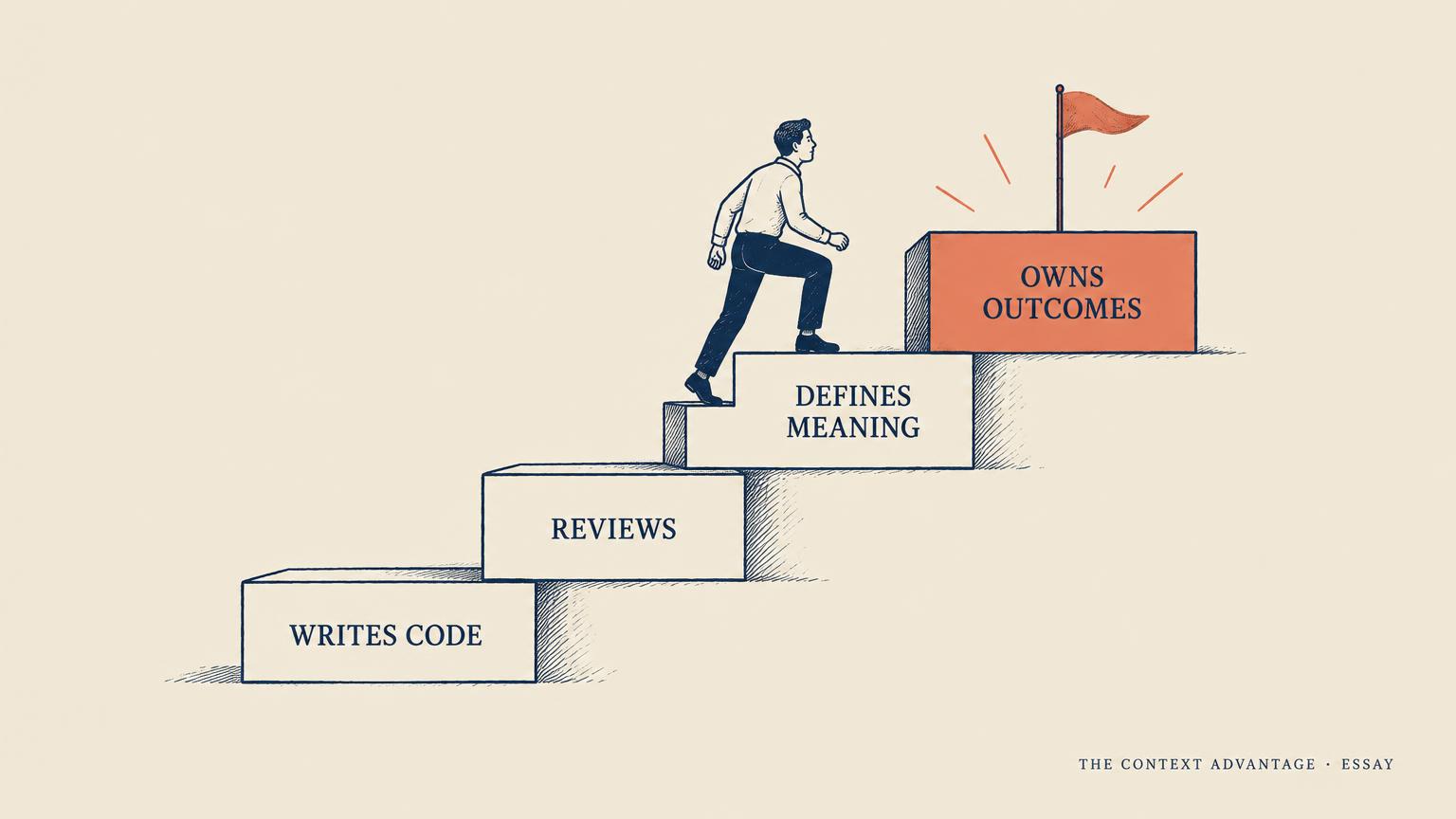
It helps to picture the work as a ladder with four steps. The first step is writing code. The second is reviewing code, including code you did not write. The third is defining meaning: the metrics, rules, and contracts that tell any author, human or agent, what correct looks like. The fourth is owning outcomes: being the named person accountable when a number drives a decision.
Agents are now competent on the first step and helpful on parts of the second. The third and fourth steps remain human work, and they are where the value of a data team has always really lived. The career move is not to compete with the agent on step one. It is to climb deliberately, and to make the climb visible.
This mirrors what we described in The Agent's Manager Is the New Job: automation rarely removes the person who understands the work. It promotes them, but only if they step up to the part the machine cannot do.
4. Review is a senior skill now
When agents write more code, review stops being a chore and becomes the main quality control in the system. A good reviewer of agent output asks different questions from a reviewer of human output. Not only does this run, but does it encode the right business rule, does it handle the edge cases the source system actually produces, and would I be comfortable if this number reached an executive tomorrow.
The most useful habit is to review against a written definition rather than against your memory. If the definition of active customer lives only in your head, every review is a negotiation. If it lives in a governed semantic layer, as Chapter 5 describes, the review becomes a check, and the agent can be given the same definition next time so it gets it right the first time.
Review also needs evidence. Reconciliation queries, row-count comparisons, and a handful of known-answer test cases turn an opinion into proof. Chapter 20 on evaluation and The Correctness Layer show how the same discipline that tests agents can test the code agents write.
5. Defining meaning is the work agents depend on
Every agent in your company, whether it writes pipelines or answers questions, is only as good as the definitions it is given. Writing those definitions down, getting them approved, and keeping them current is the highest leverage work on a modern data team. It is also exactly the work that was always postponed because there were pipelines to build.
Agents change that trade-off. If the pipeline takes an hour instead of a week, you finally have time to write the metric contract, document the exception, and record why a rule exists. That written context then makes every future agent run better. Context Debt explains what happens when teams skip this step, and Semantic Drift explains how definitions quietly rot when nobody owns them.
This is what we mean by the context engineer. Not a new person with a new title, but a data engineer who treats meaning as a deliverable. The Context Engineer Job Description lays out the full role.
6. Owning outcomes is what leaders actually pay for
Leaders rarely pay for pipelines. They pay for the confidence to make a decision. The engineer who can say this revenue figure is correct, here is how we know, and I will tell you if it changes, is far more valuable than one who can only say the job ran successfully.
Ownership means a few concrete things. Your name is on the definition. You are alerted when the data behind it drifts. You know which dashboards, agents, and reports consume it. And when something breaks, you can explain the impact in business terms within the hour. The Agent Org Chart makes the case that every piece of context needs a named human, and that human is very often a data engineer.
Ownership is also the strongest defence against the Control failures described in Chapter 15 and Chapter 16. An agent that can write a pipeline can also write a wrong one at scale. The person who owns the outcome is the one who notices.
7. Make the value visible
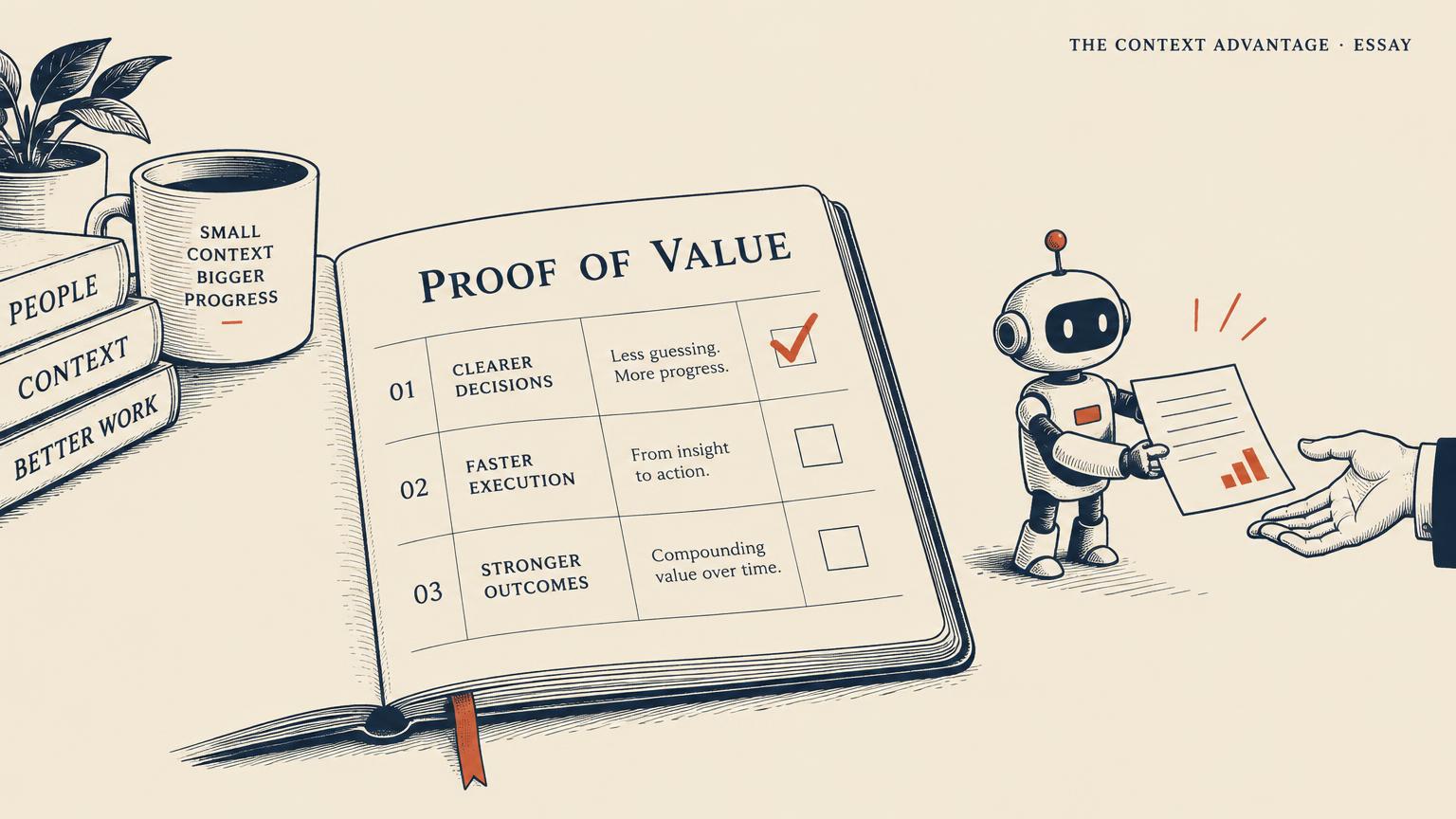
The risk for data engineers is not that their value disappears. It is that it becomes invisible. When an agent writes the code, the commit history no longer shows the work. You need a different record, one that shows the decisions, reviews, and saves that only a human could make.
Keep a simple proof of value log. Each entry has three parts: what the agent or system produced, what you caught or defined, and what it would have cost if nobody had. A wrong revenue rule caught before the quarterly review. A definition that let three teams stop arguing. A drift alert that saved a week of bad decisions. Over a quarter this log becomes the strongest evidence you have, and it pairs naturally with The Context Engineer's Promotion Packet.
Put rough numbers on it where you honestly can. The Cost of Being Wrong and Chapter 17 give a practical way to estimate what an error costs. Leaders understand avoided losses far better than lines of code.
8. Habits to build this quarter
Start using a coding agent every day, on purpose. You cannot review what you do not understand, and the engineers who know where agents fail are the ones best placed to supervise them. Treat its output the way you would treat a capable new hire's first pull request: helpful, fast, and in need of context.
Pick one important metric and make it fully owned: written definition, approval, tests that check the numbers rather than the columns, a drift alert, and a list of consumers. Then do the next one. Feed those definitions back to the agent so its next draft starts from the truth. Our 30-Day Path from Data Engineer to Context Engineer and The Context Engineer's First 90 Days turn this into a week-by-week plan.
Finally, learn to talk in Cost and Choice as well as code. Know roughly what each agent run costs, and keep your definitions portable rather than tied to one tool, as Chapter 19 recommends. If you want a structured way to test the skills, the free Context Engineer practice exam covers them domain by domain.
9. The proof of value checklist
If agents write much of your team's code, confirm these ten points about your own role:
1. You use a coding agent regularly and know its common failure modes on your data.
2. Every agent-written change you approve is reviewed against a written definition, not memory.
3. Your reviews include evidence such as reconciliations or known-answer tests.
4. You own at least one critical metric end to end, with your name on it.
5. That metric has tests that check the numbers, not only the columns.
6. You are alerted when the data behind your metrics drifts.
7. You know which dashboards, agents, and reports depend on what you own.
8. The definitions you write are fed back to agents as context.
9. You keep a proof of value log of catches, definitions, and avoided costs.
10. You can explain the business impact of a data problem within the hour.
If most of these are true, the agent did not shrink your job. It cleared the way to the part that matters. The full framework is in the book.
"When the agent writes the pipeline, the engineer's job is to know whether the pipeline tells the truth."