1. The task goes, the accountability stays
Every automation wave follows the same pattern. The spreadsheet did not remove accountants; it removed accountants who only added columns. The cloud did not remove infrastructure engineers; it removed the ones whose entire value was racking servers. The task gets automated. The accountability — knowing what good looks like, catching what is wrong, answering for the result — stays with a person, and that person's leverage grows.
Agents are the same wave at higher speed. An agent can draft the analysis, reconcile the numbers, triage the tickets, and write the first pass of the code. What it cannot do is know whether any of that was right for this organisation, this quarter, this customer. That knowledge — the context — lives in people, and the person who holds it becomes more valuable as execution gets cheaper.
This is the premise of the whole book, stated as a career fact: when intelligence is rented by the token, the scarce asset is everything the model does not know about your organisation. Chapter 2Chapter 2 · 8 min FreeThe Agentic Era Is Not Just About AgentsAgents in simple English: answer, reason, plan, use tools, take action. calls it the context gap. For a career, it is the opportunity.
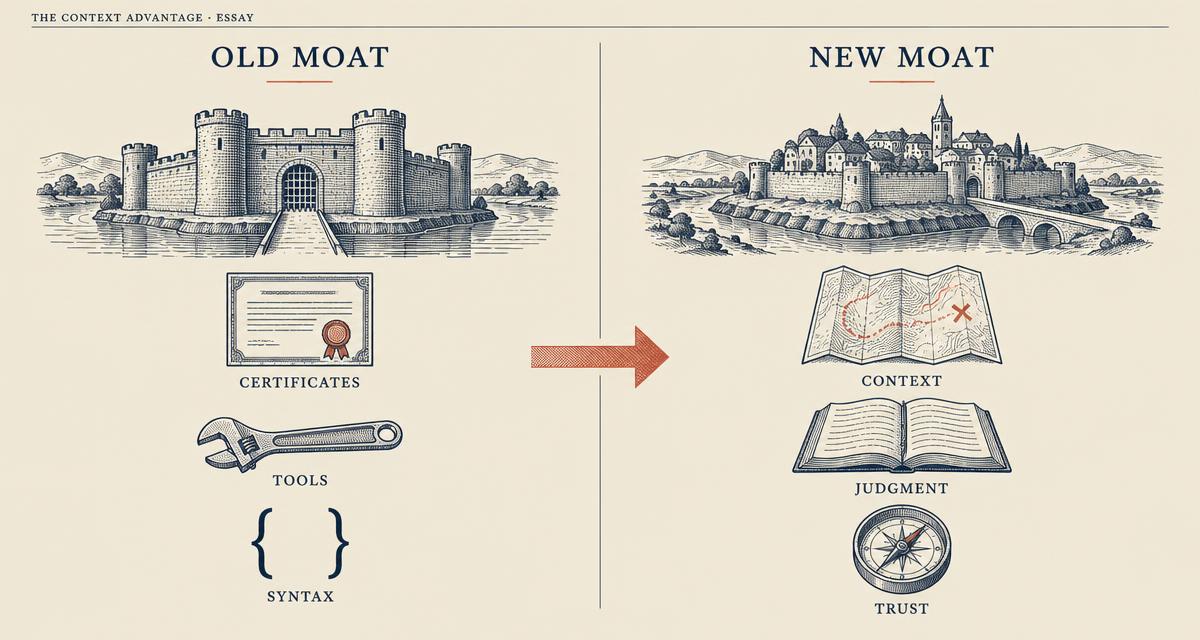
2. The old moat was execution skill
For twenty years the safe career advice in data and software was to accumulate execution skill: learn the tool, get the certification, know the syntax, ship faster than the next person. That advice priced a specific scarcity — most organisations had more work than people who could do it.
Agents invert that scarcity. Execution is now abundant and getting cheaper every quarter. The person whose entire professional identity is I can write the query faster than you is competing with something that costs fractions of a cent and never sleeps. That is not a fair fight, and it is not a fight worth having.
The new scarcity is everything around the execution: knowing which query matters, whether the answer is right, what the number means for the business, and who should act on it. None of that is in the model. All of it is in the organisation's context — and in the person who has taken the time to own it.
3. What an agent's manager actually does
The role is not science fiction; it already exists wherever agents are in production, usually under a title like data engineer, operations lead, or analytics manager. It has five parts, and none of them is prompting.
First, briefing: turning a business goal into a task an agent can attempt, with the context it needs — the definitions, the constraints, the examples of good and bad. This is Chapter 4Chapter 4 · 7 min LockedThe 4 C's FrameworkA simple lens for designing trusted enterprise AI. applied to a workforce: context engineering as delegation. Second, supervision: deciding which actions the agent may take alone, which need approval, and which it may never take — the blast-radius thinking of Chapter 15Chapter 15 · 6 min LockedGuardrails, Approvals, and Audit TrailsDesigning safe agent behavior in practice.. Third, evaluation: building and reading the scorecards that say whether the agent is actually doing well, the discipline of Chapter 21Chapter 21 · 6 min LockedQuality, Speed, and Cost TradeoffsHow to balance accuracy, latency, and spend..
Fourth, economics: knowing what the agent costs per accepted outcome and whether that number is improving — the P&L thinking from Chapter 18Chapter 18 · 6 min LockedThe Hidden Cost of Agentic AIWhere the dollars actually go. and our essay on why every agent needs a P&L. Fifth, and most important, accountability: when the agent is wrong — and it will be — a named human explains what happened, fixes the context or the guardrail that failed, and decides what changes. Chapter 10Chapter 10 · 9 min LockedInstitutional Memory Is the MoatAs frontier models converge, the durable advantage is the accumulated why — decisions, definition history, and organizational logic. makes this structural: every piece of context, and every agent that runs on it, needs a named owner.
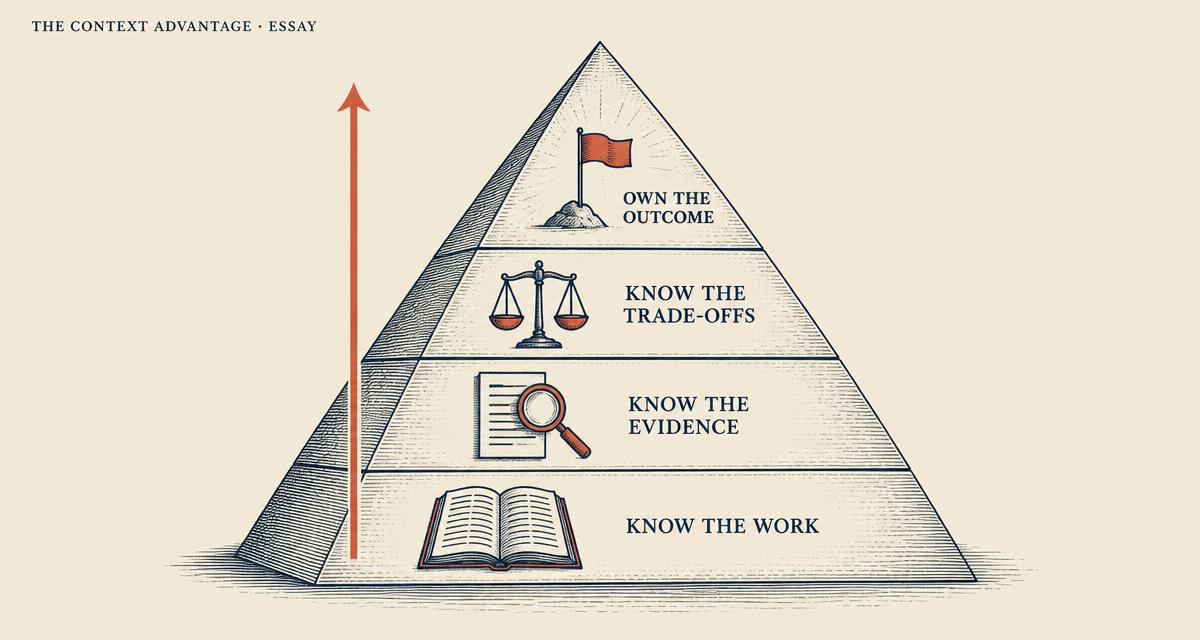
4. The judgment ladder
The skills that compound in an agentic organisation form a ladder, and the rungs are in a specific order. At the bottom: know the work. You cannot supervise a process you have never done. The people who will manage agents best in five years are doing the task by hand today, learning where the edge cases hide.
Next: know the evidence. When the agent produces an answer, can you check it — do you know which system of record settles the question, which document outranks which, what a wrong answer looks like? This is retrieval literacy, the subject of Chapter 35Chapter 35 · 11 min LockedRetrieval Mechanics: Chunking, Hybrid Search, and RerankingThe engineering layer under every context strategy — chunking, hybrid search, reranking, and how to prove it works., turned into a personal skill.
Then: know the trade-offs. Cost against latency, coverage against precision, automation against review. The agent will not choose these; it will do whatever its context and guardrails imply. Someone has to choose, and choosing well is a skill that only comes from having owned outcomes. Which is the top rung: own the outcome. Not the task, not the output — the result the business actually wanted, including the bad days.
5. Why this role cannot be automated away
A reasonable worry: if agents keep improving, does the manager of agents eventually get automated too? The honest answer is that the management tasks will be automated upward — agents will draft their own briefings, propose their own guardrails, flag their own failures. Some already do.
But accountability does not automate, because accountability is not a task. It is a promise an organisation makes to its customers, its regulators, and itself: someone looked at this, someone decided, someone answers for it. Courts, boards, and customers do not accept the model did it as an explanation, and they will not in ten years either. The form of the job will change; the function — a trusted human who owns the outcome of machine work — is the load-bearing wall of the whole structure.
There is also a compounding reason. Managing agents well requires knowing the organisation's context deeply, and context is not transferable between companies the way tool skills are. That cuts both ways in your favour: your value grows with tenure and trust, and it is hard to replace you with either a cheaper hire or a better model, because what you hold is not in any model.
6. The trust economy inside your company
Watch how work actually gets delegated in your organisation. A manager hands a task to the person she trusts, and trust is built from a history of verified outcomes: this person's numbers check out, this person flags problems early, this person's bad news arrives in time to act on it.
Delegating to agents runs on exactly the same currency. The teams that get more agents, more budget, and more autonomy are the ones whose agents have a track record of verified outcomes — and that track record is built by the human who evaluates honestly, publishes the scorecards, and reports failures before anyone else finds them. In the agentic organisation, the fastest career accelerator is being the person whose agent reports are believed.
This is why the evaluation skills in Chapter 21Chapter 21 · 6 min LockedQuality, Speed, and Cost TradeoffsHow to balance accuracy, latency, and spend. and the observability discipline in Chapter 30Chapter 30 · 7 min LockedThe Trusted Agent ArchitectureA nine-step end-to-end reference architecture for production agents. are career skills, not just engineering skills. They are how you manufacture trust at scale.
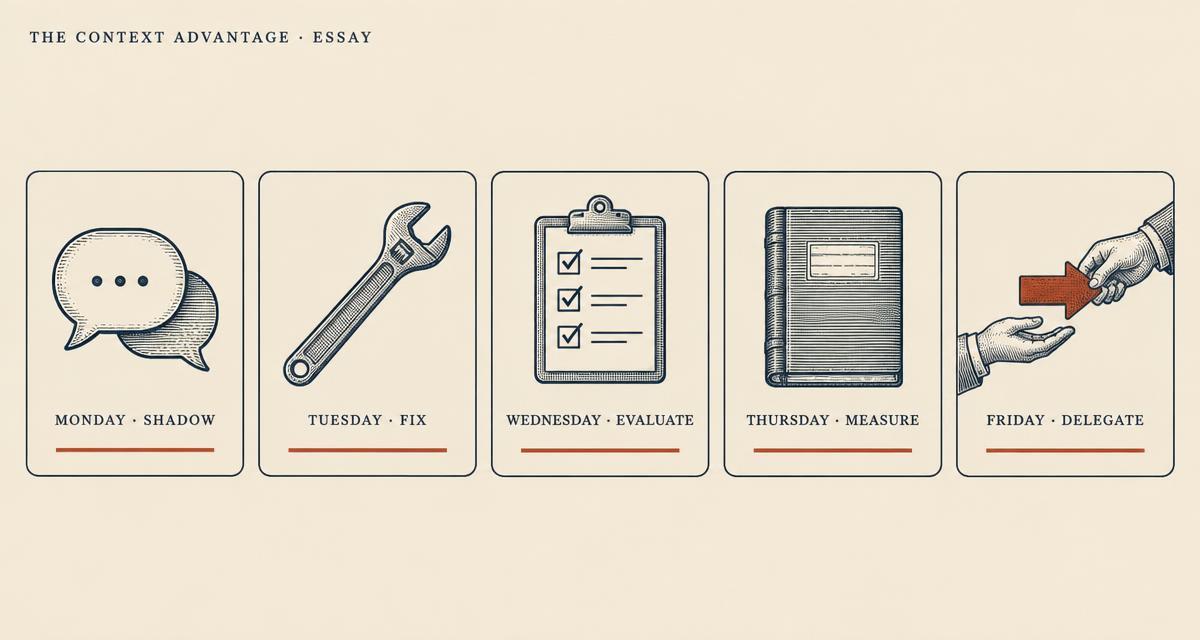
7. A working week, concretely
Abstract career advice is useless, so here is the concrete version. If you want to be the person agents report to, you can start this week with the agents — or the AI features — already around you.
Monday: shadow. Pick one agent or AI-assisted workflow in your organisation and watch it work for an hour. Read its actual outputs, not the demo. Tuesday: fix. Find one wrong or weak output and trace it to the missing context — the definition it did not have, the document it could not see, the constraint nobody wrote down. Write that context down. Wednesday: evaluate. Build a tiny scorecard — twenty real tasks, what good looks like for each — and score the agent against it. Thursday: measure. Estimate what the agent costs per accepted outcome, in tokens, review time, and rework. Friday: delegate. Propose one change to what the agent is allowed to do, up or down, with the evidence from your week.
Do that for a quarter and you will have something almost nobody in your organisation has: a verified, written, quantitative understanding of what one agent actually does. That document is a career asset. It is also, not coincidentally, most of what Chapter 33Chapter 33 · 6 min LockedThe 90-Day Enterprise AI Learning PlanThirty days to understand, thirty to build, thirty to design. recommends organisations build.
8. What to stop doing
Career strategy is as much about what you stop as what you start. Stop collecting tool certifications as a primary strategy — they expire faster than ever and say nothing about judgment. Stop competing on execution speed against something that is free and instant. Stop treating the AI rollout as someone else's project that happens to you.
And stop waiting for the job title. Organisations are creating these roles right now under a hundred names — AI operations lead, agent product owner, context engineer, automation manager. The person who has already been doing the work, even informally, even on one small agent, gets the title. The person who waited for the requisition watches someone else get it.
Our essay on the context engineer job description maps one version of this role, and the 30-day path gives the on-ramp. The agent's manager is the same trajectory, one rung further: from building the context to being accountable for what runs on it.
9. The promotion nobody announces
There is a quiet pattern in every company deploying agents seriously. Somewhere, a person who used to do the work now spends their days briefing the agents, checking the outputs, tuning the context, and answering for the results. Nobody sent a memo announcing their promotion. Their leverage simply multiplied — the same judgment, applied across ten times the output.
That is the actual shape of the AI career opportunity. Not a new job posting, but a new ratio: your judgment per unit of execution, going up. The agents are coming either way. The only question is whether they report to you.
The book exists to make that answer yes. Chapter 2Chapter 2 · 8 min FreeThe Agentic Era Is Not Just About AgentsAgents in simple English: answer, reason, plan, use tools, take action. gives you the context gap, Chapter 10Chapter 10 · 9 min LockedInstitutional Memory Is the MoatAs frontier models converge, the durable advantage is the accumulated why — decisions, definition history, and organizational logic. the ownership model, Chapter 21Chapter 21 · 6 min LockedQuality, Speed, and Cost TradeoffsHow to balance accuracy, latency, and spend. the evaluation discipline, and Chapter 33Chapter 33 · 6 min LockedThe 90-Day Enterprise AI Learning PlanThirty days to understand, thirty to build, thirty to design. the operating model. The rest is a quarter of Mondays.
"The question is not whether an agent can do your job. It is whether you can do the job of the person the agent reports to."
Try this at work
- You can name every agent or AI workflow in your area — and what outcome each one owns
- You have read your agent's real outputs this week, not the demo
- You have traced at least one bad output to the missing context that caused it
- You keep a written scorecard of real tasks and what good looks like for each
- You can state your agent's cost per accepted outcome without opening a dashboard
- You know which actions your agent may take alone, with approval, and never
- Your agent's failures get reported by you before anyone else finds them
- You are doing the task by hand often enough to know where the edge cases hide
The agent's manager runs on context, evaluation, and accountability — the three disciplines this book teaches end to end. Start with [Chapter 2](/context-advantage/book/chapter-2) on the context gap and [Chapter 21](/context-advantage/book/chapter-21) on evaluation. [Read the first chapters free](/context-advantage) or [get all 36 chapters](https://bricksnotes.com/buy).
Explore the book →If an agent in your organisation took over your three most repetitive tasks tomorrow, what would you do with the freed hours — and would your manager describe that answer as more valuable than what you do today?