Interview guide
Context engineering interview questions.
Thirty-three questions that actually get asked, grouped by the four C's, each with the answer a hiring manager is listening for — and the chapter that goes deeper.
How to use this page
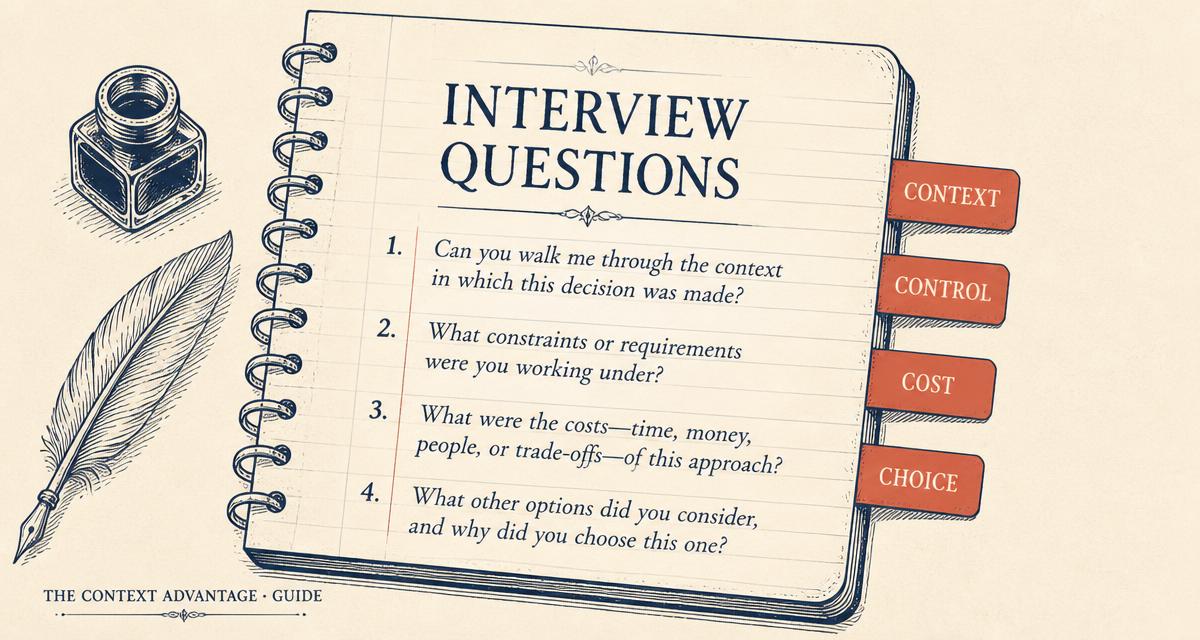
Interviews for context work have settled into a shape. There is a definitions round, a retrieval round, a governance round, and a cost round, and somewhere near the end somebody asks what you would do if the vendor doubled its prices. That shape is the four C's, whether or not the interviewer calls it that.
The answers below are deliberately short. They are the shape of a strong answer, not a script. Read the question, answer it out loud from memory, then compare. Where your answer was thinner than the one here, follow the chapter link — that is the gap worth closing before the interview, not after it.
Foundations
The warm-up round. Interviewers use these to find out whether you think in systems or in prompts.
What is context engineering, in one sentence?
It is the discipline of deciding what an AI system should know at the moment it acts, then building the retrieval, memory, and governance to deliver exactly that. Prompt wording is the last mile, not the work.
How is context engineering different from prompt engineering?
Prompt engineering optimises the instruction. Context engineering optimises the input pipeline behind the instruction: what is retrieved, what is remembered, what is compacted away, and what the model is never allowed to see.
Name the four ways context fails.
Poisoning, where an error enters the window and is then treated as fact. Distraction, where history grows so large the model loses the task. Confusion, where superficially similar material crowds out the relevant material. Clash, where two sources contradict and the model silently picks one.
Goes deeper: Chapter 3 — Smart Models Still Need Smart Systems
A larger context window arrived. Does that reduce your work?
No. A bigger window raises the ceiling on how much irrelevant material you can accidentally include. Selection quality still decides the answer, and cost and latency both scale with what you put in.
Who owns context in an organisation?
A named role with a cross-functional mandate. Retrieval sits with engineering, definitions sit with the business, and policy sits with governance. Left unowned, all three drift independently and the assistant becomes unpredictable.
Context
The largest block in real interviews, and the one candidates under-prepare for.
Walk me through your retrieval stack.
Describe the whole path: chunking strategy and why, embedding model, hybrid lexical plus vector search, metadata filters, a reranker, then a hard token budget with a cut policy. Name the evaluation set you use to prove each stage helps.
Your agent returns plausible but wrong numbers. Where do you look first?
At the definitions, not the model. Most wrong-number incidents are a metric defined two ways in two systems. Retrieval faithfully returned one of them. Fix the semantic layer, then retest.
Goes deeper: Chapter 7 — Semantic Layers, Ontologies, and Metrics
Why is business meaning more important than similarity?
Similarity finds text that looks like the question. Meaning finds the answer the company would defend in a board meeting. Vector search has no opinion about which revenue definition is authoritative; your context layer must.
Goes deeper: Chapter 6 — Business Meaning Beats Raw Retrieval
How do you decide chunk size?
Empirically, against a labelled question set, per corpus. Structure-aware splitting on headings or clauses usually beats fixed-token splitting, and overlap is a cost lever, not a quality guarantee.
What belongs in memory versus retrieval?
Retrieval answers what is true about the world. Memory answers what is true about this user, this workflow, and prior decisions. Conflating them produces an agent that either forgets everything or remembers stale preferences forever.
Goes deeper: Chapter 8 — From Data Catalog to Business Memory
How do you keep context fresh?
Treat it as a living layer with owners, review cadence, deprecation, and change logs. Documents rot silently; a maintained layer signals its own staleness.
How would you make citations trustworthy?
Bind every claim to a retrievable identifier, render the citation at the sentence level, and fail the answer when a claim cannot be traced. Unverifiable citations are worse than none because they buy false confidence.
What makes institutional knowledge defensible?
It compounds. Models are rented and shared; the accumulated record of how your organisation decides is not. That asset is the moat.
Control
Where senior candidates separate themselves. Anyone can demo an agent; few can explain how they would stop one.
How is agent governance different from user governance?
Humans are slow, few, and accountable. Agents are fast, many, and delegated. Role-based access answers who may read; agentic systems also need action control that answers what may be done, at what scale, with whose approval.
Goes deeper: Chapter 14 — From Access Control to Action Control
Design a guardrail for an agent that can issue refunds.
Value thresholds, rate limits per window, an idempotency key on every write, a mandatory human approval above a stated amount, and an immutable audit record of the inputs that justified the action.
Goes deeper: Chapter 15 — Guardrails, Approvals, and Audit Trails
Where do multi-agent systems usually fail?
At the seams. Each agent performs well in isolation and the handoff loses the constraint, the caveat, or the provenance. Fix it with explicit context contracts between agents, not with a better planner prompt.
What do you log so that an incident is reconstructable?
Inputs, retrieved material with identifiers, the tool calls attempted and their results, the policy decisions applied, and the final output. If a trace cannot answer why the agent did that, the system is unobservable.
Where should a human stay in the loop?
At irreversible actions, at low-confidence outputs, and at anything with regulatory exposure. Approval is a design decision about reversibility, not a maturity failure.
How do you earn trust in a rollout?
Ship it shadowed, publish accuracy against a known set, expose citations, and widen autonomy as evidence accumulates. Trust is designed, and it is granted in increments.
Cost
Increasingly common, because someone has now seen the invoice.
Where does agentic spend actually go?
Rarely the headline answer. It goes to retries, long histories replayed each turn, tool chatter, oversized retrieval, and reasoning depth applied uniformly to trivial tasks.
How do you route tasks across models?
By consequence. Cheap models for classification, extraction, and drafting; strong models where an error is expensive or irreversible. Route on task risk, then verify the cheap path with sampling.
Goes deeper: Chapter 19 — Not Every Task Needs the Best Model
What is your unit economics metric?
Cost per resolved task, not cost per token. Tokens fall every year; the number of times a workflow has to be redone is what actually moves the bill.
Cut latency by forty percent without losing accuracy. How?
Cache aggressively at stable boundaries, parallelise independent retrieval, shrink the replayed history through compaction, and reserve deep reasoning for the branches that need it.
Goes deeper: Chapter 21 — Quality, Speed, and Cost Tradeoffs
How do you compact history without losing the thread?
Summarise on structure, not on length. Preserve decisions, constraints, and open questions verbatim; compress narration. Keep a pointer back to the full record so the agent can re-expand on demand.
Choice
The questions that reveal whether you have ever had to migrate off something.
How would you avoid AI lock-in?
Keep the assets that are expensive to rebuild outside the vendor: definitions, evaluation sets, prompts, memory, traces, and policy. Rent the model; own the context.
What is the difference between MCP and A2A?
MCP standardises how one agent reaches tools and data. A2A standardises how agents talk to each other. They solve adjacent problems and are complementary rather than competing.
What makes context portable?
Explicit schemas, stable identifiers, exportable memory, and policy expressed as data rather than as vendor configuration. Portability is a property you build, not a clause you negotiate.
How do you run an exit test?
Attempt a real export, stand the workflow up elsewhere on a sample, and measure the days it takes. A platform you have never left is a platform you cannot cost.
Goes deeper: Chapter 25 — Platform Independent, Platform Aware
How do you design for a model you have not seen yet?
Put an interface between your system and the model, keep evaluations model-agnostic, and make swapping a configuration change rather than a project.
Behavioural and closing
Short answers, high signal. Interviewers are listening for scar tissue.
Tell me about an agent that failed in production.
Pick a real one. Name the failure mode precisely, the trace that revealed it, the fix, and the guardrail you added so it cannot recur silently. Specificity is the whole answer.
How do you explain a context problem to a business stakeholder?
In their units. Not retrieval recall, but the number of answers a director cannot defend in a meeting, and what it costs when one of them reaches a customer.
Goes deeper: Chapter 28 — Speaking the Language of Business and AI
What skills are you deliberately building next?
Evaluation design, retrieval tuning, cost modelling, and governance literacy. Naming tools is weaker than naming judgement.
Goes deeper: Chapter 27 — Skills That Will Matter More Than Tools
Where do you want this role to be in two years?
Answer in terms of ownership: the context layer, the evaluation harness, the cost envelope. Titles change faster than responsibilities.
Goes deeper: Chapter 29 — Career Roadmap for the Agentic Era
What interviewers are really testing
Three things, in order. First, whether you can tell a retrieval problem from a definitions problem from a governance problem, because applying the wrong fix is the most expensive mistake in this discipline. Second, whether you reason about cost as a design constraint rather than as an invoice that arrives later. Third, whether you have ever had to move a working system off a platform, which is the only reliable way anybody learns what portability actually means.
None of those are memorisable. They come from having been in the room when something broke. If you have not been in that room yet, the fastest substitute is the free practice exam, which is built entirely from failure scenarios, and then the chapters behind whichever ones you got wrong.
Prepare with these next
- Free Databricks Context Engineer Associate practice examForty-five timed questions with explanations. No payment, no catch.
- The 14-day certification study planDomain weights, daily reading, and mock-exam checkpoints.
- What is context engineering?
- Agentic AI glossaryDefinitions for the terms interviewers use as shorthand.
Answer like someone who has shipped it.
Every answer here is a compressed version of a chapter. The book is the long version — 36 chapters on Context, Control, Cost, and Choice.