Study plan
Fourteen days to the Context Engineer Associate.
The exam blueprint published seven domains and a weighting. This is the schedule that matches it — what to read each day, where the mock-exam checkpoints go, and which chapters cover each scored domain.
Before you start: the exam in one paragraph
Ninety minutes, forty-five scored questions, delivered online with a proctor, two hundred United States dollars, valid for two years, no formal prerequisites. Two minutes per question sounds generous until you meet the question style: a short scenario in which an agent is misbehaving, and four defensible-looking interventions of which one is correct at the lowest cost. This is diagnostic reasoning under a clock.
That style has a consequence for how you prepare. Reading definitions will not get you through it. You need to have argued with a failing system, or the closest available substitute: worked scenarios, done timed, with the explanation read afterwards even when you were right.
The domain weights, and the chapters behind each one
Retrieval and memory together are thirty-eight percent of the exam. Instruction design — the part most public discussion still treats as the whole discipline — is nine. Study in weight order, not in blueprint order.
Retrieval — 20%
Memory — 18%
Foundations of context engineering — 16%
Tools and the Model Context Protocol — 13%
Multi-agent and long-horizon design — 13%
Compaction and compression — 11%
System prompt and instruction design — 9%
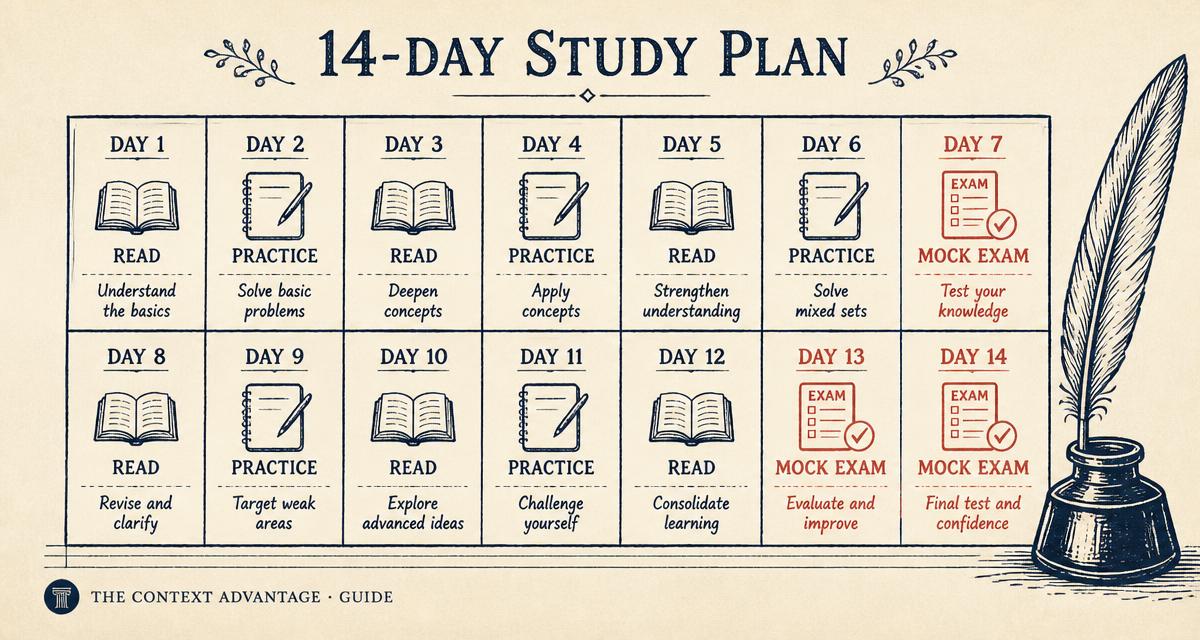
The fourteen days
Roughly ninety minutes a day, with three timed mock attempts built in. The checkpoints matter more than the reading: a mock attempt on day seven that you score by domain will redirect the second week far better than any study guide can.
- Day 1 · Foundations. Read Chapters 3 and 4. Write the four context failure modes from memory: poisoning, distraction, confusion, clash. If you cannot name the fix for each, you are not done.
- Day 2 · Foundations. Read Chapter 5. Sketch your own system's context path from question to answer on one page. Mark every place a decision is made about what to include.
- Day 3 · Retrieval. Read Chapter 35. Write down your chunking strategy and why. Then write the experiment that would prove it is the right one.
- Day 4 · Retrieval. Read Chapters 6 and 7. Take one metric your business argues about and write both definitions down. That argument is the exam's favourite scenario.
- Day 5 · Memory. Read Chapters 8 and 10. Draw the line between retrieval and memory in your own system. Anything that sits on the line is a future incident.
- Day 6 · Memory. Read Chapter 11. List what in your context layer has no owner and no review date. Staleness is a scored topic, not a hygiene note.
- Day 7 · Checkpoint. First full mock attempt. Do it timed, in one sitting, without notes. Score by domain, not overall — the overall number tells you nothing about what to study next.
- Day 8 · Tools and MCP. Read Chapters 12 and 23. Write a tool description for something in your stack, then write the sentence explaining how an agent could misread it.
- Day 9 · Control. Read Chapters 14 and 15. Design the guardrail set for one irreversible action end to end: threshold, rate limit, idempotency, approval, audit.
- Day 10 · Multi-agent. Read Chapters 34 and 30. Take one handoff in your system and write the context contract it should carry. Name what is lost today.
- Day 11 · Compaction. Read Chapter 36. Compact a real long conversation by hand. Note what you preserved verbatim and why — that instinct is the scored skill.
- Day 12 · Cost. Read Chapters 18 and 21. Compute cost per resolved task for one workflow. Then find the retry loop you did not know about.
- Day 13 · Checkpoint. Second mock attempt. Compare per-domain scores against day seven. Study only the two domains that moved least.
- Day 14 · Consolidation. Third mock attempt, then re-read your weakest two chapters. Stop studying by early evening. Fatigue costs more marks than any remaining gap.
How to use the mock attempts properly
Score by domain and ignore the total. A seventy-eight percent that hides a forty percent in retrieval is a fail waiting to happen, because retrieval is a fifth of the paper. Between attempts, study only the two weakest domains — spreading effort evenly across seven domains is how people plateau.
Read the explanation on every question, including the ones you answered correctly. A right answer for the wrong reason will not survive a rephrased scenario, and the exam rephrases relentlessly. The free practice exam is built for exactly this: three attempts a day, an explanation on each item, and a per-domain score report at the end.
The five mistakes that cost people the pass
- Studying instruction design first. It feels like the core of the discipline and it is nine percent of the paper.
- Memorising definitions. Almost every question is a scenario. Naming a failure mode is worth nothing if you cannot pick its fix.
- Confusing memory with retrieval. A large group of questions turns on exactly this line, and the wrong side of it produces a plausible wrong answer.
- Ignoring cost as a tiebreaker. When two interventions both work, the exam wants the cheaper one. That is a deliberate design choice, and it mirrors reality.
- Skipping the timed practice. The content is learnable in a week. The pace is not learnable without rehearsal.
After the exam
The credential is a starting position, not a destination. What follows is ownership — of a context layer, an evaluation harness, a cost envelope. Chapter 29 lays out the roadmap, Chapter 31 walks through building a first context layer end to end, and the interview question set covers the conversation that usually comes next.
Everything you need for the two weeks
- Free practice exam — 45 timed questionsMirrors the real domain weighting, with an explanation on every answer.
- The full blueprint walkthroughDomain by domain, with the reasoning behind each weight.
- 33 context engineering interview questionsBecause the certification is usually a step toward an interview.
- Agentic AI glossary
The practice exam is free. The reasoning behind it is the book.
Every domain on the blueprint maps to chapters in The Context Advantage — 36 chapters on Context, Control, Cost, and Choice, with lifetime updates.