The result that should not be possible
For most of the last three years, the conventional wisdom about agentic AI has been that accuracy and cost sit on opposite ends of the same lever. You could buy your way to a better answer by paying for a larger model, a longer context, more tool calls, more retries. Or you could save money by shortening the loop and accepting that some fraction of the answers would be wrong. Every architecture debate, every internal roadmap, every vendor pitch has quietly assumed that tradeoff.
A new benchmark from Databricks — Why a frontier data agent outperforms general coding agents on quality and cost — puts a hard number on how badly that assumption has aged. On 401 tasks distilled from real internal usage, their specialized data agent, Genie Code, was tested head to head against three leading general-purpose coding agents. Same 20-minute task budget. Same access to Databricks tools through MCP. Each agent running its own harness on the latest frontier models.
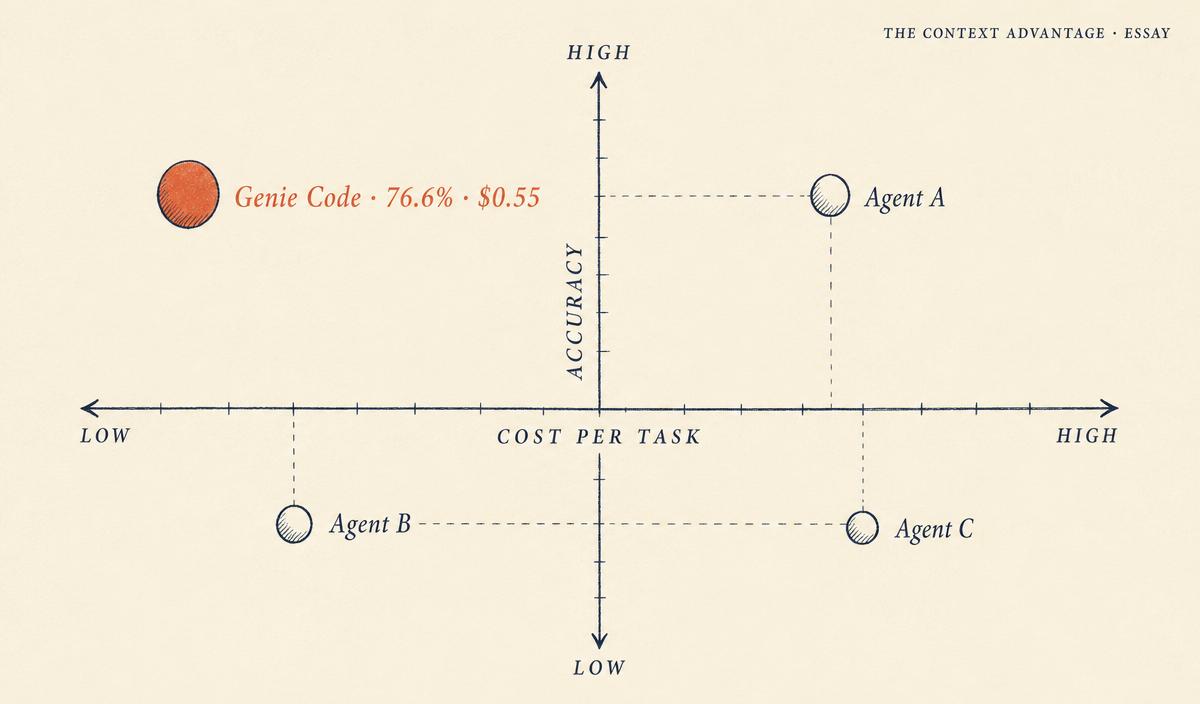
Genie Code was the most accurate agent in the run. It was also the cheapest. Not one or the other. Both. At 76.6 percent accuracy and $0.55 per task, it delivered a correct answer at less than half the cost of the general agents that competed against it. That is not a bit of jitter around the Pareto frontier. That is the frontier moving.
Why general coding agents burn money
Understanding this result begins with understanding why the general agents did worse and more expensively at the same time. It is tempting to assume the answer is model choice — that the specialized agent must have used a stronger model. Databricks is explicit that this is not the case. Every agent used the latest models from leading frontier labs, and every agent had the same MCP tools available.
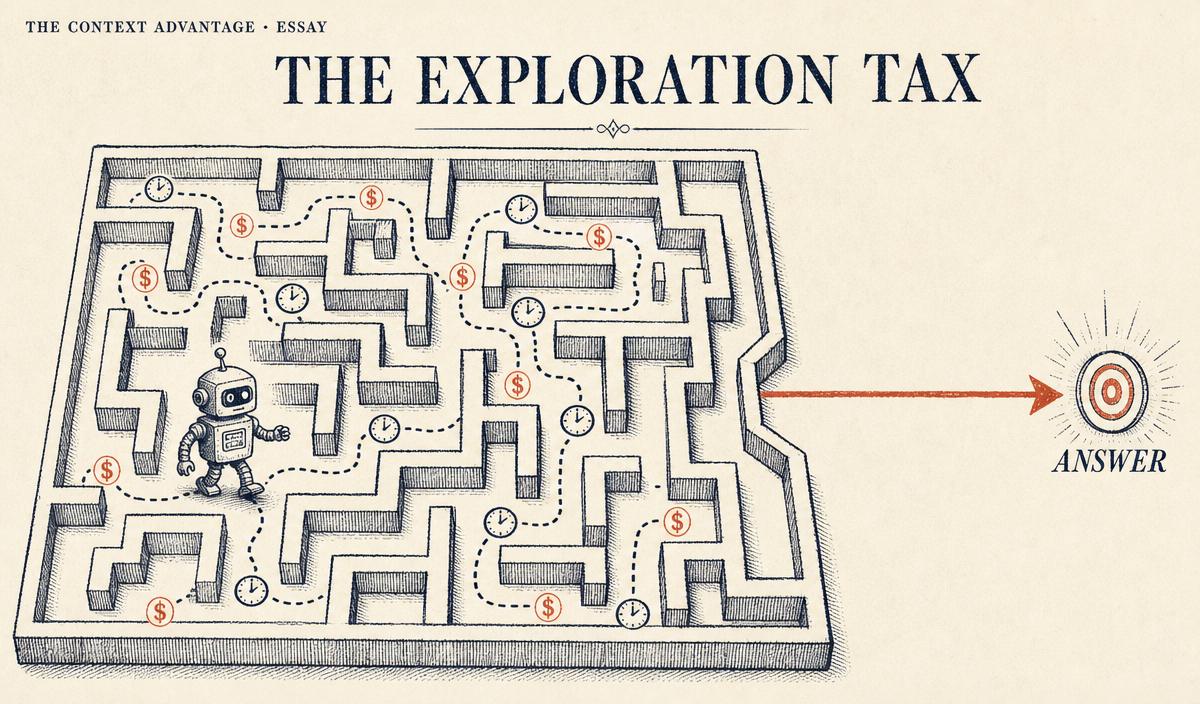
The difference is what happens in the twenty minutes between question and answer. A general coding agent, faced with a data task inside an enterprise workspace it does not know, does the only thing it can do. It explores. It reads tables it does not need. It re-reads schemas because it forgot them between tool calls. It writes speculative queries, waits for them to return, discovers they were the wrong shape, and starts again. Every step of that exploration is billed. Every timeout that ends a session with a partial answer is billed. Every retry against a rate-limited endpoint is billed.
This is the exploration tax. Chapter 18Chapter 18 · 6 min LockedThe Hidden Cost of Agentic AIWhere the dollars actually go. argues that in agentic workflows the dominant cost line is almost never the model tokens themselves. It is the cost of wandering — the reads, the retries, the tool calls that happened only because the agent did not know what it did not know. Chapter 27Chapter 27 · 6 min LockedSkills That Will Matter More Than ToolsDurable skills that outlast every framework, model, and platform. frames the same idea from the demo-to-product angle: what makes a demo look magical (loops that eventually converge) is what makes a product economically broken (loops that occasionally converge, at the cost of everything else).
What context actually did in this benchmark
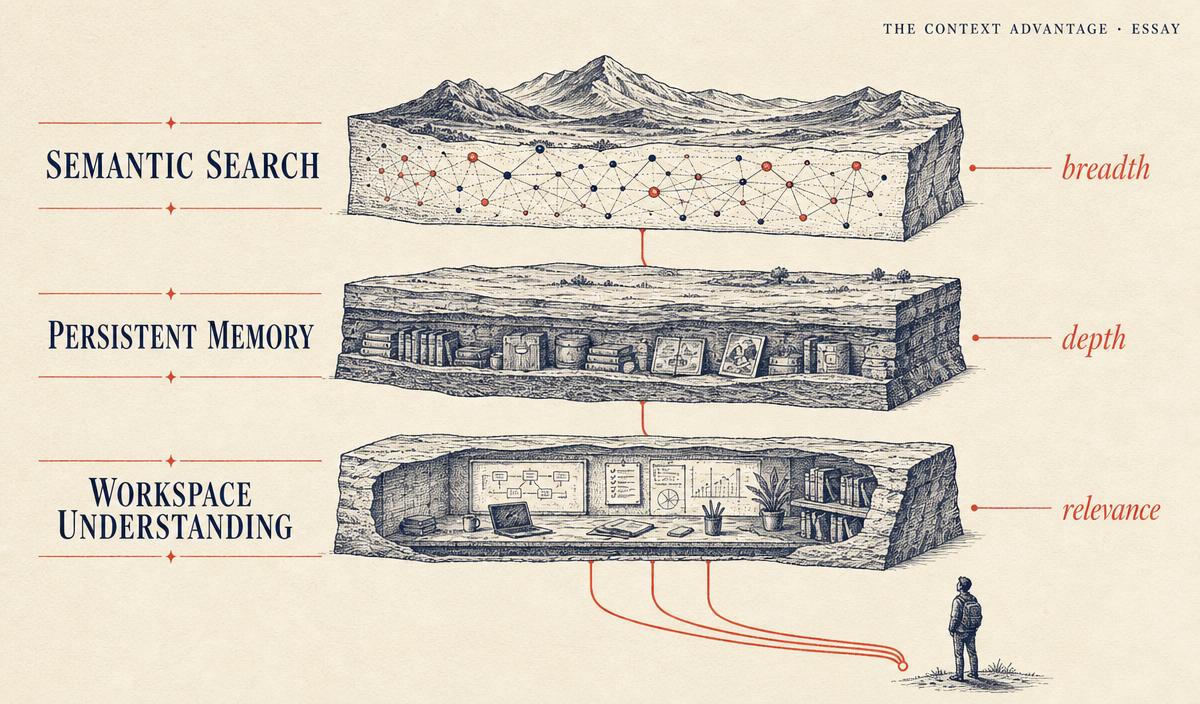
Databricks names three things that Genie Code has and the general agents do not. Semantic search that understands the shape of the workspace's data. Persistent memory that survives across turns and sessions. Workspace understanding — the ability to reason about tables, columns, notebooks, dashboards, and policies as first-class objects rather than as generic files on a disk.
None of those are model capabilities. All three are context. This is the single most important sentence of the entire benchmark, and it is worth staring at for a moment. The specialized agent won on accuracy and won on cost using the same models the losing agents used. The delta lives one layer above the model.
Chapter 4Chapter 4 · 7 min LockedThe 4 C's FrameworkA simple lens for designing trusted enterprise AI. introduces the framework the whole book runs on: Context, Control, Cost, and Choice. It argues that in a world where every serious model is capable enough, the compounding advantage does not live in the model. It lives in the context that surrounds it. The Databricks result is that argument, measured on 401 tasks and priced to the cent.
Chapter 6Chapter 6 · 6 min LockedBusiness Meaning Beats Raw RetrievalNaive RAG is not a context strategy. and Chapter 7Chapter 7 · 7 min LockedSemantic Layers, Ontologies, and Metrics in Simple WordsThe big context words, explained without the jargon. go deeper into what a semantic layer actually is — not a data catalog, not a glossary of column names, but a curated, versioned representation of what the business means when it says revenue, customer, region, delinquency, or churn. When an agent can query that layer instead of guessing from raw table names, its first attempt at a solution is much closer to correct. Fewer wrong attempts means fewer wasted tool calls, which means lower cost and higher accuracy at the same time.
The compute, latency, and accuracy triangle, redrawn
An earlier essay on this site, The Compute and Latency Budget, argued that agentic workflows are governed by a three-axis budget. You choose how much compute to spend, how much latency the user will tolerate, and how much accuracy you are willing to accept. Push on one axis and the other two contract.
The Databricks benchmark suggests a fourth axis that reshapes the triangle. Call it context density — the amount of relevant, retrievable meaning the agent can lean on before it has to spend a tool call to find out. Context density does not just improve accuracy in isolation. It shrinks the amount of compute and latency required to reach a given level of accuracy, because it removes the searching and re-reading that would otherwise be needed. A denser context layer is, in effect, a discount on the entire budget.
This is why Genie Code's numbers are not a bit of luck. They are the mathematical consequence of a denser layer feeding the same models. The chapters on cost, Chapter 18Chapter 18 · 6 min LockedThe Hidden Cost of Agentic AIWhere the dollars actually go. and Chapter 20Chapter 20 · 6 min LockedBudget-Aware AI DesignDesigning for budgets from day one., lay out the mechanics: what to instrument, how to attribute cost to the specific unit of work that caused it, and how to spot the exploration tax in your own agents before it shows up in your monthly bill.
76.6 percent is not 100 percent
It would be dishonest to write this essay without staring at the remaining gap. Genie Code won the benchmark, but it did not solve the benchmark. Almost a quarter of the tasks still ended in a wrong or incomplete answer. That is a very different world from software engineering as we have known it, where a compiler either accepts your program or it does not.
This is why the correctness layer matters. Two earlier essays on this site — The Correctness Layer and Evals Are the New Dashboards — argue that in the agentic era, the discipline that decides whether an AI product is trustworthy is not model choice and not prompt design. It is the eval harness that runs against every change to the context layer, every change to the tool contract, every change to the agent's plan.
Chapter 15Chapter 15 · 6 min LockedGuardrails, Approvals, and Audit TrailsDesigning safe agent behavior in practice. walks through the audit trail behavior that makes 76 percent acceptable in production: not by pretending the 24 percent does not exist, but by ensuring that every answer carries its citation, its confidence, and its escape hatch. Chapter 20Chapter 20 · 6 min LockedBudget-Aware AI DesignDesigning for budgets from day one. frames the governance side — the approvals and guardrails that decide which agent actions can execute automatically and which have to route through a human. A specialized data agent without those two layers is faster and cheaper, but it is not yet safe.
The organizational lesson: buy specialized, or build context
Every enterprise leader reading the Databricks benchmark will draw one of two conclusions. The first is that they should adopt a specialized data agent for their data workflows and be done with it. That is a reasonable conclusion, and for many teams it is the right first move. Specialized agents built on top of a runtime that already understands the workspace will outperform generic coding agents on data tasks for the foreseeable future, on both axes.
But the deeper lesson is not about which agent to buy. It is about what makes a specialized agent specialized. Genie Code is faster and cheaper because it sits on top of a context layer — semantic search, persistent memory, workspace understanding — that Databricks has invested in for years. Any enterprise that wants a specialized agent for its own workflows, in its own tools, on its own data, has to build the equivalent layer underneath.
Chapter 10Chapter 10 · 9 min LockedInstitutional Memory Is the MoatAs frontier models converge, the durable advantage is the accumulated why — decisions, definition history, and organizational logic. makes the case for institutional memory as the durable moat once the models themselves converge. Chapter 11Chapter 11 · 7 min LockedContext Is a Living Layer, Not a DocumentDefinitions drift, macro conditions shift, agents relearn — treat context like code, with ownership, versioning, and continuous review. argues that this memory has to be run like production code — owned, versioned, evaluated on every change — not like a launch document. Chapter 12Chapter 12 · 7 min LockedPortable Context: The Open Contract for AgentsContext is your IP — it must move across agents, models, and clouds through an open contract, not sit locked inside one runtime. closes the loop with portability: if the context you build lives only inside one vendor's runtime, you have not built a moat, you have leased one.
The Databricks result is not a case study for buying more Databricks. It is a case study for taking context seriously enough to build it, wherever it lives, whoever runs it, on top of whatever model wins the next benchmark.
The 4 C's scorecard, applied
The book's four-part framework — introduced in Chapter 4Chapter 4 · 7 min LockedThe 4 C's FrameworkA simple lens for designing trusted enterprise AI. and revisited across the essay The 4 C's of Enterprise AI — is a useful lens for reading benchmarks like this one without getting swept away by the headline number.
On Context, Genie Code is the reference case. Semantic search, persistent memory, and workspace understanding are exactly the three surfaces the book argues every serious enterprise AI program has to build. The benchmark shows what happens when those three surfaces are present and working: accuracy up, cost down, both at once.
On Cost, the win is unambiguous. $0.55 per task versus more than a dollar for the general agents, at a higher success rate. Chapter 18Chapter 18 · 6 min LockedThe Hidden Cost of Agentic AIWhere the dollars actually go. and Chapter 20Chapter 20 · 6 min LockedBudget-Aware AI DesignDesigning for budgets from day one. explain why cost per successful task, not cost per token, is the only unit economics number that matters for agentic workflows.
On Control, the benchmark is quieter. The paper measures accuracy and cost but does not yet tell us how many of Genie Code's actions were governed, approvable, or reversible. That is not a criticism of the benchmark — it is a reminder that the correctness layer sits on top of the accuracy layer, not inside it. Chapter 13Chapter 13 · 6 min LockedGovernance Was Built for Humans. Agents Need More.Access control is not action control. and Chapter 14Chapter 14 · 7 min LockedFrom Access Control to Action ControlMoving from who can see to what can act. make the case that in the next phase of agentic AI, action control matters more than answer quality.
On Choice, the honest reading is that a specialized data agent tied to a specific runtime is a portability question, not a portability answer. Chapter 22Chapter 22 · 5 min LockedThe Danger of AI Lock-InHow yesterday's choices limit tomorrow's options. and Chapter 24Chapter 24 · 5 min LockedBuild for ChangeDesigning for change you can't predict. frame what portability actually requires — open tool contracts, exportable context, model-agnostic evals — and set the bar for any team choosing between a specialized runtime and a portable one.
What to do about this on Monday
The temptation after reading a benchmark like this one is to schedule a strategy offsite. That is almost never the right move. A strategy offsite about a shifting technical frontier will produce a slide deck that is out of date by the next major model release. What the Databricks result actually rewards is a very small number of concrete moves, this week, on your existing workflows.
First, measure your own exploration tax. Pick one agent that is already in production and instrument every tool call, every retry, every timeout. Attribute cost to the specific unit of work that caused it. You will almost certainly discover that a small number of ambiguous tasks are consuming a disproportionate share of the budget.
Second, look at what those tasks have in common. In most cases they will trace back to something the agent had to guess about — a definition it did not know, a table it had not seen, a workflow it had never been walked through. That is your first context gap.
Third, treat the fix as a context project, not a prompt project. Move the missing definitions, memory, and workspace knowledge into a durable layer that any agent — the one you use today and the one you might use next quarter — can read from. Chapter 9Chapter 9 · 6 min LockedThe Context EngineerA new role at the heart of agentic systems. describes the role, the Context Engineer, that owns this work.
Fourth, wire evals to the layer, not to the agent. If your evaluations only measure the agent's final answer, you cannot tell whether a regression came from a model change, a prompt change, or a definition change. Evaluate the definitions themselves, and you will catch drift before it costs you a wrong number in front of the board.
Fifth, and most important, resist the urge to conclude that the answer is simply a new agent vendor. The Databricks benchmark is a lesson about what specialized agents can achieve. It is not a lesson about which specialized agent to buy. The lesson underneath the lesson is that context density is the compounding investment. Everything else is downstream of it.
The next benchmark, and the one after that
There will be many more benchmarks like the Databricks one over the next twelve months. Some will show a specialized agent winning by more. Some will show general agents catching up on some tasks. Most will be run by vendors on their own harnesses on their own data, and every serious reader should treat that with the appropriate skepticism.
But the direction of the result — that context, not model choice, is what collapses the accuracy-versus-cost tradeoff — is not going to reverse. It is going to intensify. Every quarter that passes, the frontier models get closer to each other and the marginal advantage of any single model gets smaller. That is why the enterprises that are quietly winning right now are not the ones with the fanciest model contracts. They are the ones that started building the layer above the model a year ago, when nobody was watching.
The Databricks benchmark is a snapshot of that shift, priced to the cent, on 401 real tasks. The response, for any team serious about the next two years, is not to admire the result. It is to build the layer that would produce a similar result in their own workflows, on their own terms.
"The specialized agent did not win by using a smarter model. It won by not needing to guess."
Try this at work
- Instrument one production agent this week for tool calls, retries, and timeouts, and attribute cost to the specific task that caused it.
- List the top ten tasks that consume a disproportionate share of the budget and identify the missing definition, memory, or workspace knowledge each one had to guess about.
- Move those missing pieces into a durable, versioned context layer that any agent — the one you use today and the one you might use next quarter — can read from.
- Wire your eval harness to the context layer, not just to the final answer, so definition drift is caught before it reaches production.
- Write down the export contract for your context on day one. If it cannot leave the vendor, you have leased the advantage, not built it.
The Context Advantage is the long-form playbook for building the layer above the model — the layer that turned a 76.6 percent, $0.55 result from a headline into a repeatable practice. Thirty-four chapters, lifetime updates. Start with the free chapters at [/context-advantage/blog](/context-advantage/blog), or unlock the full book at [/context-advantage/buy](/context-advantage/buy).
Explore the book →If a benchmark ran your production agents against a specialized alternative next quarter, would the delta be model choice, prompt design, or the context layer underneath?