The ten-million-token illusion
Every quarter, a frontier lab announces a bigger context window and the industry treats it as progress on context. It is progress on capacity. The two are not the same thing, and the gap between them is where most enterprise AI budgets are quietly disappearing.
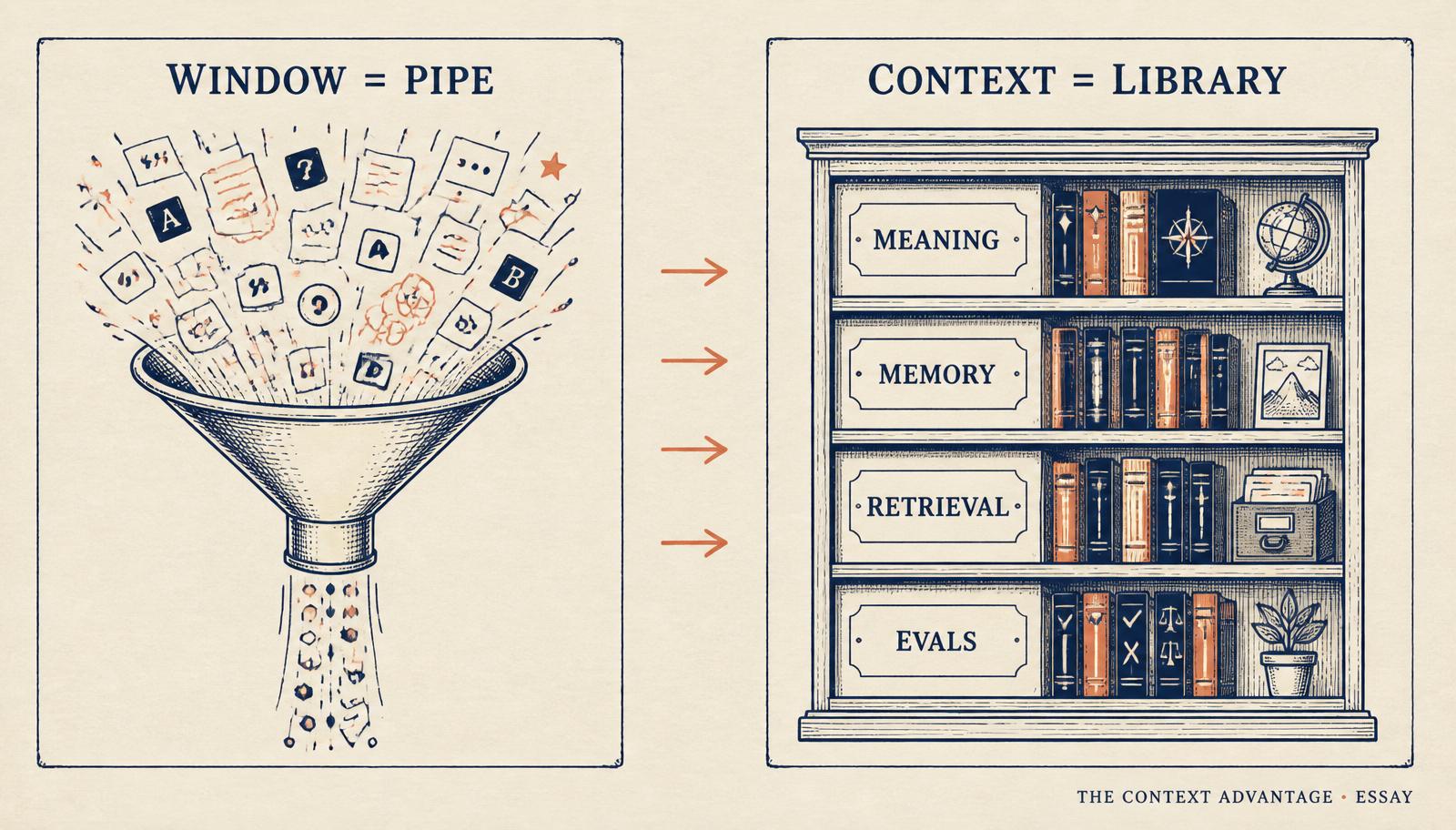
A window is a pipe. It carries whatever you put in it. It does not decide what belongs in it, whether the pieces cohere, whether the model can find the relevant fragment among the noise, or whether the answer that comes out the other side is grounded in anything real. A bigger pipe moves more water. It does not build a reservoir.
The confusion is not academic. Teams that treat window size as a substitute for a context system make five very specific mistakes on the way to production, and each of them shows up on a spreadsheet a quarter later — as retries, as timeouts, as answers nobody trusts, as bills nobody predicted.
What a context window actually is
A context window is the maximum sequence of tokens a model can attend to in a single forward pass. That is the entire definition. It is a mechanical property of the transformer, expensive to widen, worth widening for specific use cases, and mostly indifferent to whether the tokens you fed it have anything to do with the question you asked.
Everything the window does well — hold a whole document, carry a longer agent trace, forgive a sloppy prompt — it does at the level of the transport layer. Nothing about the window has an opinion about what should be transported. Nothing about the window prefers the correct passage to a plausible-looking one. Nothing about the window knows what your company means by revenue, active customer, or eligible.
This is why the earlier essay on this site, 10 Million Tokens ≠ Context, argued that the window changes what is possible and does not change what is true about how these systems fail in production. This piece picks up where that one left off: if the window is not context, what is, and how do you build it.
What context actually is
Context, in the sense that decides whether an enterprise AI product is trustworthy, is a system with four working parts. Meaning — the definitions and relationships the business agrees on. Memory — what the organization has learned and needs to keep. Retrieval — the machinery that decides which slice of meaning and memory belongs in this specific request. Evals — the harness that catches when any of those three drift.
Chapter 4Chapter 4 · 7 min LockedThe 4 C's FrameworkA simple lens for designing trusted enterprise AI. introduces the 4 C's framework the book runs on, and names context as the first of them for a reason. When every serious model is capable enough, the compounding advantage moves one layer up. It moves to the surface that decides what the model sees, when it sees it, and how you know it saw the right thing.
Chapter 6Chapter 6 · 6 min LockedBusiness Meaning Beats Raw RetrievalNaive RAG is not a context strategy. and Chapter 7Chapter 7 · 7 min LockedSemantic Layers, Ontologies, and Metrics in Simple WordsThe big context words, explained without the jargon. go deeper into the meaning half — the semantic layer as a curated, versioned representation of what the business actually means. Chapter 10Chapter 10 · 9 min LockedInstitutional Memory Is the MoatAs frontier models converge, the durable advantage is the accumulated why — decisions, definition history, and organizational logic., Chapter 11Chapter 11 · 7 min LockedContext Is a Living Layer, Not a DocumentDefinitions drift, macro conditions shift, agents relearn — treat context like code, with ownership, versioning, and continuous review., and Chapter 12Chapter 12 · 7 min LockedPortable Context: The Open Contract for AgentsContext is your IP — it must move across agents, models, and clouds through an open contract, not sit locked inside one runtime. — the three chapters added to the book last month — handle memory: how institutional memory becomes the moat, how it has to be run like production code, and how it survives across vendors instead of leasing itself to one.
None of those are properties of the window. All of them are decisions the organization has to make once and maintain forever. A window that inherits none of them is a very fast way to send the wrong answer with more confidence.
Why bigger windows make weak context worse
The intuition most teams start with is that more room in the prompt cannot hurt. If the relevant passage is in there somewhere, the model will find it. If some irrelevant material is in there too, the model will ignore it. Both halves of that intuition are wrong in ways that grow with the size of the window.
The first failure is the exploration tax. When a general-purpose agent does not know the shape of the workspace it is operating in, it explores. It reads tables it does not need. It re-reads schemas because it forgot them between tool calls. Every step of that exploration is billed. A bigger window does not remove the reason to explore. It just makes each exploration step more expensive per token and less selective per answer. Chapter 18Chapter 18 · 6 min LockedThe Hidden Cost of Agentic AIWhere the dollars actually go. works through the arithmetic: in agentic workflows, the dominant cost line is almost never the model itself. It is the cost of wandering.
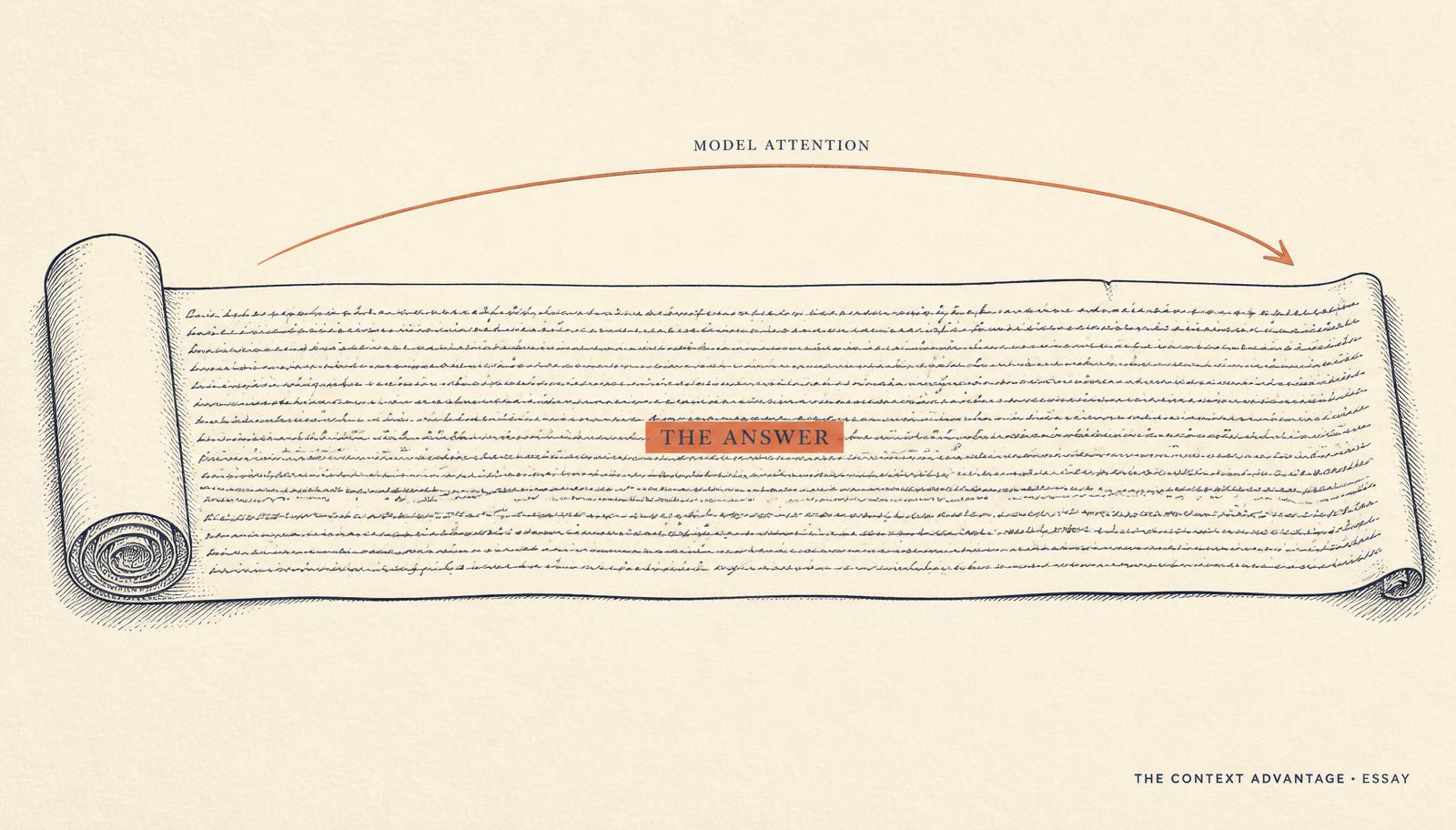
The second failure is lost-in-the-middle. Independent evaluations across every frontier model class in the last two years agree: recall on a needle-in-haystack task is high near the beginning and end of a long context and sags — sometimes by twenty or thirty points — in the middle. The larger the window, the wider the sag. Put your most important policy on page eight hundred and the model will confidently ignore it. This is not a bug that will patch out. It is a consequence of how attention distributes over long sequences.
The third failure is governance drift. When the prompt was four thousand tokens, someone reviewed what was in it. When the prompt is a firehose of documents, memory notes, tool outputs, and retrieval fragments assembled at request time, no one reviewed anything. You have built an ungoverned data pipeline into every model call, and compliance did not sign off on it because nobody told them it existed.
The four layers of a real context system
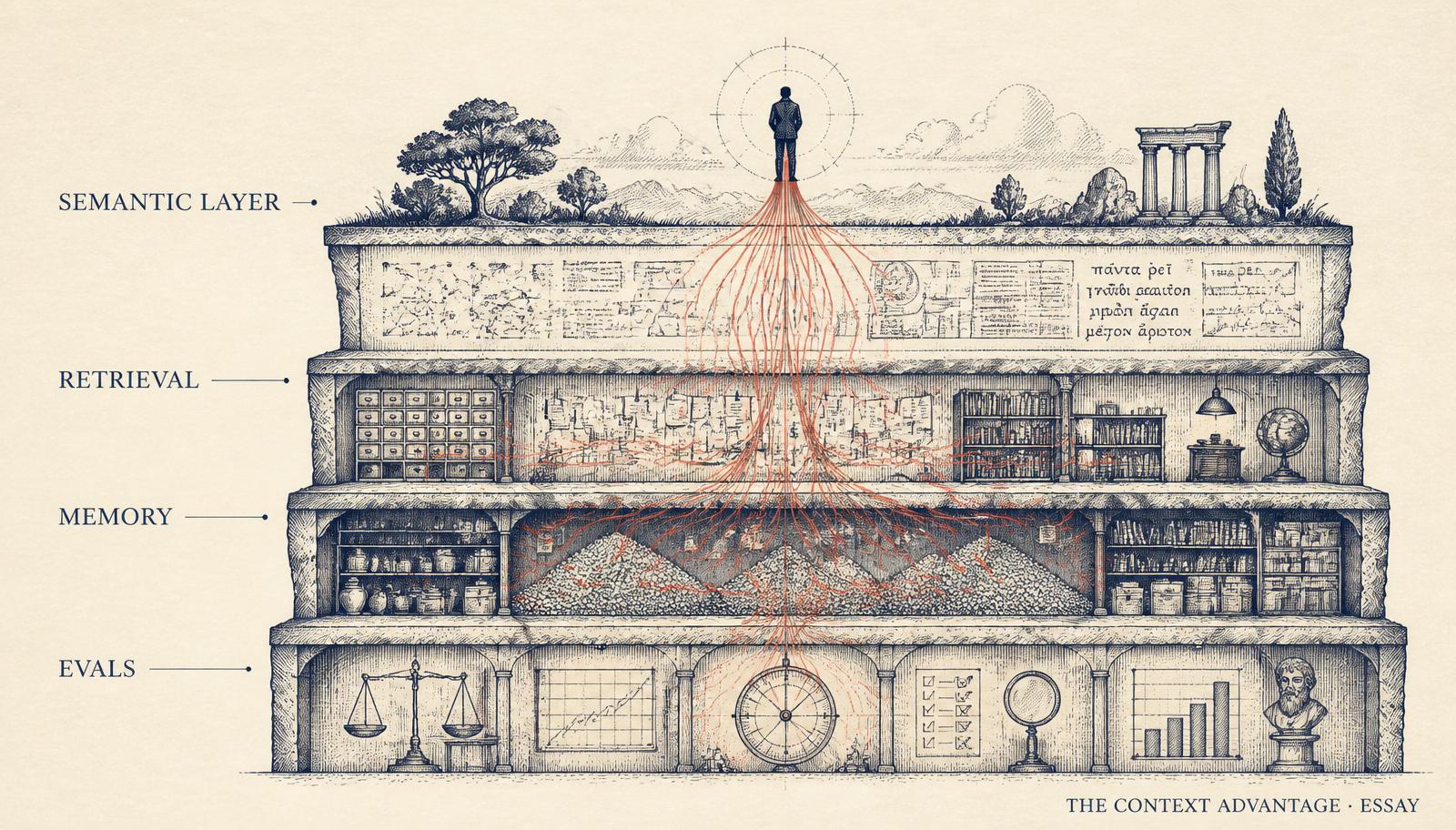
The replacement mental model is not complicated. It is that context is a stack, and every serious enterprise AI program owns four layers of it. The layers do not stand alone. Each depends on the one below.
The semantic layer is the ground floor. It is the durable, versioned definition of the entities, metrics, and relationships the business runs on. It is not a catalog and not a glossary. It is the answer to the question, when this company says active customer, what does it mean, who owns the definition, and how does it change over time. Chapter 6Chapter 6 · 6 min LockedBusiness Meaning Beats Raw RetrievalNaive RAG is not a context strategy. and Chapter 7Chapter 7 · 7 min LockedSemantic Layers, Ontologies, and Metrics in Simple WordsThe big context words, explained without the jargon. make the case that without this layer, everything above it inherits the ambiguity underneath.
Retrieval sits above the semantic layer. Its job is not to squeeze a knowledge base into a small window. Its job is curation — deciding, for this specific request, which slice of meaning and memory belongs in the prompt and which slice would add noise, cost, and latency for no accuracy gain. In 2026, retrieval is not a compression problem. It is an editorial one.
Memory sits above retrieval. It is what the system remembers across turns, sessions, and agents — what a user has already asked, what a team has already decided, what an earlier agent already tried. Chapter 10Chapter 10 · 9 min LockedInstitutional Memory Is the MoatAs frontier models converge, the durable advantage is the accumulated why — decisions, definition history, and organizational logic. argues that memory becomes the moat once the models converge, because it is the only layer that compounds with every interaction. Chapter 11Chapter 11 · 7 min LockedContext Is a Living Layer, Not a DocumentDefinitions drift, macro conditions shift, agents relearn — treat context like code, with ownership, versioning, and continuous review. shows how that memory has to be maintained — reviewed, versioned, evaluated — or it becomes a slowly aging liability instead of an asset.
Evals sit on top of everything. They are the harness that catches when any layer below drifts. Chapter 20Chapter 20 · 6 min LockedBudget-Aware AI DesignDesigning for budgets from day one. and Chapter 22Chapter 22 · 5 min LockedThe Danger of AI Lock-InHow yesterday's choices limit tomorrow's options. explain why evaluations wired to the final answer alone cannot tell you whether a regression came from a model change, a definition change, or a retrieval change. Evaluate the layers, not just the outputs, and you can find the drift before it reaches production.
This is the stack. It is what a specialized agent has that a generic one does not. It is what makes context a compounding investment instead of a per-request one.
The benchmark that already proved it
Anyone who thinks this argument is theoretical should read the Databricks Genie Code benchmark from last week. On four hundred and one real internal tasks, a specialized data agent with semantic search, persistent memory, and workspace understanding beat three leading general coding agents on accuracy and on cost — 76.6 percent correct at $0.55 per task. Same twenty-minute budget. Same access to the underlying tools. Same frontier models available to every competitor.
The specialized agent did not win because it had a bigger window. It won because it did not need one. Its context stack answered most of what the general agents had to explore for. The exploration tax stayed in the general agents' bills, not in Genie Code's.
That result is not a story about which agent to buy. It is the strongest evidence yet published that context density — the amount of relevant, retrievable meaning the system can lean on before it has to spend a tool call to find out — is the axis that collapses the classic accuracy-versus-cost tradeoff. Bigger windows do not deliver density. Systems do.
The three-question test
If a founder or a data leader wants to know, in fifteen minutes, whether they have a context system or just a context window, three questions do most of the work. Each of them targets one of the layers the window cannot substitute for.
One. Who owns the semantic layer? Not who runs the catalog, not who administers the warehouse — who owns the definitions the business acts on. If the answer is a shrug, or four different names on four different teams, the meaning layer does not exist yet. Everything above it is inheriting ambiguity. Chapter 9Chapter 9 · 6 min LockedThe Context EngineerA new role at the heart of agentic systems. makes the case for the Context Engineer role that owns exactly this surface.
Two. What is your retrieval eval? Not the model's eval — the retriever's. Precision and recall and grounding rate, tracked per query type, per corpus segment, per model version. If the retriever is not measured, it is not owned. If it is not owned, it is drifting right now and nobody will find out until a customer does. Chapter 22Chapter 22 · 5 min LockedThe Danger of AI Lock-InHow yesterday's choices limit tomorrow's options. sets the standard.
Three. What survives a model swap? If tomorrow you replaced your primary model with a different vendor's model of similar quality, what would survive intact? The prompts probably would not. The tool contracts might. The semantic layer, the memory, the retrieval index, the eval suite — those either survive cleanly or they do not, and the answer tells you exactly how much of what you have built is context and how much of it was a lease on the model. Chapter 12Chapter 12 · 7 min LockedPortable Context: The Open Contract for AgentsContext is your IP — it must move across agents, models, and clouds through an open contract, not sit locked inside one runtime. is the whole chapter on making the answer be yes.
Three questions. If the honest answers are unclear, unknown, and no, the organization has a window. It does not yet have context.
What this means for the next model release
There will be another window announcement. There always is. Somebody will demonstrate a fifty-million-token prompt reading an entire enterprise wiki and answering trivia about it in a single call. The demo will be impressive. The instinct in every enterprise AI team will be to ask whether the new capacity finally makes the context layer optional.
It does not, and it will not. The demo runs on curated data, an unambiguous question, and no downstream consequences. Production runs on messy data, ambiguous questions, and consequences that can hit customers, regulators, or the board. The gap between demo and production is exactly the gap between window and context. A larger window narrows that gap. It does not close it. Closing it is a systems job — meaning, memory, retrieval, evals — and no vendor is going to close it for you because no vendor knows what your business means.
Chapter 27Chapter 27 · 6 min LockedSkills That Will Matter More Than ToolsDurable skills that outlast every framework, model, and platform. frames this from the demo-to-product angle: what makes a demo look magical (a single call succeeding) is what makes a product economically broken (single calls occasionally succeeding, at the cost of everything else). The window belongs in the demo. The stack belongs in the product.
What to do about this on Monday
Five moves, in order. None of them require permission from a vendor. All of them can start this week.
First, name an owner for the semantic layer. Not a committee, not a working group — one person with the authority to say what active customer means and to make it stick. If that person does not exist, the layer will not, and nothing above it can be trusted. Read Chapter 9Chapter 9 · 6 min LockedThe Context EngineerA new role at the heart of agentic systems. if the role needs a description to hire against.
Second, measure your retriever the way you measure a model. Precision, recall, grounding rate, per query type, per model version. Put the numbers on the same dashboard as the model's accuracy. If retrieval regresses, that becomes visible before customers see the effect.
Third, treat memory as production code. Version it. Own it. Review it on a cadence. The three chapters on institutional memory (10Chapter 10 · 9 min LockedInstitutional Memory Is the MoatAs frontier models converge, the durable advantage is the accumulated why — decisions, definition history, and organizational logic., 11Chapter 11 · 7 min LockedContext Is a Living Layer, Not a DocumentDefinitions drift, macro conditions shift, agents relearn — treat context like code, with ownership, versioning, and continuous review., 12Chapter 12 · 7 min LockedPortable Context: The Open Contract for AgentsContext is your IP — it must move across agents, models, and clouds through an open contract, not sit locked inside one runtime.) exist because most enterprises are running memory as launch documents and getting the associated results.
Fourth, wire evals to the layers, not just the answers. When the number moves, you want to know which layer moved it. Chapter 22Chapter 22 · 5 min LockedThe Danger of AI Lock-InHow yesterday's choices limit tomorrow's options. shows how.
Fifth, write the export contract for your context on day one. If the meaning, memory, and retrieval you build cannot leave one vendor's runtime, you have leased the advantage instead of building it. Chapter 12Chapter 12 · 7 min LockedPortable Context: The Open Contract for AgentsContext is your IP — it must move across agents, models, and clouds through an open contract, not sit locked inside one runtime. is the whole chapter on that mistake.
The through-line
Every year in enterprise AI, one confusion dominates the budget. In 2023 it was prompt engineering versus system design. In 2024 it was RAG versus fine-tuning. In 2025 it was agent frameworks versus workflow engines. Each of those debates burned a lot of quarters and left, in the end, the same lesson: the durable investment is the one that survives the next release, and the next release always changes something.
The 2026 confusion is window versus context. It will resolve the same way. The teams that treat capacity as a substitute for a system will keep paying the exploration tax and keep being surprised when accuracy does not scale with the number in the marketing slide. The teams that build the four-layer stack underneath will keep compounding, quietly, on every model that ships next.
The window is a pipe. Bigger pipes are welcome. But nobody drinks from a pipe. The library is the point.
"A larger window narrows the gap between demo and production. It does not close it. Closing it is a systems job."
Try this at work
- Name one accountable owner for the semantic layer this week — the person who decides what the core business terms mean.
- Add retrieval metrics (precision, recall, grounding rate) to the same dashboard that tracks model accuracy.
- Treat institutional memory as production code — versioned, owned, and reviewed on a fixed cadence.
- Wire evaluations to each layer of the context stack, not only to the model's final answer.
- Write the export contract for your context on day one so nothing you build is leased from a single vendor.
The Context Advantage is the long-form playbook for the four-layer stack this essay names — meaning, memory, retrieval, evals — chapter by chapter, with the checklists and role definitions to run it. Thirty-four chapters, lifetime updates. Start with the free chapters at [/context-advantage/blog](/context-advantage/blog), or unlock the full book at [/context-advantage/buy](/context-advantage/buy).
Explore the book →If the next model release doubled your context window overnight, which of the problems your users actually complain about would go away?