The refinement gap
Almost every production AI agent that gives wrong answers is retrieving the right documents. That is the part teams find hardest to accept. The retrieval works. The embedding model is fine. The reranker is doing its job. The agent pulls back the three most relevant pages in the company wiki, reads them faithfully, and produces an answer that is confidently, specifically wrong.
The reason is that the wiki page was written for a human who already knew four things the page never says. It does not say which of the two definitions of active customer applies. It does not say that the policy changed in March. It does not say who owns the number or where it came from. It does not say that the paragraph below it was superseded and nobody deleted it. A human reader fills those gaps automatically from years of accumulated organizational memory. A model has no such memory, so it fills them with plausible invention.
AI business context refinement is the discipline of closing that gap on purpose. It is the work of converting raw organizational knowledge into structured, attributed, versioned units that a retrieval system can serve and a model can ground on without guessing. It sits between your source systems and your retrieval index, and in most enterprises it is the single largest unclaimed source of quality improvement available right now.
This guide is the practical version: what refinement produces, the five stages of the pipeline, how to measure it, and where teams most often get it wrong. If you are building production agents and your quality has plateaued despite better models, this is almost certainly your bottleneck.
Refinement is not prompt engineering
The confusion is worth killing early, because it costs teams entire quarters. Prompt engineering shapes how the model reasons over the material it is given. Context refinement shapes the material itself. One is a runtime concern measured in tokens; the other is a data engineering concern measured in coverage, freshness, and attribution.
The practical test is simple. If the fix lives in a template that is rewritten per request, it is prompting. If the fix lives in an artifact that persists, is versioned, is owned by a named person, and improves every future request against it, it is refinement. Prompting has a ceiling set by the quality of the retrieved material, and no amount of instruction gets a model past a source document that is ambiguous, stale, or contradicted by its neighbor.
Refinement is also distinct from ingestion, which is the other common conflation. Ingestion moves bytes: it crawls the wiki, parses the PDFs, chunks the text, and writes vectors. Ingestion is necessary and it is not sufficient, because it faithfully preserves every ambiguity in the source. A pipeline that ingests without refining produces a high-recall index of unreliable statements, which is the exact architecture behind most disappointing retrieval-augmented generation projects.
The essay on why retrieval alone is not enough makes the broader argument at /context-advantage/blog/rag-is-not-enough, and Chapter 4Chapter 4 · 7 min LockedThe 4 C's FrameworkA simple lens for designing trusted enterprise AI. develops the case that meaning — not storage and not retrieval — is the layer enterprises are actually missing.
What a refined context unit looks like
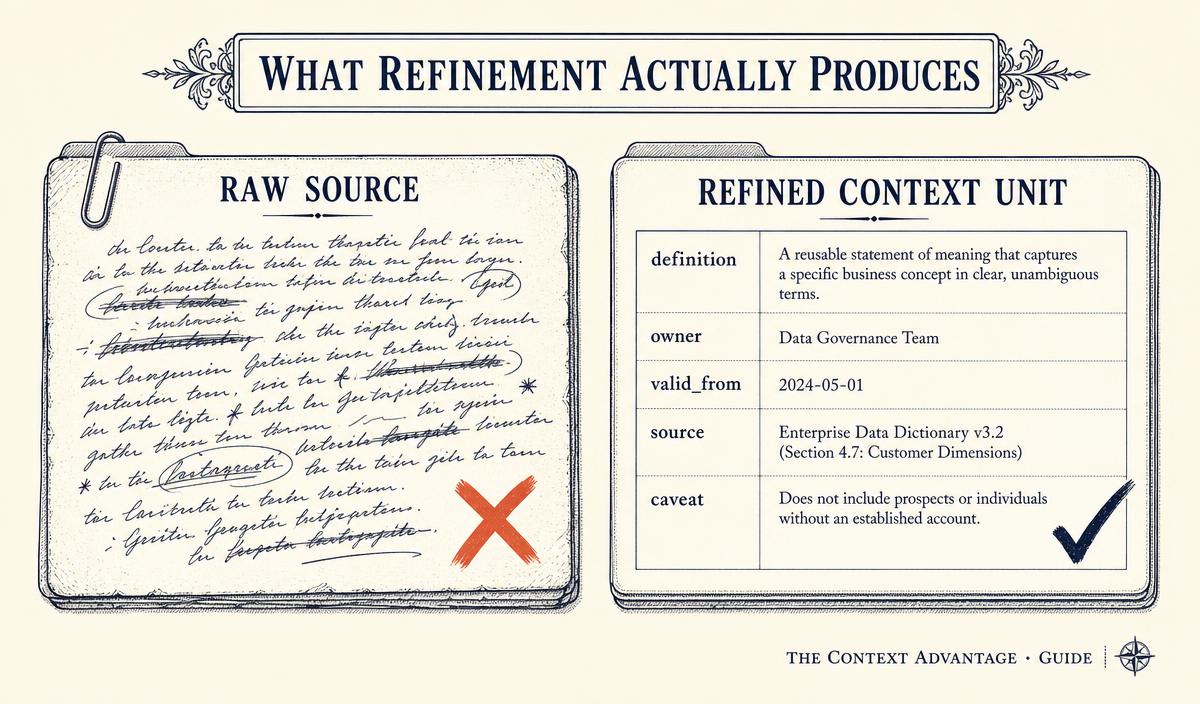
Refinement has an output artifact, and naming it precisely is what makes the work tractable. Call it a context unit: the smallest self-contained statement of organizational meaning that a model can retrieve and use without needing anything else.
A context unit has a body and a set of required fields. The body is a single claim or definition, written to be read cold by someone with no institutional background — which is exactly the reader profile of a language model. The fields carry everything the body cannot: a definition scope, an owner, a validity window, a source pointer, and any caveats or exclusions that a careless reader would miss.
Those fields are not bureaucracy. Each one prevents a specific, observed failure. The owner field prevents the orphaned-truth problem, where nobody can confirm whether a statement is still correct. The validity window prevents the stale-answer problem, where a superseded policy outranks its replacement because it is better written. The source pointer makes citation possible, which is what converts an answer into something a person can verify. The caveat field prevents the most expensive category of error in enterprise AI — a technically correct number applied to the wrong population.
Chunk size, embedding choice, and hybrid search all matter, but they operate on whatever you hand them. Chapter 35Chapter 35 · 11 min LockedRetrieval Mechanics: Chunking, Hybrid Search, and RerankingThe engineering layer under every context strategy — chunking, hybrid search, reranking, and how to prove it works. covers those retrieval mechanics in depth; refinement is the upstream discipline that decides what those mechanics have to work with.
The five-stage refinement pipeline
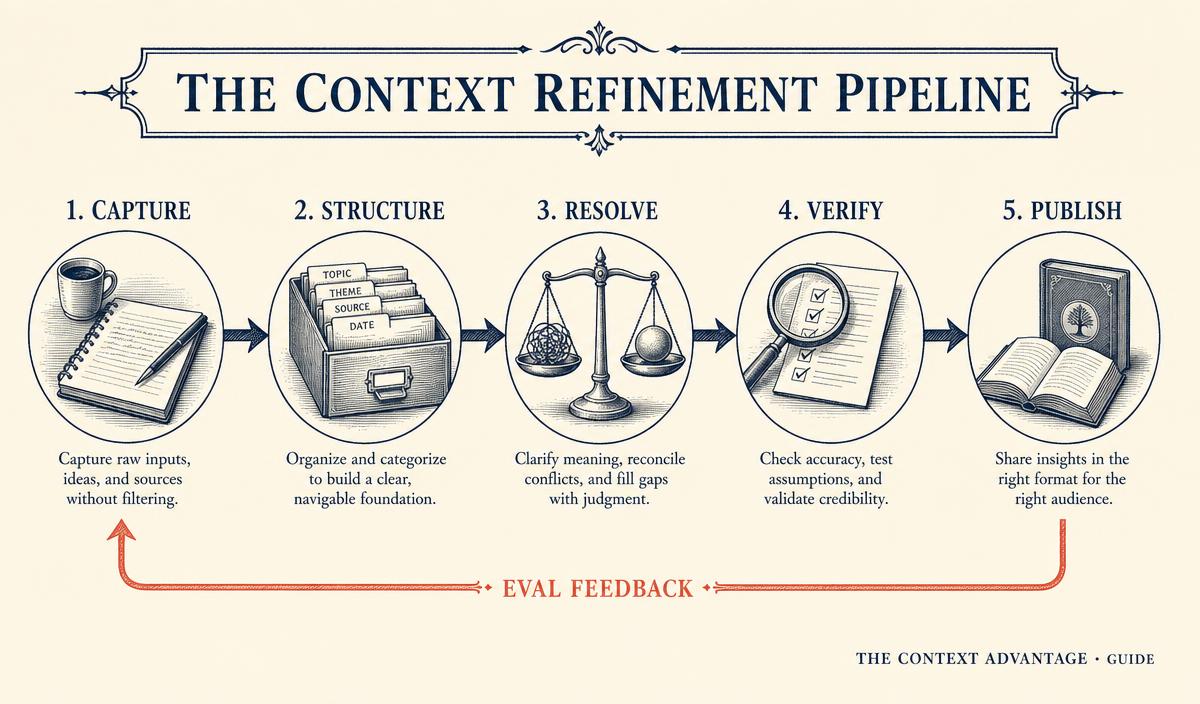
Refinement is repeatable, which means it should be a pipeline with stages, owners, and tests — not a one-time cleanup project that a well-meaning team does before launch and never repeats. Five stages, each with a clear input and output.
Capture is the first stage, and its only job is coverage. Pull from every system where organizational meaning actually lives, which is rarely just the wiki: ticket resolutions, decision records, contract clauses, Slack threads where a definition got settled, the comments in the metrics repository. The failure mode here is capturing only the tidy sources, which produces an index that is clean and incomplete.
Structure is the second stage. Decompose captured material into candidate context units and attach the required fields. This is the stage where language models genuinely help — extraction, field population, and first-pass decomposition are well within reach of a mid-sized model with a good schema. It is also the stage where teams over-trust automation, which is why the next two stages exist.
Resolve is the third stage and the one nobody plans for. Your sources contradict each other. Two definitions of the same metric, three revenue-recognition rules, a policy that changed and a page that did not. Resolution is a human decision with a machine-readable output: pick the authoritative version, mark the others superseded with a pointer, and record who decided. Skipping this stage is how you get an agent that answers the same question two different ways depending on which chunk wins the similarity contest.
Verify is the fourth stage. Every refined unit gets checked against the questions it is supposed to answer, using an evaluation set built from real queries. This is not optional polish; it is the only way to know that refinement improved anything. Chapter 29Chapter 29 · 6 min LockedCareer Roadmap for the Agentic EraLearning paths for beginners, intermediates, and senior professionals. makes the case for treating evaluation as core infrastructure, and the companion essay at /context-advantage/blog/evals-are-the-new-dashboards covers how to build the suite.
Publish is the fifth stage: write the verified units into the retrieval index with their fields intact as filterable metadata, and emit a version. The feedback loop closes here — evaluation failures in production become capture and resolve tasks in the next cycle, which is what makes the pipeline a living system rather than a migration. Chapter 11Chapter 11 · 7 min LockedContext Is a Living Layer, Not a DocumentDefinitions drift, macro conditions shift, agents relearn — treat context like code, with ownership, versioning, and continuous review. argues that context has to be treated as a living layer for exactly this reason.
Measuring refinement
Refinement without measurement becomes a documentation project, and documentation projects lose funding. Four metrics are enough to keep it honest, and all four are cheap to compute.
Coverage is the share of your real question distribution that has at least one refined unit capable of answering it. Build the denominator from actual queries, not imagined ones. Coverage is the metric that tells you whether to keep capturing.
Groundedness is the share of agent answers where every factual claim traces to a retrieved unit. This is the metric most directly correlated with user trust, and it is the one that improves fastest when refinement starts working, because attribution becomes mechanically possible.
Freshness is the share of served units whose validity window includes today and whose owner has confirmed them within your review interval. Freshness decays silently, which is why it needs a number rather than a vibe.
Conflict rate is the share of queries where retrieval returns units that contradict each other. It is the direct measure of whether your resolve stage is keeping up, and it is the leading indicator of the inconsistent-answer complaints that erode confidence in an agent faster than outright errors do.
Watch the four together, because they trade against each other in instructive ways. Aggressive capture raises coverage and conflict rate at the same time. Aggressive pruning improves freshness and hurts coverage. The trade-offs are the same class of engineering decision described in Chapter 21Chapter 21 · 6 min LockedQuality, Speed, and Cost TradeoffsHow to balance accuracy, latency, and spend., and they should be made deliberately rather than discovered.
Where refinement pipelines go wrong
The most common failure is treating refinement as a project. A team spends a quarter cleaning the knowledge base, ships an agent, declares victory, and moves on. Six months later quality has drifted back to baseline, because the organization kept making decisions and nobody kept refining them. Refinement is an operating cost, not a capital expense, and it needs a standing owner the way a data pipeline does.
The second failure is refining everything. Enterprises have enormous document estates and most of it never gets asked about. Start from the top fifty real questions, refine only what answers them, and expand as coverage data tells you where the gaps are. Breadth-first refinement burns quarters and produces beautifully structured knowledge nobody queries.
The third failure is full automation. Extraction and field population automate well. Resolution does not, because resolving a contradiction between two business definitions is an authority decision, not a text-processing task. Teams that automate resolution end up with a system that has confidently picked the wrong definition at scale, which is strictly worse than an unresolved conflict a human can see.
The fourth failure is refining into a proprietary black box. If your refined units live in a format only one vendor's platform can read, the most valuable asset your AI program produces has become non-portable. Chapter 12Chapter 12 · 7 min LockedPortable Context: The Open Contract for AgentsContext is your IP — it must move across agents, models, and clouds through an open contract, not sit locked inside one runtime. makes the case for portable context, and the essay at /context-advantage/blog/the-exit-test-ai-vendor-portability gives you the test for whether yours actually is.
The fifth failure is organizational rather than technical: refinement with no named owner. It sits between the data team, the domain experts, and the AI team, and work that sits between three teams belongs to none of them. Name a person. Chapter 22Chapter 22 · 5 min LockedThe Danger of AI Lock-InHow yesterday's choices limit tomorrow's options. describes the emerging role that increasingly does this job full time.
Where to start this week
The smallest useful version of this takes about a week and does not require a platform decision, a budget line, or a reorganization.
Collect the fifty questions people most often ask your agent, from logs if you have them and from the support queue if you do not. For each, record whether the current answer is right, wrong, or unverifiable. Unverifiable is the interesting bucket, because it is almost entirely a refinement problem rather than a model problem.
Take the ten worst offenders and refine by hand. Write each answer as a context unit with all five fields filled in, resolving conflicts as you go and recording who decided. Ten units is enough to feel where your sources are actually broken, and hand-refining first is what tells you which parts of the work automate well.
Then run the before-and-after evaluation on just those ten questions and write down the groundedness delta. That single number is what funds the pipeline, because it converts an abstract argument about knowledge quality into a measured improvement a stakeholder can act on.
The strategic point behind all of this is that refined context is the part of your AI stack nobody else can buy. Models are available to your competitors on the same terms. Frameworks are open source. The structured, resolved, owned representation of how your organization actually works is the one asset that is genuinely yours, and it compounds every cycle you keep refining it.
"Your competitors can buy the same model tomorrow. They cannot buy a refined, resolved, owned representation of how your business actually works."
Try this at work
- Collect the fifty most frequent real questions and classify each answer as right, wrong, or unverifiable.
- Define a context unit schema with definition, owner, validity window, source, and caveats as required fields.
- Stand up the five stages with a named owner each: capture, structure, resolve, verify, publish.
- Keep resolution human — automate extraction and field population, never authority decisions.
- Track coverage, groundedness, freshness, and conflict rate on a weekly cadence.
- Store refined units in an open, exportable format so the asset stays portable.
Context is the first of the four C’s in The Context Advantage — thirty-six chapters on Context, Control, Cost, and Choice, including full treatments of retrieval mechanics, institutional memory, context as a living layer, and the evaluation practices that keep refinement honest. Read the free chapters at [/context-advantage/book](/context-advantage/book), or unlock the full book at [/context-advantage/buy](/context-advantage/buy).
Explore the book →Of the last ten wrong answers your agent produced, how many were retrieval failures — and how many were faithful readings of a source nobody had refined?