The month you find out intelligence is a rental
There is a specific Tuesday that arrives in every serious AI programme. A newer model appears, somebody swaps the endpoint on a Tuesday afternoon, the evaluation suite runs green, and by Wednesday the change is invisible to everybody outside the team that made it. Nothing about the product feels different. Nothing about the company feels different. The thing that was supposed to be the crown jewel of the architecture turned out to be a component with a part number.
That Tuesday is the most strategically useful day of the whole programme, and most organisations waste it. The correct reaction is not relief that the migration was easy. The correct reaction is a question: if the model can be replaced in an afternoon without anybody noticing, then whatever makes this product worth paying for is not the model. So what is it, where does it live, and who actually owns it?
The answer is almost always the same, and it is almost never on the architecture diagram. What makes the system valuable is the accumulated record of a relationship — with a customer, with a business unit, with a regulator, with a body of work. The model supplies fluency and reasoning, which you lease. The record supplies knowledge of this specific customer, this specific promise, this specific exception, which nobody can lease to you and nobody can lease away from you unless you let them.
That is the asymmetry this essay is about. Intelligence is converging towards a utility. Relationship is diverging into a moat. The programmes that win the next five years are the ones that keep those two things clearly separated and make deliberate ownership decisions about each.
What you rent, and what you own
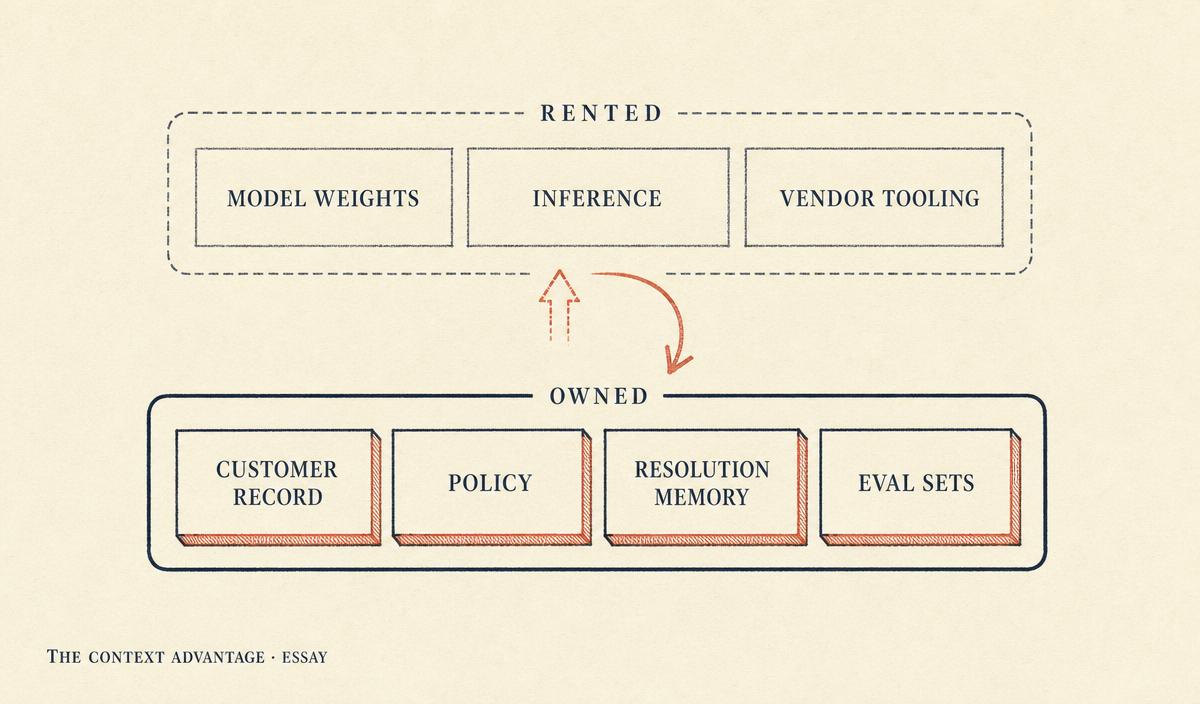
Draw the line explicitly, because a great deal of confused strategy comes from failing to draw it. On the rented side sit model weights, inference capacity, the vendor console, the orchestration framework of the season, and the embedding endpoint. Every one of these is substitutable, priced competitively, and improving without any effort on your part. Treating any of them as a differentiator is a category error, and paying a strategic premium for one is a mistake you will notice in about eighteen months.
On the owned side sit four things. The customer or entity record: identity, entitlements, contract terms, open commitments. The policy: what your organisation is willing to do, for whom, under what conditions, and who must approve the edge cases. The resolution memory: what happened last time, what worked, what was escalated, and what was quietly agreed. And the evaluation sets: the encoded, versioned statement of what a good answer looks like in your business, which is the single most underrated asset in any AI programme.
Notice what these four have in common. None of them can be bought. None of them arrive with a model upgrade. All of them get more valuable every month you operate, because every interaction adds to them. And all of them are cheap to lose, because they can be created inside somebody else's product without a single decision ever being made about it.
This division is the practical form of the argument in Chapter 34Chapter 34 · 7 min LockedDesigning Multi-Agent Systems That Actually WorkWhen one agent is not enough — and how to make many cooperate without chaos. on choice and lock-in, and it depends on the portability work in Chapter 12Chapter 12 · 7 min LockedPortable Context: The Open Contract for AgentsContext is your IP — it must move across agents, models, and clouds through an open contract, not sit locked inside one runtime.. Rent the fungible layer aggressively and switch it often. Own the compounding layer completely and never let it live somewhere you cannot read it.
What is actually inside a relationship record
Companies nod at the idea of owning the relationship and then discover they cannot describe it in schema terms. So describe it. A usable relationship record has six layers, and each one fails in a different way when it is missing.
Identity and entitlement: who this party is, what they have bought, what tier they are on, what they are contractually owed. Without it the agent is polite and useless, because every answer has to be hedged. History: the interactions that came before, in enough fidelity that the current conversation does not start from zero. Without it your customer repeats themselves, which is the single most reliable way to make an expensive AI system feel cheaper than a human on a bad day.
Commitments: what your organisation has promised this party, including the informal promises made by a support agent at 4pm on a Friday. Without it the system contradicts its own company, which is worse than not answering. Exceptions: the cases where policy was deliberately bent, by whom, and on what authority. This is the most valuable and least captured layer in almost every business, because exceptions live in people's heads and in closed tickets rather than in any structured store.
Judgement: the reasoning pattern your best operators apply when the rules do not decide the case. And provenance: which of the five layers above the system actually used to produce a given answer, so that a human can audit it later. That last layer is what turns a relationship record from a convenience into something you can defend in front of a regulator, and it is the subject of Chapter 4Chapter 4 · 7 min LockedThe 4 C's FrameworkA simple lens for designing trusted enterprise AI. on meaning and Chapter 10Chapter 10 · 9 min LockedInstitutional Memory Is the MoatAs frontier models converge, the durable advantage is the accumulated why — decisions, definition history, and organizational logic. on institutional memory as a moat.
One curve is falling, the other is compounding
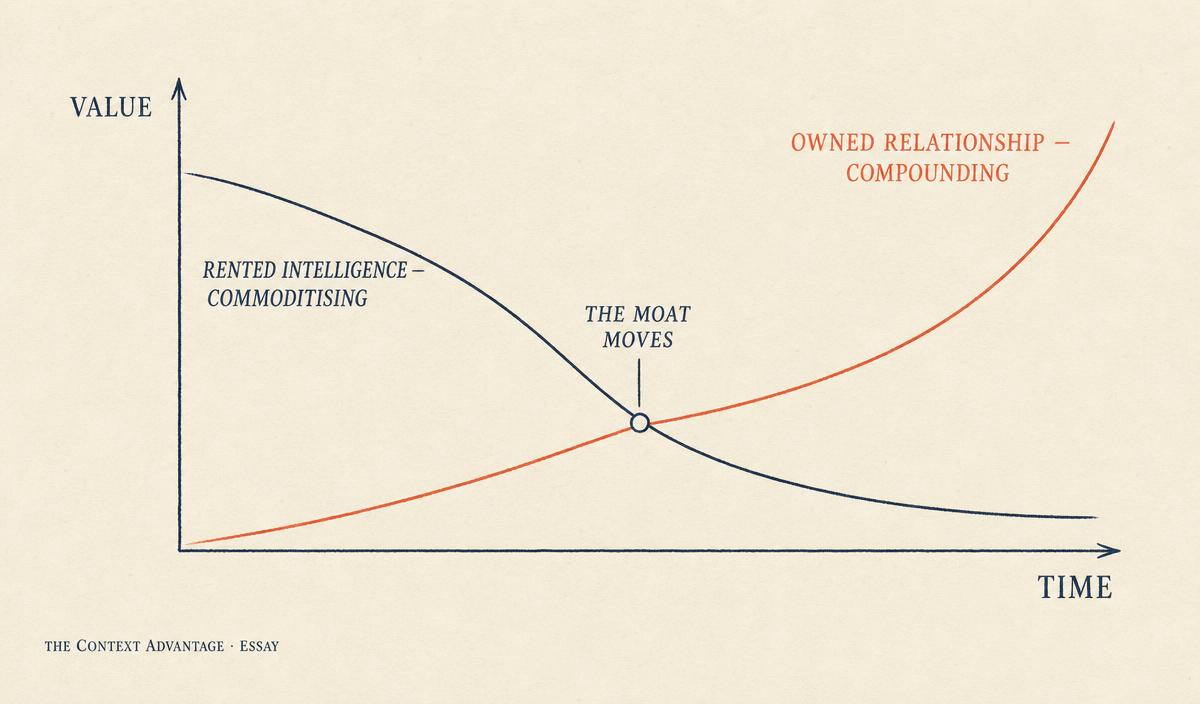
The economics here are not subtle, they are simply mis-tracked. The cost of intelligence per unit of work has fallen by more than an order of magnitude in the space of a couple of years and shows no sign of stopping. Capability is converging too: the gap between the best available model and the third best, measured on the tasks most enterprises actually run, is now small enough that it rarely determines outcomes. Anything on that curve is heading towards a commodity, and commodity inputs do not produce durable advantage no matter how much you spend on them.
The relationship curve runs the other way. Each resolved case adds an exception. Each escalation adds a judgement pattern. Each corrected answer improves an evaluation set. Each month of operation makes the record denser, and a denser record makes every future answer cheaper and more accurate at the same time. That is compounding, and compounding is the only mechanism in business strategy that reliably outruns competitors with the same budget and the same vendors.
The two curves cross. Before the crossing, the model choice feels like the decision that matters, and organisations spend accordingly — benchmark bake-offs, model committees, premium contracts. After the crossing, the model is a line item and the record is the product. Most enterprises are past the crossing already and are still budgeting as though they are before it.
Chapter 18Chapter 18 · 6 min LockedThe Hidden Cost of Agentic AIWhere the dollars actually go. and Chapter 19Chapter 19 · 6 min LockedNot Every Task Needs the Best ModelRouting, cascades, and right-sized intelligence. work through the cost structure this implies, and Chapter 11Chapter 11 · 7 min LockedContext Is a Living Layer, Not a DocumentDefinitions drift, macro conditions shift, agents relearn — treat context like code, with ownership, versioning, and continuous review. treats context as a living layer rather than a project — which is the only framing under which compounding actually happens.
Three ways companies give the relationship away
Nobody signs a contract that says the vendor owns your customer memory. The transfer happens through default settings and reasonable-seeming shortcuts, and it happens in three recognisable ways.
The first is transcripts that only exist inside the vendor. Every conversation your agent has with a customer is a new row of relationship history, and in a great many deployments those rows are written to the platform's conversation store, read through the platform's dashboard, and never land in a system you control. When you leave, you get a CSV export if you are lucky, stripped of the structure that made it useful. Two years of accumulated history becomes two years of unstructured text.
The second is memory written in a proprietary shape. Long-term memory is now a checkbox in most agent platforms, and it works well enough that teams adopt it without asking what shape the memory takes. The summaries, embeddings, entity links, and salience scores are all generated by the vendor's pipeline against the vendor's schema. The content is nominally yours. The structure — which is where the value is — is not portable, and re-deriving it against a new platform costs more than the original build.
The third is policy encoded as prompt text in somebody else's console. This is the quietest and most damaging one. Your escalation rules, tone guidance, refusal conditions, and approval thresholds are the codified judgement of your organisation. When they live as untracked strings in a vendor UI, edited by whoever had the tab open, they are not an asset — they are neither versioned, reviewable, testable, nor exportable. Chapter 15Chapter 15 · 6 min LockedGuardrails, Approvals, and Audit TrailsDesigning safe agent behavior in practice. and Chapter 16Chapter 16 · 5 min LockedTrust Is Designed, Not AssumedHow leaders earn confidence in AI systems. make the case that policy has to be an artifact under change control, and the portability argument is a second, independent reason for the same conclusion.
The portability contract
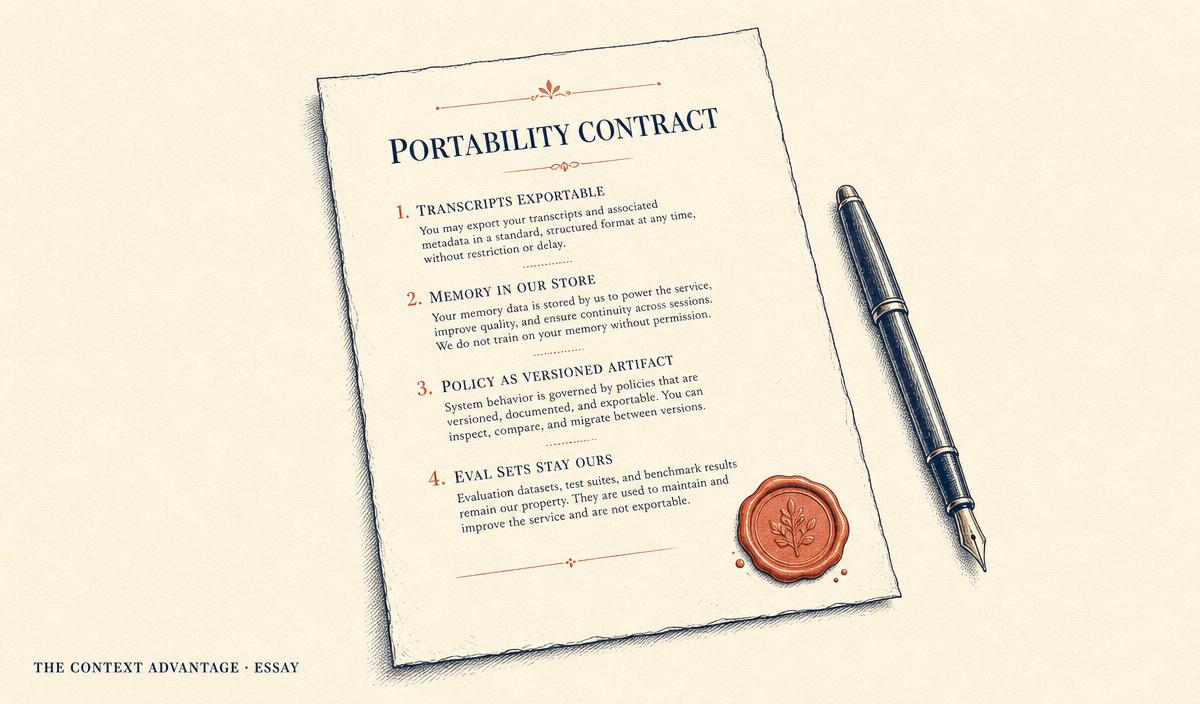
Owning the relationship is not a philosophy, it is four clauses you either can or cannot satisfy today. Write them down, test them against your current stack, and treat every failure as a project rather than a preference.
One: transcripts are exportable in a structured form you designed, on a schedule, without asking anybody. The test is not whether an export button exists. The test is whether last night's conversations are already in your own store this morning, with turn structure, tool calls, citations, and outcomes intact.
Two: long-term memory lives in a store you operate. The vendor may read it and may propose additions, but the canonical record — entities, summaries, salience, decay — is written by a pipeline you can inspect and re-run. If you cannot rebuild your memory layer against a different model in a week, you do not own it.
Three: policy is a versioned artifact in your repository, rendered into the platform at deploy time rather than typed into it. Every change has an author, a diff, a reviewer, and a test. Four: evaluation sets stay yours, in your repository, and run in your pipeline. Golden cases, rubric definitions, and regression thresholds are the encoded form of your standards, and they are the one asset that makes switching vendors safe, because they let you prove the replacement is not worse before you commit.
These four clauses are the operational core of Chapter 12Chapter 12 · 7 min LockedPortable Context: The Open Contract for AgentsContext is your IP — it must move across agents, models, and clouds through an open contract, not sit locked inside one runtime. on portable context, and they pair naturally with the vendor evaluation approach in Chapter 29Chapter 29 · 6 min LockedCareer Roadmap for the Agentic EraLearning paths for beginners, intermediates, and senior professionals.. If you are choosing a platform this quarter, the AI vendor scorecard turns them into questions you can ask on a call, and the exit test turns them into a drill you can actually run.
The relationship is also a liability
There is an uncomfortable corollary to all of this, and skipping it produces the sort of programme that gets shut down by legal in month fourteen. A record dense enough to be a moat is dense enough to be a serious risk. The same accumulation that makes the agent feel like it knows your customer makes it capable of remembering something it should have forgotten, revealing something to the wrong party, or acting on a commitment that has since been withdrawn.
So ownership has to arrive with governance attached, and the governance questions are specific rather than abstract. Who consented to what being remembered, and does the record hold that consent alongside the content? What is the retention rule per layer — because a contract term should probably outlive a conversational aside by years. Which fields are redacted before they ever reach a model prompt. Which memories a given agent is entitled to read, and which it is entitled to write. And how a deletion request propagates through summaries and embeddings that were derived from the deleted source, which is the part nearly everybody gets wrong on the first attempt.
This is where control stops being a compliance chore and becomes an enabler. Teams with a governed memory layer ship more aggressively, because they can answer the questions that otherwise stall a launch. Teams without one negotiate every release. Chapter 15Chapter 15 · 6 min LockedGuardrails, Approvals, and Audit TrailsDesigning safe agent behavior in practice. and Chapter 16Chapter 16 · 5 min LockedTrust Is Designed, Not AssumedHow leaders earn confidence in AI systems. cover the mechanics of action-level control and audit; the point worth carrying is that governed memory is faster memory, not slower memory.
Depth beats length, and depth is cheaper
There is a tempting shortcut available now that context windows are enormous: skip the record and simply push everything into the prompt. It works in a demonstration and it fails in production for reasons that are economic rather than technical.
A well-maintained relationship record lets you assemble a small, precise context for each request — the three relevant prior interactions, the two applicable policies, the one exception that governs this account. A large window with no record encourages the opposite: a wide dump of loosely relevant material, re-sent on every turn, at a token cost that scales with your traffic and an accuracy cost that scales with the noise. The cheapest accurate answer comes from knowing exactly which forty lines matter, and only a curated record can tell you that.
The mechanics are worked through in Chapter 35Chapter 35 · 11 min LockedRetrieval Mechanics: Chunking, Hybrid Search, and RerankingThe engineering layer under every context strategy — chunking, hybrid search, reranking, and how to prove it works. on retrieval and Chapter 36Chapter 36 · 10 min LockedCompaction and the Token BudgetBudget tokens like money, compact history without dropping commitments, and detect degradation before a user does. on compaction and the token budget, with the budget-aware design patterns in Chapter 21Chapter 21 · 6 min LockedQuality, Speed, and Cost TradeoffsHow to balance accuracy, latency, and spend.. The strategic reading is simpler: investment in the owned layer reduces your spend on the rented layer. Depth of relationship is not only the moat, it is the discount.
This is also why the two curves reinforce each other rather than trading off. The better your record, the smaller the model you can use for a given quality bar, and the smaller the model, the less it matters which vendor supplies it. Ownership of the relationship buys you genuine freedom in the rented layer, and freedom in the rented layer is what keeps its price honest.
The audit you can run this week
Take your most-used agentic workflow and answer five questions in writing. First: if the underlying model were withdrawn tomorrow, what would the migration cost, and how much of that cost is re-deriving things you thought you owned? Second: where do last night's conversations physically live, and can you query them without a vendor login? Third: where is your policy text, and does it have a commit history?
Fourth: could you rebuild your long-term memory layer against a different platform, and how long would it take? Fifth: do you have an evaluation set that would tell you, within a day, whether a replacement is worse than the incumbent? If the answer to the fifth question is no, that is where to start, because every other move in this essay is unsafe without it.
The pattern in the answers will be consistent and slightly embarrassing. The rented layer will look well managed, because vendors compete to make it easy. The owned layer will be scattered across a conversation store you do not control, a prompt field somebody edited last month, and the memory of two senior people who are the real context engine of your company. That is the gap. Closing it is not a platform purchase. It is a decision about which half of your stack you intend to actually own.
Rent the intelligence with a clear head and change suppliers whenever it suits you. Build the record that makes the intelligence worth anything, keep it in your own hands, and let it compound. The models will keep arriving on their own schedule. The relationship only accumulates if somebody decides it should.
"If your model can be replaced in an afternoon and nobody notices, the model was never the product. The record underneath it was."
Try this at work
- List your stack in two columns, rented and owned, and be honest about which column each item is actually in today.
- Set up a nightly structured export of agent conversations into a store you operate, with turn structure and tool calls preserved.
- Move long-term memory generation into a pipeline you can inspect and re-run against a different model.
- Put every prompt, policy, and refusal rule in version control with a reviewer, and render it into the platform at deploy time.
- Build a golden evaluation set of fifty real cases, keep it in your repository, and make it the gate for any vendor or model change.
- Attach a retention rule and a consent basis to each memory layer, and test that a deletion request propagates into derived summaries.
- Run a one-day portability drill: stand the workflow up on a second model using only assets you own.
Choice is the fourth of the four C’s in The Context Advantage. Chapters 10 through 12 build institutional memory, the living context layer, and portable context; Chapters 15 and 16 cover governed action; Chapters 18 through 21 cover the economics; and Chapters 34 through 36 cover lock-in, retrieval mechanics, and the token budget. Start with the free chapters at [/context-advantage/book](/context-advantage/book), or unlock the full book at [/context-advantage/buy](/context-advantage/buy).
Explore the book →If your primary AI vendor disappeared this quarter, how much of what makes your agent valuable would leave with them — and who in your organisation could answer that today?