1. The sentence that identifies the real bottleneck
Databricks CEO and co-founder Ali Ghodsi recently joined Brian Halligan on Long Strange Trip to discuss his path to the CEO role, how he hires, and where enterprise AI goes next. Near the end, the conversation moved from leadership to the constraint hiding underneath most corporate AI programmes: "You need to capture the enterprise context — every meeting that is being recorded, every email — then feed it to your AI." The episode places the discussion inside a broader claim that enterprises still use powerful AI like a chatbot when the larger opportunity is coordinated agents that move work forward. The full conversation is available from Sequoia Capital.
The important word is not capture. It is context. A model can know the public world and still know almost nothing about why your organisation works the way it does. It does not know that the policy in the handbook was softened after a customer escalation. It does not know that finance approved one exception for one region. It does not know that the metric called active customer changed in April, or that the product team promised a capability during Tuesday's account review, or that an incident runbook is technically current and operationally ignored.
That missing knowledge is the distance between an impressive answer and useful work. A chatbot can survive the gap because a human reads the answer, supplies what is missing, and decides what to do. An autonomous agent cannot. When an agent plans, delegates, writes, approves, updates systems, or hands work to another agent, missing organisational context becomes an operational defect.
This is the heart of Chapter 5Chapter 5 · 7 min LockedContext Is the New Data LayerWhy meaning sits above storage and compute.: context is not another document collection. It is the data layer that explains what the business means now.
2. The enterprise already produces its memory — then throws most of it away
Every organisation generates a continuous stream of meaning. Meetings explain why decisions were made. Email records commitments and exceptions. Tickets reveal where policies fail in practice. Customer calls expose language no product taxonomy contains. Documents state the official rule. Workflow events show what people actually did. Together, these sources form the lived model of the company.
Most of that model is transient. A decision is discussed in a meeting, summarised imperfectly in a message, and remembered by three people. Six months later, one has left, one has changed teams, and one remembers the conclusion but not the constraint that produced it. The organisation still has the recording, transcript, and email thread, but possession is not memory. Nobody can reliably retrieve the decision at the moment it matters.
This is why Chapter 8Chapter 8 · 8 min LockedFrom Data Catalog to Business MemoryCatalogs describe data. Memory describes meaning. distinguishes a data catalog from business memory. A catalog can tell an agent where a table lives. Business memory tells it why the revenue definition changed, who approved the change, which reports still use the old version, and what date the new rule became effective.
The first opportunity is therefore not to make agents remember everything. It is to stop the organisation from forgetting the few things that should remain true after the meeting ends.
3. Recording everything is not the strategy
Taken literally, the instruction to capture every meeting and email creates a larger problem than the one it solves. A complete corporate transcript is not a knowledge base. It is a surveillance system, a legal discovery surface, a security target, and an expensive archive full of contradictory statements. More raw material does not automatically produce more truth.
A useful company memory layer begins with boundaries. Which conversations may be captured? Who consented? Which categories — legal privilege, health information, employee relations, acquisition planning, customer secrets — must be excluded or isolated? How long should raw records survive? Can a person see and challenge a memory derived from something they said? What happens when local law, contract terms, or works-council rules differ by region?
These are not objections to the vision. They are the engineering requirements that make the vision legitimate. Chapter 13Chapter 13 · 6 min LockedGovernance Was Built for Humans. Agents Need More.Access control is not action control. explains why governance designed for human readers does not cover autonomous actors. Chapter 14Chapter 14 · 7 min LockedFrom Access Control to Action ControlMoving from who can see to what can act. moves the question from who may see a source to what an agent may do with what it learned.
The design principle is simple: capture deliberately, not indiscriminately. The goal is not an omniscient corporate recorder. The goal is a governed path by which important organisational knowledge can become available to the right agent for the right task, without becoming available to every agent for every task.
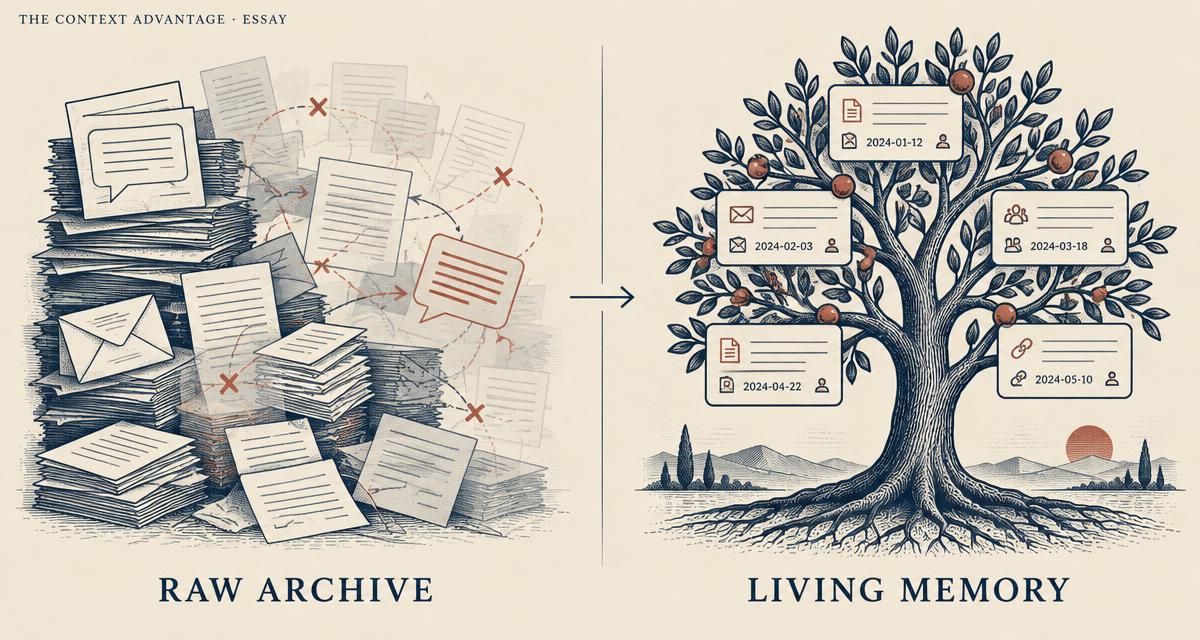
4. An archive stores statements. Memory preserves decisions
Imagine that a sales meeting contains four hypotheses, two objections, one joke, a discarded price, and a final commitment. A transcript stores all eight. A memory system must identify which statement became the decision, who had authority to make it, what evidence supported it, when it takes effect, which customer or region it applies to, and whether a later decision superseded it.
Without that transformation, retrieval can make the agent less reliable. The system may surface the most repeated statement rather than the approved one, the latest mention rather than the effective rule, or a confident executive opinion that was rejected five minutes later. The agent will be grounded in a source and still be wrong.
A durable memory object therefore needs more than text. It needs provenance, owner, scope, effective date, review date, sensitivity, status, source links, and relationships to earlier versions. It should distinguish observation from proposal, proposal from decision, and decision from policy. Chapter 10Chapter 10 · 9 min LockedInstitutional Memory Is the MoatAs frontier models converge, the durable advantage is the accumulated why — decisions, definition history, and organizational logic. calls this institutional memory: not a pile of words, but the accumulated why behind how the organisation operates.
This is also why Chapter 11Chapter 11 · 7 min LockedContext Is a Living Layer, Not a DocumentDefinitions drift, macro conditions shift, agents relearn — treat context like code, with ownership, versioning, and continuous review. treats context as a living layer. A memory can expire. A decision can be reversed. A definition can drift. If the system cannot represent change, it does not preserve memory; it preserves fossils.
5. The architecture is Capture, Govern, Ground, Act
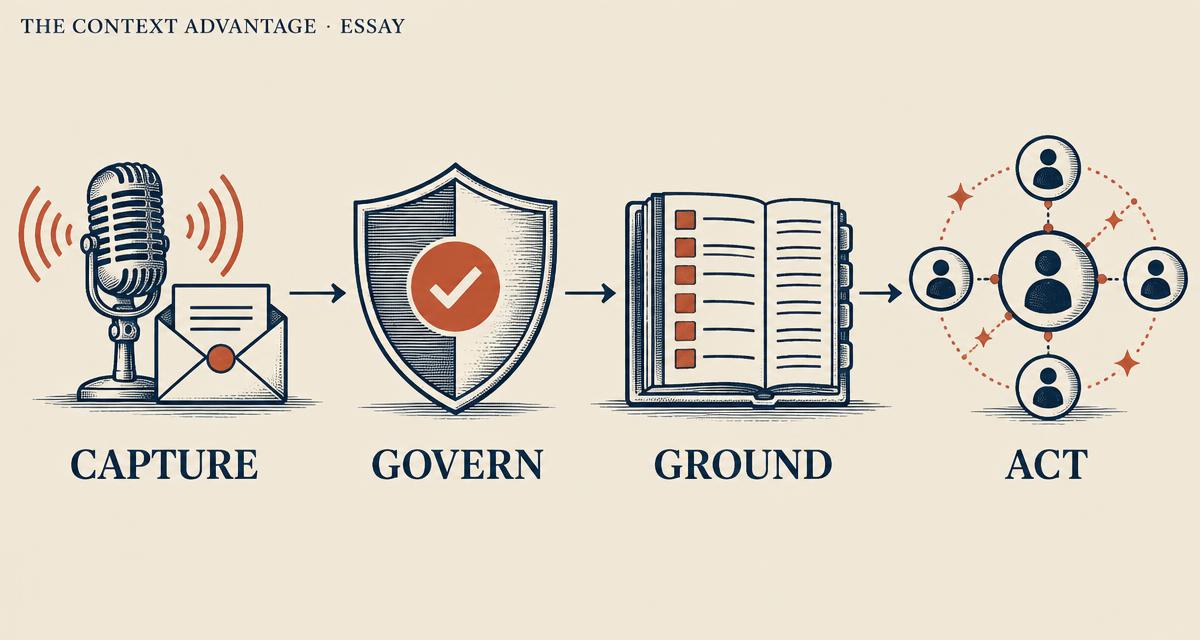
A practical company memory layer can be understood as four stages. Capture brings in selected meetings, email, tickets, documents, data changes, and workflow events. Govern applies consent, classification, retention, identity, permissions, and exclusion rules before material becomes broadly discoverable. Ground converts approved material into retrievable memory objects with provenance and business meaning. Act lets an agent use those objects under task-specific controls.
Each stage has a different failure mode. Poor capture misses the decision. Poor governance exposes the wrong conversation. Poor grounding retrieves an obsolete or ambiguous claim. Poor action control lets a correct memory trigger an unacceptable action. Teams often purchase the first stage, prototype the third, and assume the other two will emerge later. They rarely do.
The architecture must also preserve the boundary between evidence and interpretation. An extracted memory should always point back to the recording, message, ticket, or system event that supports it. If an agent says a renewal discount was approved, a reviewer should be able to inspect who approved it, in what context, and whether the approval still applies. Citations are not decoration here. They are the route back from machine confidence to organisational accountability.
Chapter 30Chapter 30 · 7 min LockedThe Trusted Agent ArchitectureA nine-step end-to-end reference architecture for production agents. provides the end-to-end trusted agent architecture. The company memory layer is its context spine: the path through which an agent receives enough meaning to act without receiving unlimited authority.
6. Retrieval is where memory becomes operational
Even perfectly governed memory is useless if the right fragment cannot be found at the right moment. Enterprise questions rarely match the language used when the decision was recorded. A customer-success agent asks whether a concession is allowed. The source meeting discussed commercial flexibility. The contract uses service credit. The ticket says make-good. Literal search sees four topics. Business context sees one decision.
That is why retrieval needs multiple signals: semantic similarity, exact terms, entity relationships, recency, authority, permissions, and task intent. Results need reranking against the actual decision the agent faces. They need filters that remove records the requesting identity may not see. And they need evaluations based on realistic questions, not a demonstration where the query repeats the wording in the document.
Chapter 35Chapter 35 · 11 min LockedRetrieval Mechanics: Chunking, Hybrid Search, and RerankingThe engineering layer under every context strategy — chunking, hybrid search, reranking, and how to prove it works. covers chunking, hybrid search, and reranking in detail. Its deeper lesson is that retrieval is a product with measurable quality. For the memory layer, test whether the system finds the approved decision, rejects superseded guidance, respects permissions, and returns enough evidence for a human or another agent to verify it.
The metric is not documents retrieved. It is decisions correctly supported.
7. Compaction decides what the organisation remembers
No agent can carry every transcript, thread, and workflow event into every task. Even if context windows keep growing, dumping the archive into a prompt increases cost, latency, distraction, and conflict. The system needs compaction: summarising repeated history, preserving commitments, pruning noise, and refreshing the working set as the task develops.
Compaction looks technical, but it is an editorial and governance act. When a six-hour project history becomes six paragraphs, somebody — a person, policy, or model — decides what survives. Did the summary retain the rejected alternative and why it failed? Did it preserve the deadline, exception, and owner? Did it accidentally convert a possibility into a promise?
Chapter 36Chapter 36 · 10 min LockedCompaction and the Token BudgetBudget tokens like money, compact history without dropping commitments, and detect degradation before a user does. treats the token budget like a financial budget because every retained item displaces another. The right pattern is layered memory: compact decision records for routine retrieval, linked evidence for verification, and raw sources retained only where policy allows. Agents begin with the smallest sufficient context and expand only when uncertainty or risk justifies it.
A good compaction policy makes forgetting intentional. A bad one makes forgetting invisible.
8. Thousands of agents need shared context, not shared confusion
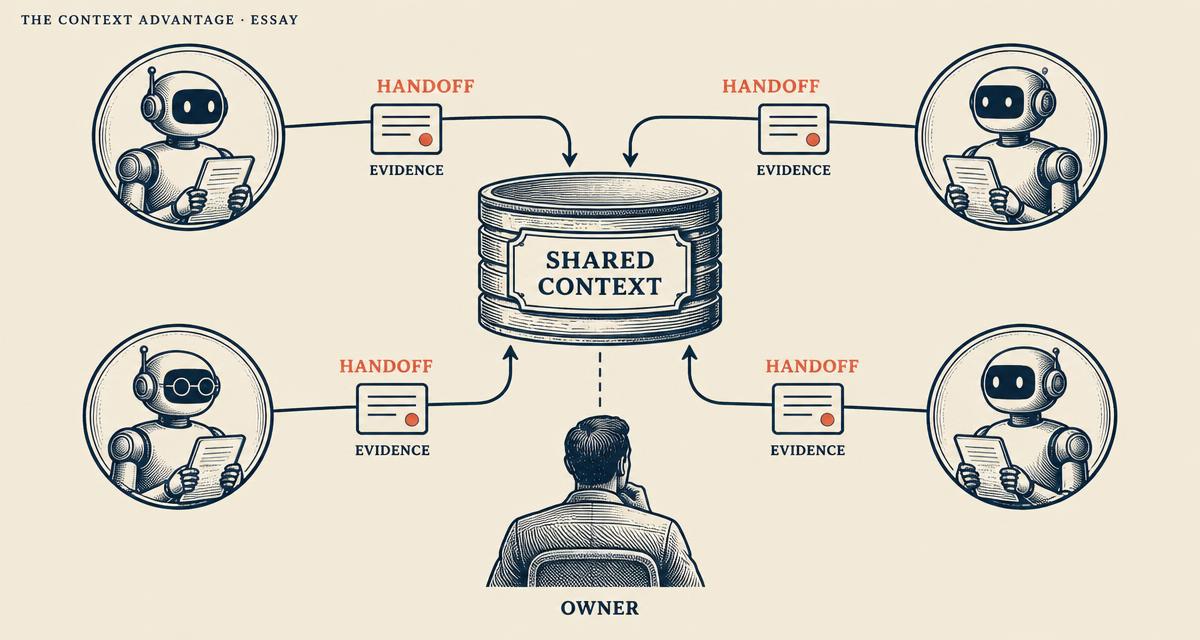
Ghodsi's larger vision is not one assistant with a better inbox search. It is many agents working across functions and handing work to one another. That changes the role of context. Memory is no longer only something an agent reads. It becomes the contract that allows one agent to understand what another agent did.
A research agent may identify an account risk. A planning agent proposes a response. A pricing agent checks commercial limits. A communication agent drafts the message. An execution agent updates the system. Each handoff must carry the goal, evidence, assumptions, constraints, confidence, owner, and remaining questions. If it carries only prose, the next agent must infer all of that again.
This is where shared context can either reduce coordination cost or multiply errors. One stale memory can propagate through a thousand agents faster than it could through a thousand employees. A source that appears authoritative can turn a local misunderstanding into an automated policy. Scale does not forgive weak context. It amplifies it.
Chapter 34Chapter 34 · 7 min LockedDesigning Multi-Agent Systems That Actually WorkWhen one agent is not enough — and how to make many cooperate without chaos. explains how multi-agent systems need explicit roles, contracts, state, and recovery. The related essay The Handoff Problem shows why the seam between agents is often more dangerous than either agent alone.
9. Build a memory maturity ladder, not a data land grab
The safest path starts narrow. Level one is searchable evidence: a bounded collection, permission-aware retrieval, and citations. Level two is structured memory: decisions, definitions, owners, effective dates, and supersession. Level three is workflow grounding: agents receive relevant memory automatically at specific steps. Level four is governed action: agents act within budgets, approvals, and reversible boundaries. Level five is coordinated agency: multiple agents share typed state and evidence-backed handoffs.
Do not jump from recordings to level five. Choose one workflow where context loss has a visible cost: support escalations, incident response, pricing exceptions, contract review, or customer onboarding. Identify the decisions people repeatedly reconstruct. Build memory objects for those decisions. Connect them to evidence. Measure whether people and agents find the right answer faster and whether fewer exceptions need to be re-litigated.
Only then widen the source set. This sequence prevents the familiar enterprise mistake of ingesting millions of records before deciding what useful knowledge looks like. It also creates an accountable owner for each new memory type instead of treating context as another central platform that everybody uses and nobody maintains.
Chapter 31Chapter 31 · 7 min LockedBuilding Your First Context LayerA step-by-step practical guide from zero to a working layer in eight weeks. offers an eight-week path for building the first context layer. Start with the business decision, not the connector list.
10. The operating model matters more than the model
A company memory layer needs named roles. Source owners decide what may be captured. Domain owners approve what becomes canonical. Security and legal define exclusions and retention. Context engineers design extraction, retrieval, and evaluation. Workflow owners decide where memory enters a task. Human reviewers handle disputed or high-impact decisions. Platform teams provide the common controls without pretending they own the meaning.
It also needs routines. Review stale memories. Sample retrieval failures. Trace an answer back to evidence. Revoke access when a team or agent changes role. Delete expired raw material. Record corrections as new versions rather than silently rewriting history. Run tests that deliberately introduce contradictory evidence and confirm the system chooses the authoritative source.
These routines are the difference between a launch and a capability. The technology can ingest a year of recordings in a weekend. The organisation must still decide what those recordings are allowed to mean.
This is why the Context pillar cannot be separated from Control. Memory without control becomes surveillance. Control without memory leaves agents safely useless. The four C's work as a system because enterprise AI has to be informed, bounded, economical, and portable at the same time.
11. The next unlock is not capture. It is accountable memory
Ghodsi is right about the missing piece. Enterprises will not move from chatbots to agents merely by purchasing a stronger model. The model needs access to the organisation's accumulated situation: its decisions, language, relationships, constraints, exceptions, and history. Meetings and email contain a large part of that truth because that is where organisations actually negotiate meaning.
But capture is the beginning, not the achievement. The unlock arrives when a conversation can become a permission-aware memory; when that memory carries provenance and an owner; when retrieval can distinguish current policy from discarded debate; when compaction preserves commitments; when an agent can use the memory only inside an approved task; and when every handoff carries evidence forward.
The companies that build this well will look as if their agents know the business. What they will really have done is make the business knowable.
That is the company memory layer: not a recording of everything people said, but a governed system for preserving what the organisation learned.
"A company does not lack context because its people never said the important thing. It lacks context because the important thing was said once, in the wrong room, and never became memory."
Try this at work
- Choose one workflow where people repeatedly reconstruct the same decision history.
- Define which sources may be captured, which must be excluded, and how consent is recorded.
- Represent decisions with an owner, scope, effective date, review date, sensitivity, status, and source evidence.
- Preserve the difference between proposals, observations, decisions, and policies.
- Evaluate retrieval on approved, superseded, restricted, and contradictory memories.
- Use layered compaction so agents receive the smallest sufficient context with a route back to raw evidence.
- Require every agent handoff to carry goals, constraints, evidence, confidence, and ownership.
- Create deletion, correction, review, and access-revocation routines before expanding capture.
The Context Advantage provides the practical architecture behind the company memory layer. Chapters 5–12 cover context, business meaning, institutional memory, living context, and portability. Chapters 13–17 cover governance and human control. Chapters 30, 31, 34, 35, and 36 cover trusted architecture, implementation, multi-agent design, retrieval, and compaction. Read the free opening chapters at [/context-advantage/book](/context-advantage/book), or unlock all 36 chapters at [/context-advantage/buy](/context-advantage/buy).
Explore the book →If your best operator left tomorrow, which decisions would disappear with them even though the meetings, emails, and tickets still exist — and who owns turning those decisions into memory?